
Name numerologyNumerology guide
Balance Number in Numerology: Calculate It from Your Initials
Use one practitioner’s rule to map the initials of a full birth name, add their Pythagorean values, and reduce to one digit; see what changes when a middle name or initial is omitted.
The short answer
Start here
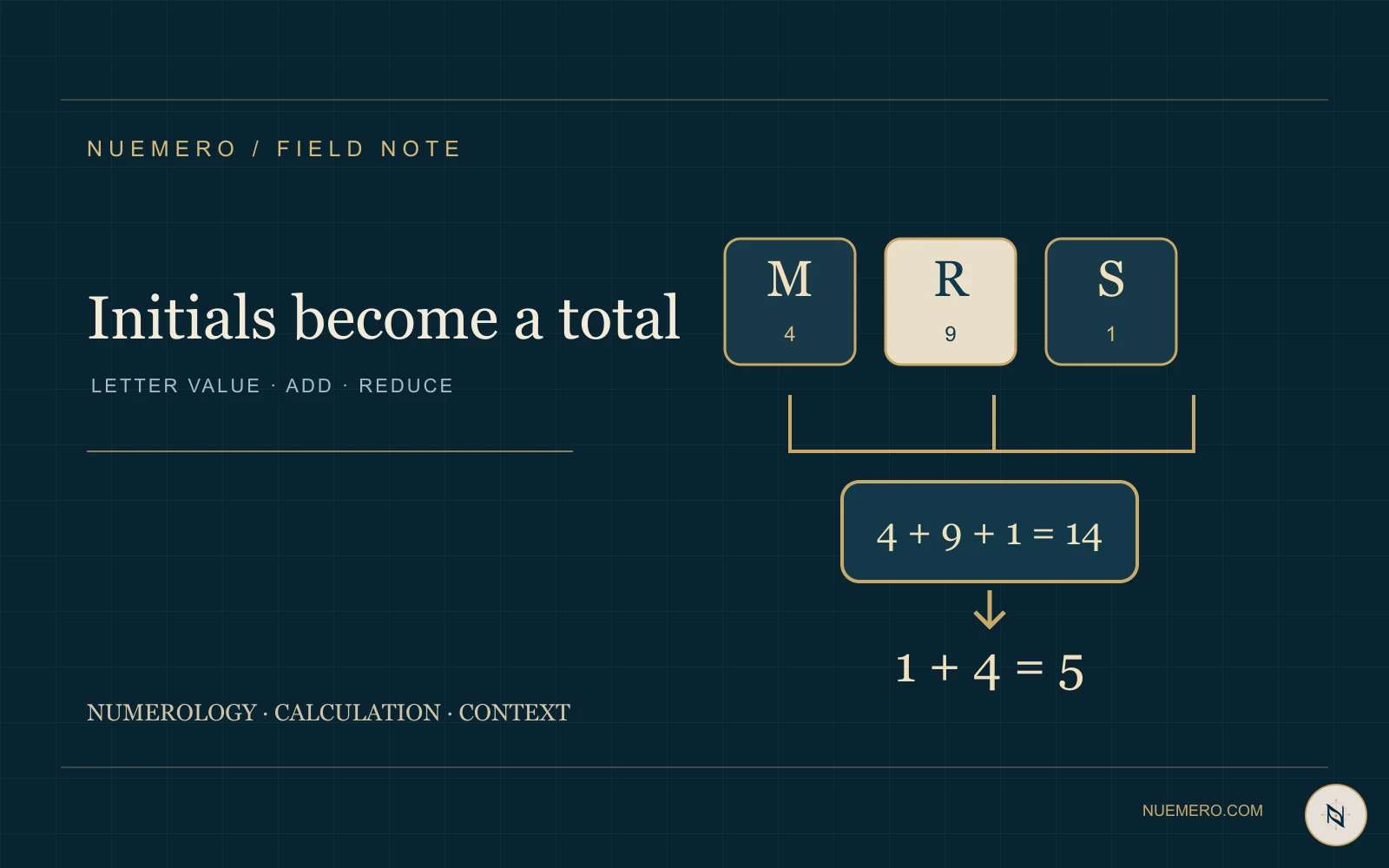
In Hans Decoz’s Balance Number convention, take the first, middle, and last initials of the full birth name, map them through the Pythagorean letter chart, add the values, then reduce to one digit—including master numbers. For fictional “Maya R Singh,” M=4, R=9, and S=1: 4 + 9 + 1 = 14 → 5. Omitting a middle name or using a different initial changes the input. The result is a traditional name-chart value, not evidence of how someone will respond under pressure.
Key takeaways
Use the initials specified by the source—here, first, middle, and last initials of the full birth name.
Map each initial, add the values, then reduce to one digit; this source reduces master numbers too.
A missing middle initial or changed transliteration can change the answer.
A Balance Number is a symbolic chart interpretation, not a behavioral test or diagnosis.
On this page
Choose the initials before adding
Hans Decoz defines the Balance Number as the numerical values of the initials of the full name at birth. His example uses first, middle, and last initials, maps each letter through a Pythagorean chart, adds the results, and reduces to a single digit—even if the sum is 11 or 22. Some calculators or practitioners may handle name parts differently, so follow the convention you are documenting.
For fictional “Maya R Singh,” the initials are M, R, and S. In the Pythagorean A–Z sequence, M=4, R=9, and S=1. Add 4 + 9 + 1 = 14; reduce 1 + 4 = 5. If the middle initial is left out, 4 + 1 = 5 by coincidence in this example; another name could produce a different result, which is why the input should always be shown.
Maya R Singh · fictional example
M(4) · R(9) · S(1)4 + 9 + 1 = 141 + 4 = 5A short calculation still needs clear name rules
A two-letter versus three-letter initial set can change the total. So can a transliteration choice when the name is written in a Roman alphabet, or a different mapping table. Before comparing two Balance Numbers, note which full name is being represented, whether the middle name is included, how initials were chosen, and which letter chart assigns their values.
Do not assume that initials from a current or married name replace the birth-name input in every school. If you are exploring another convention, label it and calculate it separately instead of blending initials from different names.
Keep the interpretation in its proper scope
Practitioner sources attach a balancing theme to the number. This is a traditional symbolic reading, not a validated measure of coping style, emotional balance, or decision-making under stress. A digit produced by initials does not substitute for observed behavior or a mental-health assessment.
If the theme helps you reflect, ask what support you actually use when a difficult decision comes up. Consider trusted people, reliable information, time to think, and professional help when needed. Let real experience—not a name calculation—guide the answer.
Method and limits
This guide describes the conventions stated above and the way Nuemero’s current calculator works. Numerology interpretations are traditional beliefs, not scientific predictions. Check a source’s method before applying its meanings.
Read Nuemero’s full methodQuick answers
Frequently asked questions
How do I calculate my Balance Number?
In the cited method, take the initials of the full birth name, map them with the Pythagorean letter table, add their values, and reduce to a single digit, including master numbers.
Should I include my middle initial?
The cited source uses first, middle, and last initials from the full birth name. Other tools may define the input differently; state the chosen convention and apply it consistently.
Do I keep 11 or 22 as a Balance Number?
The cited Decoz method reduces every double-digit total to one digit for Balance Number, including master numbers. A different practitioner may use another display rule, so identify the source.
Can a Balance Number diagnose how I handle stress?
No. It is a traditional interpretation of name initials, not a validated behavioral or mental-health test. Use real experience and qualified support for those questions.
Read further
Sources and method notes
- Hans Decoz: Balance NumberSource for the full-name initials, Pythagorean mapping, example, and single-digit reduction convention used here.
- Hans Decoz: How to Do Your Own ReadingConfirms this practitioner’s short definition: the Balance Number is based on name initials.
Sources document calculation conventions and claims made within their traditions. They are not evidence that numerology predicts real-world outcomes.
Name numerology·7 min
Maturity Number: Add Life Path and Expression with a Worked Example
Calculate a Maturity Number from a declared Life Path and Expression method, verify the example for a fictional birth date and name, and understand why chart conventions change the inputs.
Read the guide
Name numerology·7 min
Baby-Name Numerology: How to Calculate Without Predicting a Child's Future
Compare a baby name under a clearly named letter system, preserve the family's preferred spelling, and keep a symbolic number separate from a child's future or worth.
Read the guide