
Research, evidence & responsible useNumerology guide
How to Grade Evidence in Numerology Articles: Math, History, Symbolism, Prediction
Use a four-lane reader checklist to separate reproducible calculations, historical documentation, tradition-specific symbolism, and testable prediction claims.
The short answer
Start here
“Evidence” means different things for different claims. Arithmetic can be checked by reproducing the steps. A historical claim needs dated primary sources and careful context. A symbolic interpretation can be described accurately as one school’s teaching without claiming it is a measured trait. A prediction about people or events needs a specific test, transparent outcome rules, suitable comparisons, and independent repetition. Label each claim before weighing it; a reliable source for one lane does not prove a claim in another.
Key takeaways
Arithmetic, history, tradition, and prediction are different claim types with different checks.
A primary source can document what an author taught, not prove that the teaching predicts outcomes.
A clear calculation supports the arithmetic only; interpretation and accuracy claims need their own evidence.
State uncertainty and the limit of each source instead of using a citation as decoration.
On this page
Place the claim in the right evidence lane
Lane 1—arithmetic: Can another person reproduce the number from the stated input and rule? Lane 2—history: Does a dated primary source support the statement about when or where a method appeared? Lane 3—tradition: Is the interpretation accurately attributed to a named school, author, or edition? Lane 4—prediction: Does a fair, repeatable test support a claim about future outcomes or measured traits?
A source can be strong for one lane and irrelevant to another. An old book is primary evidence that an author printed an interpretation; it does not establish that the interpretation predicts a person’s future. A calculator can verify addition; it cannot validate the meaning attached to its result.
Inspect the source before trusting the sentence
Check who produced the source, when, for what purpose, and what evidence it actually contains. Follow a citation to the original page or dataset; do not assume that a list of references supports every nearby sentence. Distinguish a primary historical source, a practitioner explanation, a regulator’s guidance, and an empirical study.
For empirical evidence, note the sample, comparison condition, measures, missing results, uncertainty, and replication. For an interpretive tradition, note the author and convention. For a calculation, write the input and show every reduction. Keep these review notes separate so one kind of evidence cannot silently stand in for another.
A compact reader’s scorecard
Use four labels in your notes: “reproduced” for arithmetic you checked; “documented” for history tied to a primary source; “attributed” for a tradition-specific interpretation; and “tested” only when a defined empirical design supports the stated predictive claim. Add “uncertain” when the source is missing, indirect, or too weak. These are review labels, not a universal scientific grading scale.
This simple separation helps you enjoy symbolic material while being precise about what has actually been verified. If an article makes several kinds of claims, assess each one separately rather than giving the whole page one blanket evidence rating.
Method and limits
This guide describes the conventions stated above and the way Nuemero’s current calculator works. Numerology interpretations are traditional beliefs, not scientific predictions. Check a source’s method before applying its meanings.
Read Nuemero’s full methodQuick answers
Frequently asked questions
Does an old numerology book prove the method works?
It can document what an author taught at a particular time. A claim that the method predicts outcomes needs separate empirical evidence.
Does a correct calculation prove the interpretation is accurate?
No. Reproducible arithmetic verifies the sum under a stated rule. The symbolic meaning and any predictive claim require separate attribution and evidence.
What does “tested” mean in this reader checklist?
It means a specific predictive claim was evaluated with a defined empirical design and transparent outcomes. It does not mean that the claim is universally proven or that every numerology system was tested.
Read further
Sources and method notes
- APA: Open science and preregistrationAPA resource describes preregistration, replication, and sharing research materials as tools that support transparent evaluation.
- NIST: Generative AI ProfilePrimary guidance on evaluating source reliability and confabulation risks when AI is used to summarize or explain claims.
Sources document calculation conventions and claims made within their traditions. They are not evidence that numerology predicts real-world outcomes.
Research, evidence & responsible use·8 min
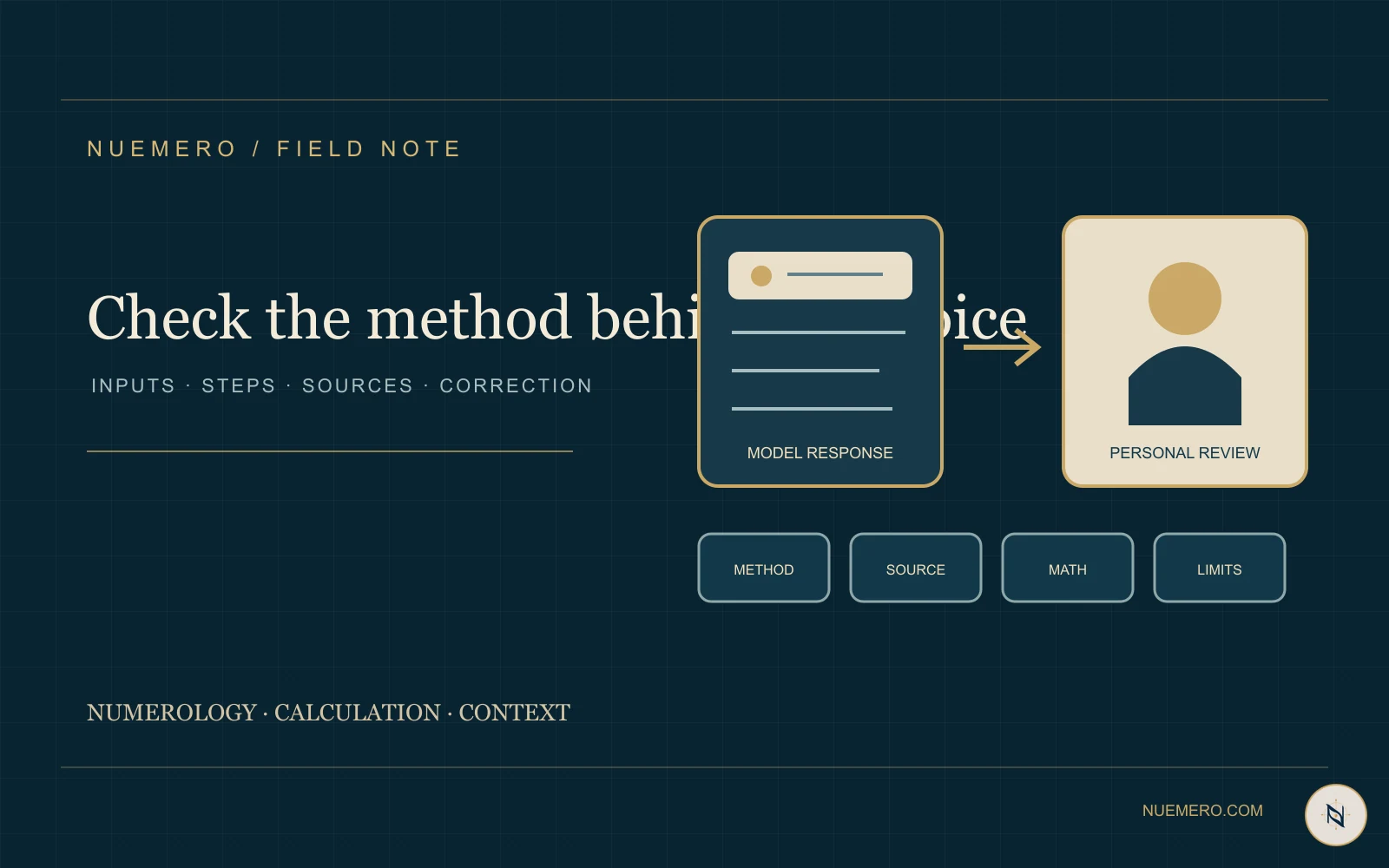
AI vs Human Numerology Readings: Compare the Work, Not the Mystique
Compare calculators, AI explanations, and practitioner conversations by arithmetic, sources, clarification, privacy, and uncertainty—not by an assumed guarantee.
Read the guide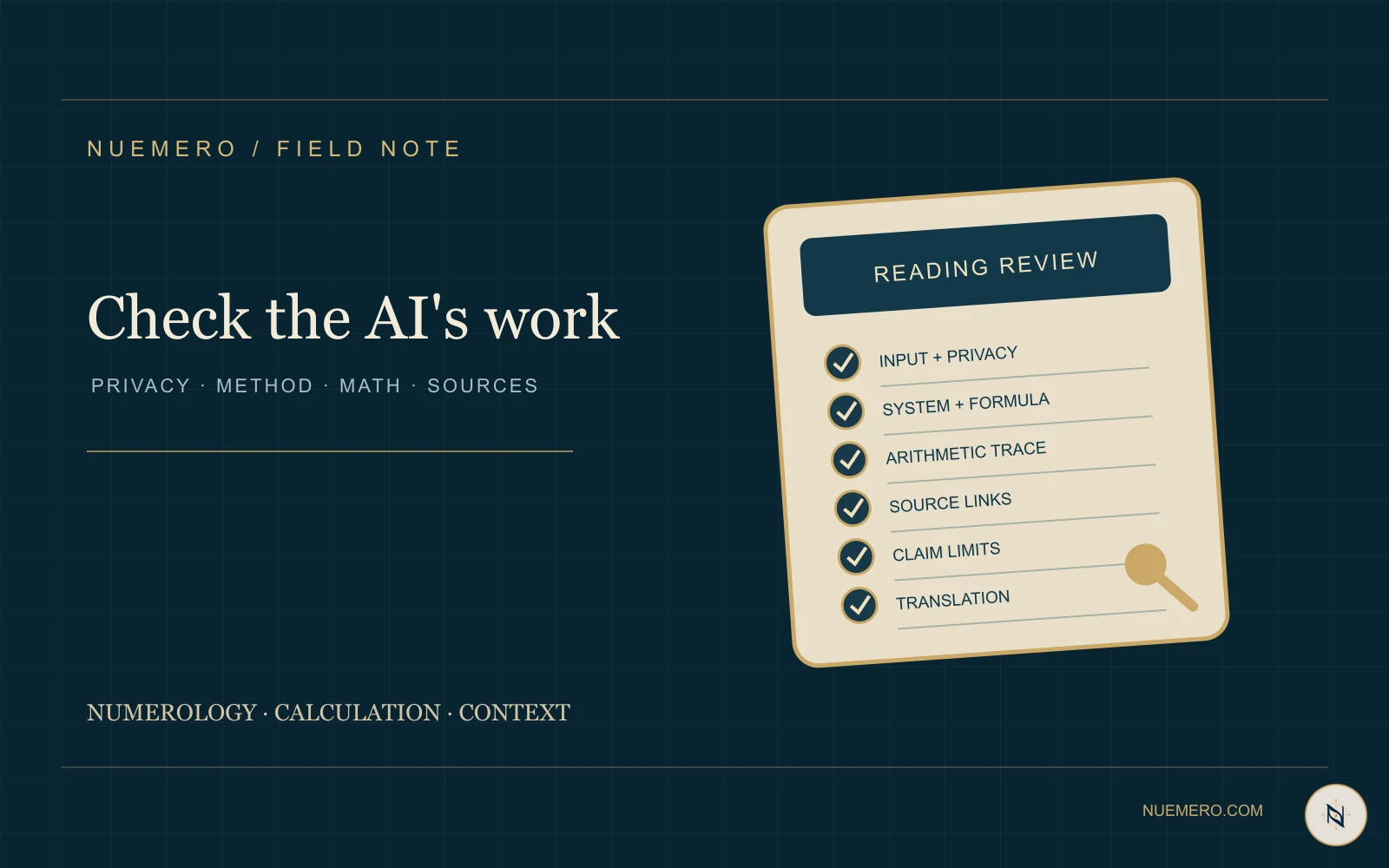
Research, evidence & responsible use·7 min
How to Check an AI Numerology Reading: A 6-Step Review
Audit an AI numerology answer for input privacy, system choice, arithmetic, source quality, unsupported certainty, and language accuracy before acting on it.
Read the guide