
Number meanings & traditionsNumerology guide
Lucky Numbers and Lottery Odds: Why Numerology Cannot Improve a Random Draw
Separate a personally meaningful number from probability. A worked 6-from-49 example shows why every combination has the same chance in a fair independent draw.
The short answer
Start here
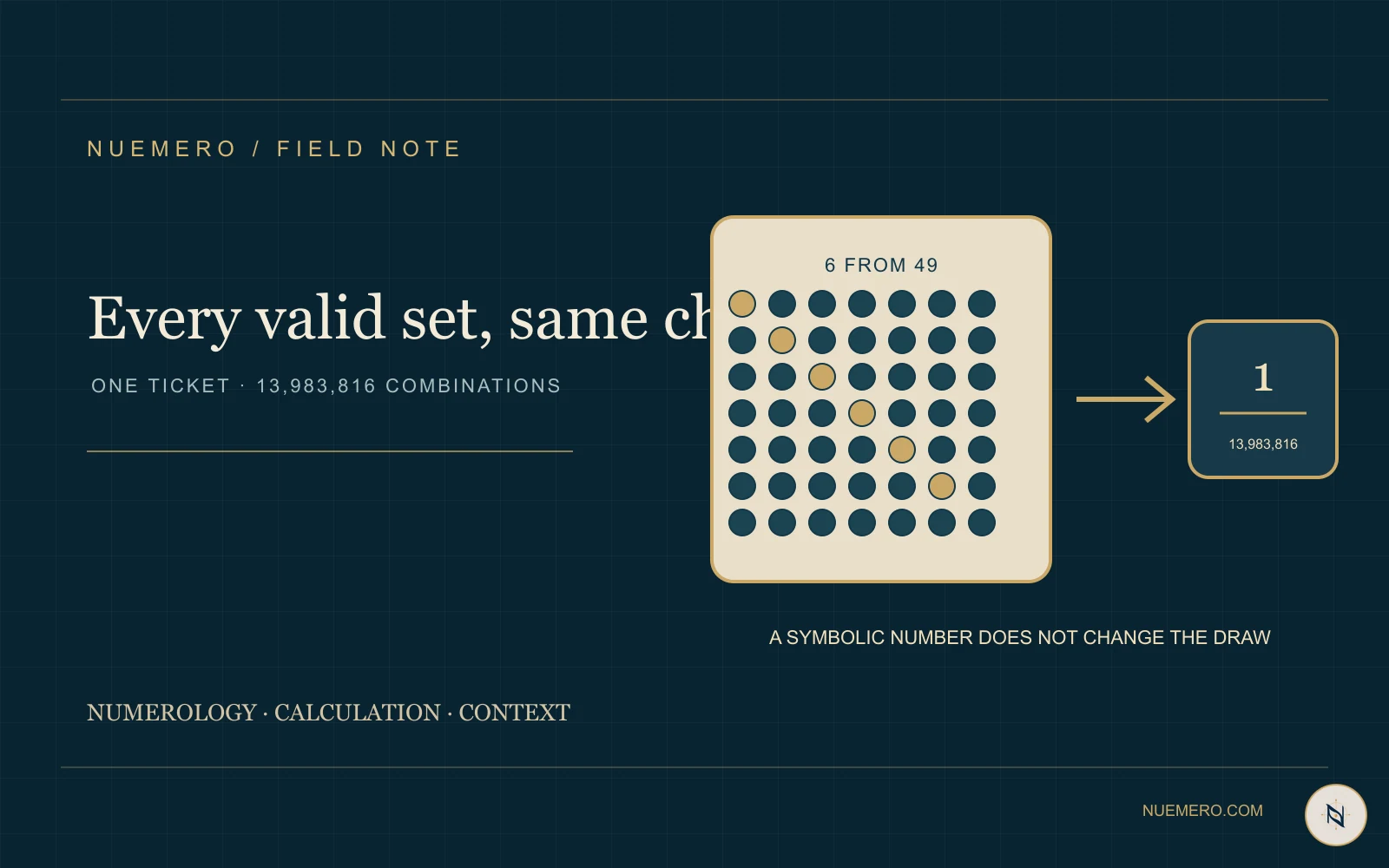
A number can feel personally meaningful, but symbolism does not change the probability rule of a fair lottery draw. In a six-from-49 example, there are 13,983,816 possible six-number combinations, so one ticket has a 1-in-13,983,816 jackpot chance for that game’s classic draw. Every combination has the same chance; previous draws do not make a number due. Set a strict entertainment budget or skip gambling—never spend money you need or chase losses.
Key takeaways
A numerology or lucky-number reading cannot change the odds of a properly random draw.
In a 6/49 jackpot draw, one specific combination is 1 of 13,983,816 possibilities.
Each draw is independent; a number is not “due” because it has not appeared lately.
If you gamble, set an affordable limit beforehand and do not chase losses.
On this page
Personal meaning is not probability
A person may choose a date, birth number, or repeating sequence as a favorite. That choice can carry memory or cultural meaning. But if a lottery uses a fair random draw and every valid combination is eligible, a symbolic reading does not give one combination extra weight.
This article is not a prediction or a suggestion to buy a ticket. Lottery rules differ by game and jurisdiction; check the official operator’s published odds before participating.
Worked example: six numbers from 49
For one classic 6/49 jackpot draw, order does not create a new ticket: the set {1, 2, 3, 4, 5, 6} is one combination, just like {8, 17, 22, 31, 40, 49}. The number of sets is “49 choose 6,” equal to 13,983,816. Therefore one fixed set has probability 1/13,983,816 for the jackpot in that specific draw, assuming the stated game rules and a fair selection.
A number picked from a personal chart, a birthday, or a random quick-pick is still one set. The official Loto-Québec explanation also notes that each draw is independent: the same set has the same chance each time under that game’s rules.
Protect your money and attention
Decide in advance whether you will play at all and, if so, a small amount you can comfortably lose. Never borrow, use rent or bill money, follow a numerology “guarantee,” or buy repeated systems that claim to reveal a winning set. A prediction seller cannot overcome the game’s stated mathematics.
If gambling stops feeling optional, creates conflict, or leads you to chase losses, pause and seek help from a trusted person or a local gambling-support service. This reading is informational and does not provide financial advice.
Method and limits
This guide describes the conventions stated above and the way Nuemero’s current calculator works. Numerology interpretations are traditional beliefs, not scientific predictions. Check a source’s method before applying its meanings.
Read Nuemero’s full methodQuick answers
Frequently asked questions
Can numerology pick winning lottery numbers?
No. A symbolic number does not change a fair draw’s odds. Check the official game rules and odds, and never treat a reading as a way to earn money.
Are some lottery numbers more likely because they have not appeared recently?
Not in an independent fair draw. Past results do not make a valid number combination due in the next draw.
Does picking my own numbers improve my chance over a quick-pick?
For a fair draw where both tickets cover one valid combination, the chance is the same. The official rules and odds depend on the particular game.
Read further
Sources and method notes
- Loto-Québec: Lottery games and chanceOfficial operator explanation that each 6/49 combination has equal probability and draws are independent; other games have different rules.
- Nuemero number meanings across systemsShows how symbolic meanings vary by tradition and remain distinct from probability calculations.
Sources document calculation conventions and claims made within their traditions. They are not evidence that numerology predicts real-world outcomes.
Number meanings & traditions·7 min
Lucky Colours and Numbers: A Cross-System Guide to Optional Symbolism
Compare how numerology sources connect colours and numbers, check where associations differ, and choose clothing or objects by preference rather than promised outcomes.
Read the guide
Number meanings & traditions·8 min
What Does Number 8 Mean in Different Numerology Systems?
Compare traditional interpretations of 8 without turning a number into a guarantee about money, power, or success; check the source and method behind each claim.
Read the guide