
Name numerologyNumerology guide
Subconscious Self Number: Count the Name’s Represented Values
Follow one Pythagorean name-chart convention to count represented values from 1–9, calculate Subconscious Self from missing values, and keep traditional coping claims in perspective.
The short answer
Start here
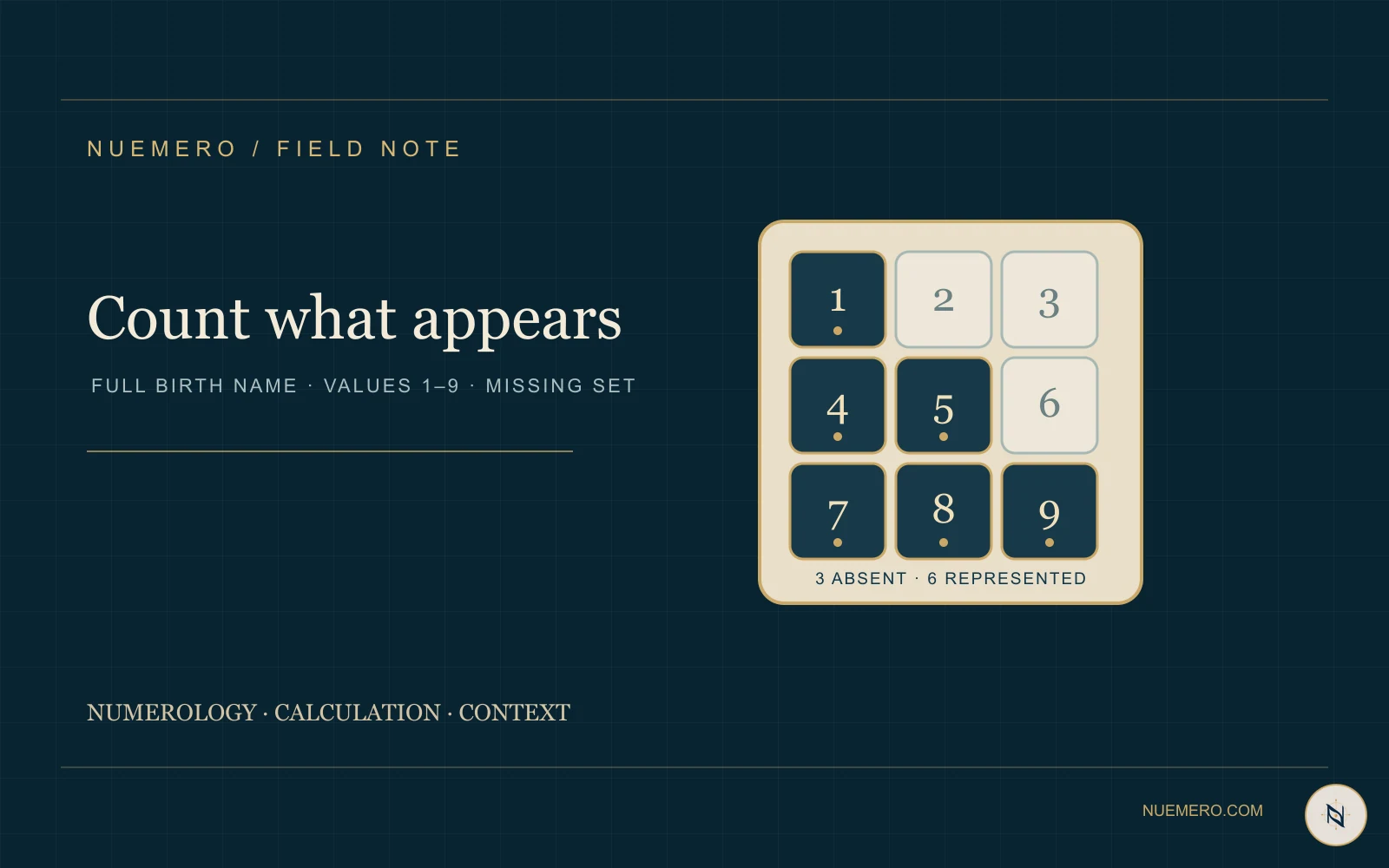
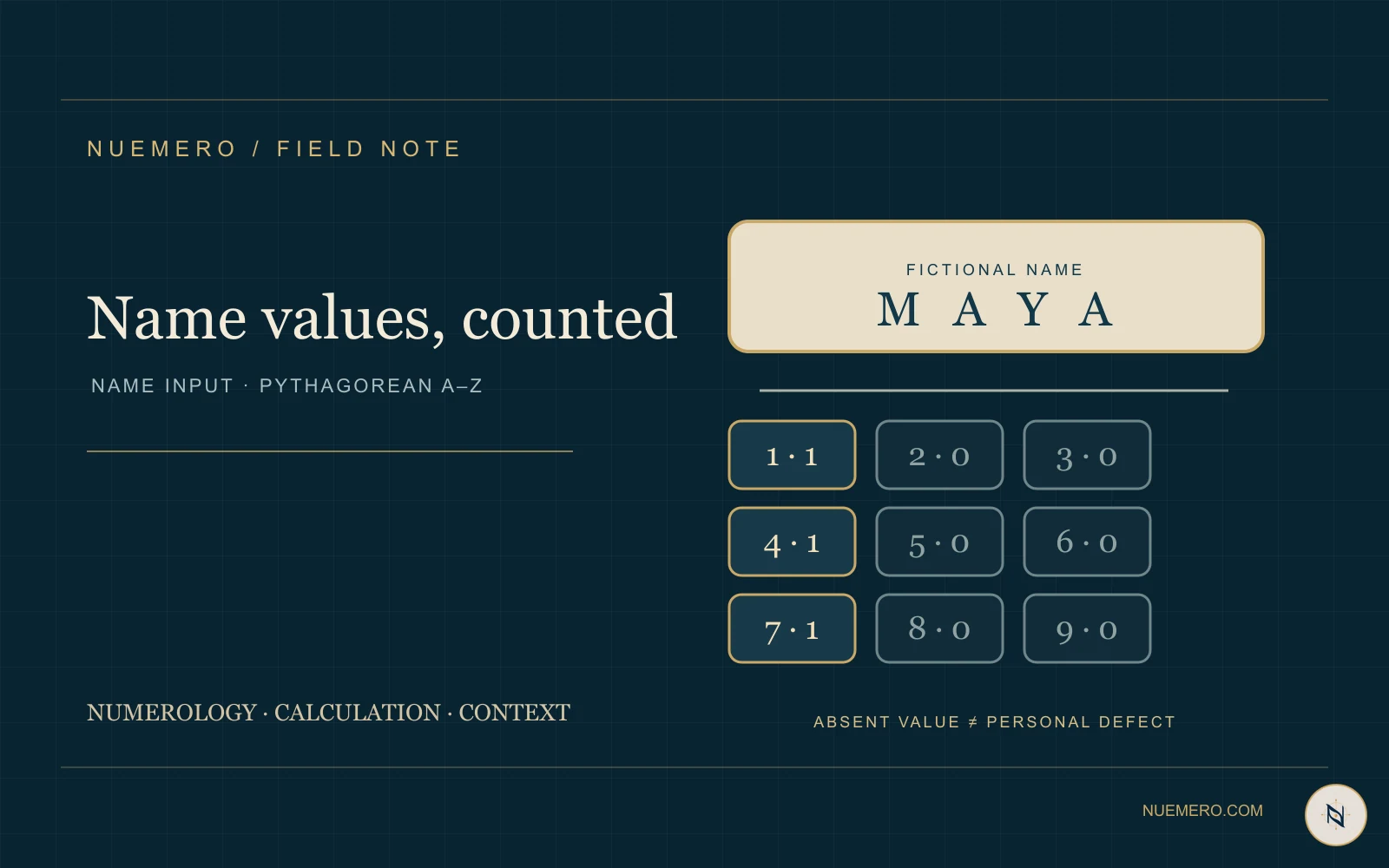
In Hans Decoz’s method, count which values from 1 to 9 appear in a person’s full birth name. The Subconscious Self number is 9 minus the number of Karmic Lessons (the absent values); equivalently, it is the number of represented values. For the fictional name Maya R Singh using Pythagorean A–Z values, the represented set is 1, 4, 5, 7, 8, and 9, so three values are absent and this convention gives 6. The arithmetic describes a name chart; it does not measure resilience or predict behavior.
Key takeaways
Count distinct represented values from 1 to 9; repeated letters do not add new represented values.
Under the cited convention, Subconscious Self equals 9 minus the number of missing values.
A traditional coping theme is not a psychological assessment or prediction.
On this page
Count values, not letter frequency
This is a name-based Pythagorean convention attributed here to Hans Decoz. Map the full birth name’s letters using the stated A–Z table, then mark which of the nine values appear at least once. A repeated A still represents value 1; it does not make value 1 count as two different values for this calculation.
Maya R Singh · fictional Pythagorean example
M4 · A1 · Y7 · A1 · R9 · S1 · I9 · N5 · G7 · H81, 4, 5, 7, 8, 9 · six values2, 3, 6 · 9 − 3 = 6Two equivalent ways to calculate it
The source gives two routes: count the values represented in the name, or subtract the number of Karmic Lessons from 9. If a name represents six distinct values, three of the nine are absent, and 9 − 3 = 6. Showing both the represented set and the missing set makes a data-entry mistake easier to spot.
The result depends on the name used and the letter-value table. If you compare a birth name with a current name, calculate them separately and label the input; do not silently combine the two.
Keep the interpretation separate from the count
The cited practitioner associates this number with confidence and coping with change. That is a traditional interpretation, not a validated psychological measure. A value derived from letters cannot tell you how someone will handle a crisis, make decisions, or respond to stress.
If the theme is useful, turn it into a question you can answer from experience: what helps you adapt when plans change? Use your actual habits, support network, and relevant professional advice for real-life decisions.
Method and limits
This guide describes the conventions stated above and the way Nuemero’s current calculator works. Numerology interpretations are traditional beliefs, not scientific predictions. Check a source’s method before applying its meanings.
Read Nuemero’s full methodQuick answers
Frequently asked questions
How do I calculate Subconscious Self?
Under the cited method, count distinct values from 1 to 9 represented in the full birth name, or subtract the number of missing values from 9.
Do repeated letters count more than once?
They can repeat in the name, but for the represented-value count a number is present if it appears at least once. Frequency is a different calculation, often called Hidden Passion in this tradition.
Does this number measure resilience?
No. It is a numerology chart value, not a validated measure of coping, confidence, or psychological health.
Read further
Sources and method notes
- Hans Decoz: How to Do Your Own Numerology ReadingDefines Subconscious Self as 9 minus Karmic Lessons and alternatively the count of represented numbers.
- Hans Decoz: The Subconscious SelfPrimary practitioner explanation; interpretation is attributed to the author and not presented as psychological evidence.
Sources document calculation conventions and claims made within their traditions. They are not evidence that numerology predicts real-world outcomes.
Name numerology·7 min
Karmic Lessons in Numerology: Find Missing Name Numbers Without Fear Claims
See how one Pythagorean name-chart method finds Karmic Lessons from absent letter values, work a fictional example, and distinguish a name chart from a Lo Shu birth-date grid.
Read the guide
Name numerology·9 min
Birth Name, Current Name, Nickname, or Initials: Which One Does Numerology Use?
Name numerology has no universal input rule. Compare birth, current, professional, and shortened forms without silently changing spelling or mixing systems.
Read the guide