
Research, evidence & responsible useNumerology guide
The Barnum Effect in Numerology: Why General Readings Can Feel Personal
Understand the psychology of personal validation, then test whether a reading is specific, falsifiable, and genuinely based on your stated inputs.
The short answer
Start here
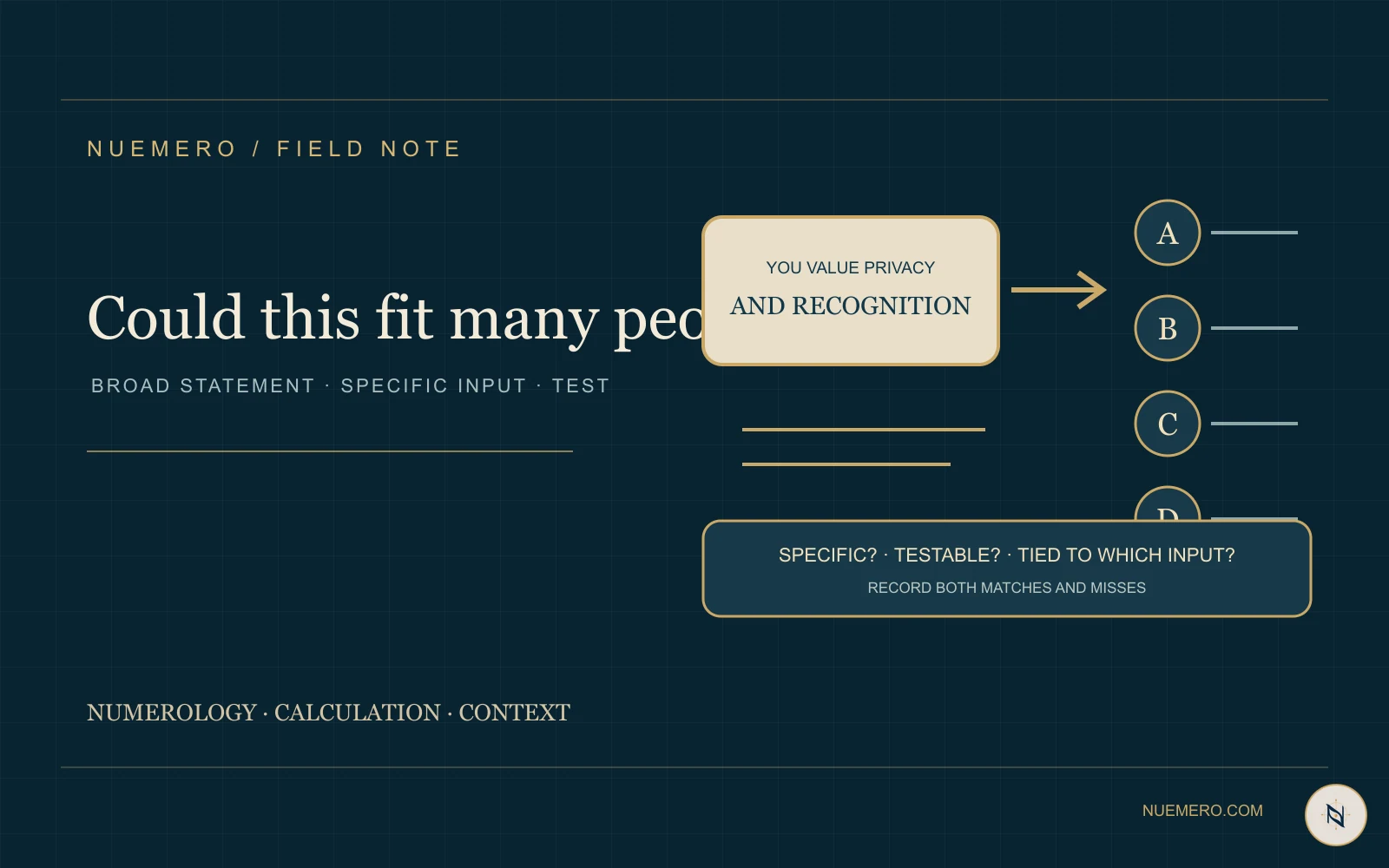
The Barnum or Forer effect describes how people may judge broad personality descriptions as uniquely accurate for themselves. It does not prove that every numerology reading is wrong; it gives readers a reason to check specificity. Ask whether a statement could fit many people, whether it names the input that produced it, and what evidence could show it is mistaken. Keep a reading as a reflection prompt rather than a diagnostic or predictive test.
Key takeaways
The effect is a reason to test a description’s specificity, not a diagnosis of the reader.
A statement that fits many people is weak evidence of a uniquely personal calculation.
Record what was said before searching for a fit; note both matches and misses.
Keep symbolic interpretations separate from measured, testable predictions.
On this page
What the Barnum or Forer effect describes
The APA Dictionary describes the Barnum effect as a tendency to believe vague or general personality descriptions apply specifically to oneself. Psychologist Bertram Forer’s 1949 classroom demonstration is associated with the related idea of personal validation. The effect concerns how feedback can be received; it does not evaluate every person’s motives or settle each claim in advance.
A numerology reading often uses familiar human themes—confidence, patience, recognition, independence, or belonging. A broad sentence may feel relevant because many people encounter those experiences. That feeling is real; it is different from evidence that the sentence was uniquely derived from your chart.
A practical specificity check
Take one sentence and ask four questions: Is it concrete? Does it name a measurable behavior or date range? Could it fit a large share of people? What observation would count against it? For example, “you sometimes want recognition but also value privacy” may describe many people; a statement about one named calculation step can be checked directly against the input and rule.
Write the reading down before deciding what it means. Mark each claim as a match, a miss, or unclear. Include statements that did not fit instead of remembering only the hits; this reduces hindsight editing of the original message.
Use the reading without handing it authority
Keep an interpretation as an invitation to reflect: Does this describe something I recognize? Is there another explanation? Would I reach the same conclusion without seeing the number? Discuss consequential choices with relevant people and professionals, not with a generalized sentence alone.
Good numerology content shows its method, distinguishes arithmetic from symbolism, states limits, and welcomes disagreement. A sentence that feels meaningful can matter personally without serving as scientific proof or a promise about the future.
Method and limits
This guide describes the conventions stated above and the way Nuemero’s current calculator works. Numerology interpretations are traditional beliefs, not scientific predictions. Check a source’s method before applying its meanings.
Read Nuemero’s full methodQuick answers
Frequently asked questions
Does the Barnum effect prove numerology is fake?
No. It describes a way people may respond to broad descriptions. Use it as a prompt to check whether a claim is specific and testable; it does not settle every tradition or calculation.
How do I know whether a reading is specific to me?
Check whether it names a concrete, falsifiable detail tied to a stated input. Write the reading down before judging it and record misses as well as matches.
Is feeling seen by a reading proof that it is accurate?
The feeling may be meaningful, but by itself it does not establish that a description is uniquely accurate or that a prediction will come true. Look at specificity, method, and evidence separately.
Read further
Sources and method notes
- APA Dictionary: Barnum effectAPA’s psychology definition of the tendency to view vague or general personality descriptions as specifically applicable to oneself.
- Forer (1949): The fallacy of personal validationPrimary publication record for the classic classroom demonstration; it is a psychology experiment, not a direct test of every numerology school.
Sources document calculation conventions and claims made within their traditions. They are not evidence that numerology predicts real-world outcomes.
Research, evidence & responsible use·8 min
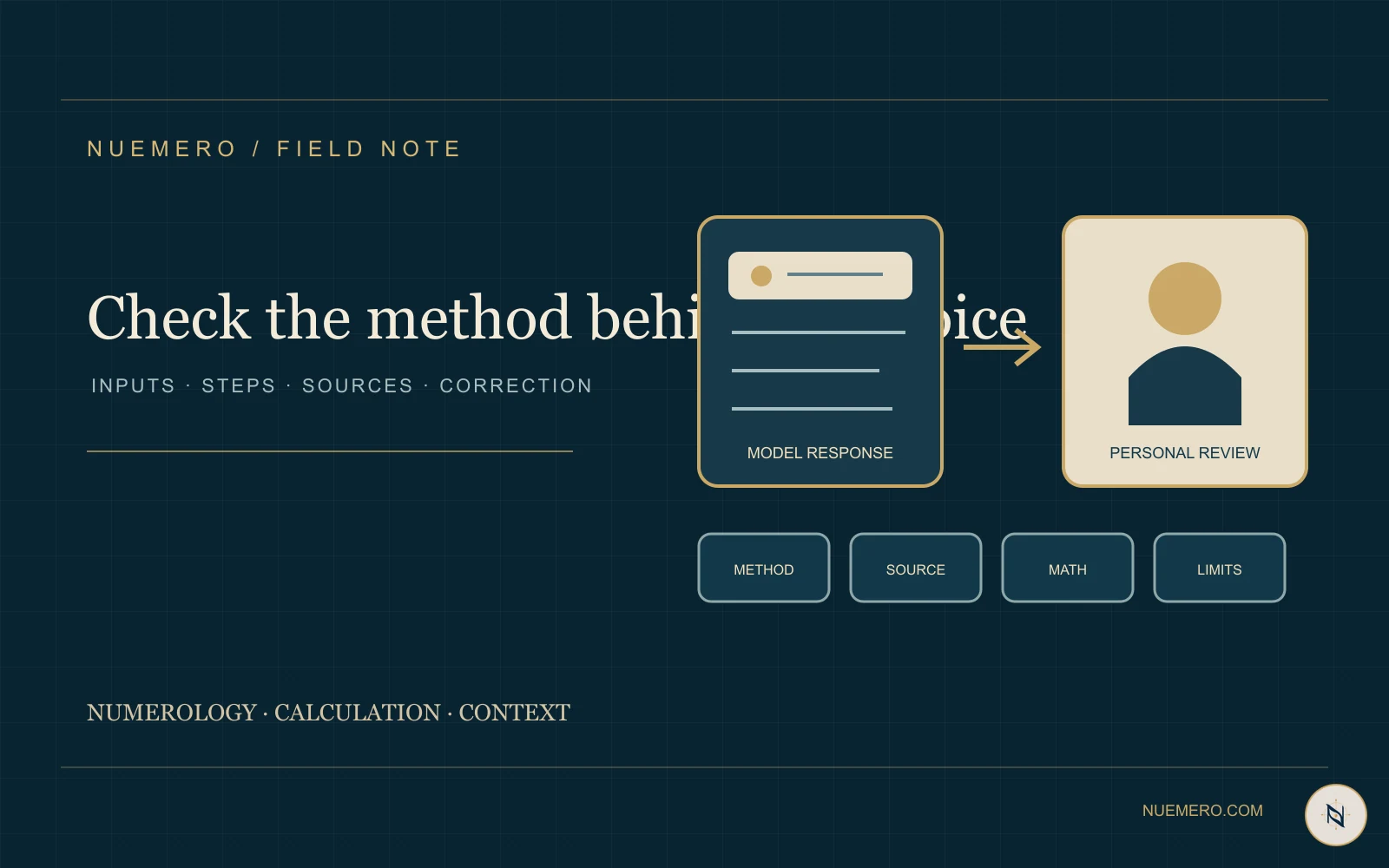
AI vs Human Numerology Readings: Compare the Work, Not the Mystique
Compare calculators, AI explanations, and practitioner conversations by arithmetic, sources, clarification, privacy, and uncertainty—not by an assumed guarantee.
Read the guide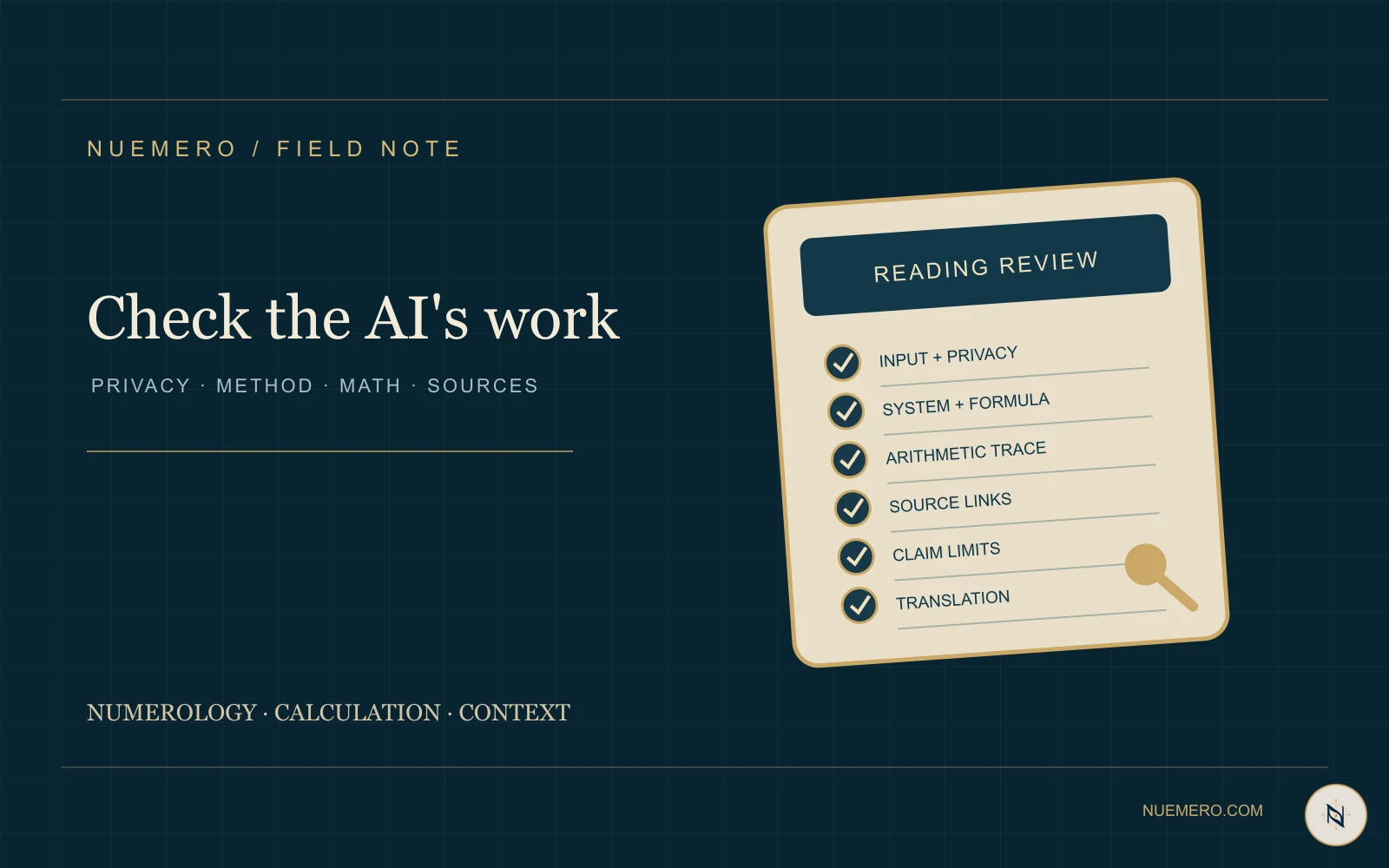
Research, evidence & responsible use·7 min
How to Check an AI Numerology Reading: A 6-Step Review
Audit an AI numerology answer for input privacy, system choice, arithmetic, source quality, unsupported certainty, and language accuracy before acting on it.
Read the guide