
Research, evidence & responsible useNumerology guide
Is Numerology Scientific? Separate Checkable Math from Predictive Claims
A careful guide to what a correct numerology calculation proves, what an empirical test must show, and how to assess claims about personality or future events.
The short answer
Start here
A correct sum proves that someone followed a stated arithmetic rule; it does not prove that a number measures personality or predicts events. Those are empirical claims and need clear predictions, appropriate comparisons, preregistered or otherwise transparent methods, and results that hold up beyond a single anecdote. Numerology can still be meaningful to people as a cultural, spiritual, or reflective practice, but that meaning should not be mistaken for scientific validation.
Key takeaways
Arithmetic accuracy and predictive validity are different questions.
Anecdotes and broad descriptions do not by themselves establish prediction.
Ask for a defined claim, a fair test, and independent replication.
Respect personal meaning while being clear about what the evidence supports.
On this page
Two questions that should not be confused
The first question is mathematical: did the calculator apply its declared letter table or date formula correctly? That can be checked by repeating the addition. The second is empirical: does the result reliably measure a trait or predict an outcome? A transparent calculation helps answer the first, but it cannot establish the second by itself.
A person may find a reading personally resonant. That experience is real as an experience, but it is not the same as showing that the number caused, measured, or predicted the described quality. Keep the personal meaning and the public evidence claim in separate sentences.
What a fair test would need
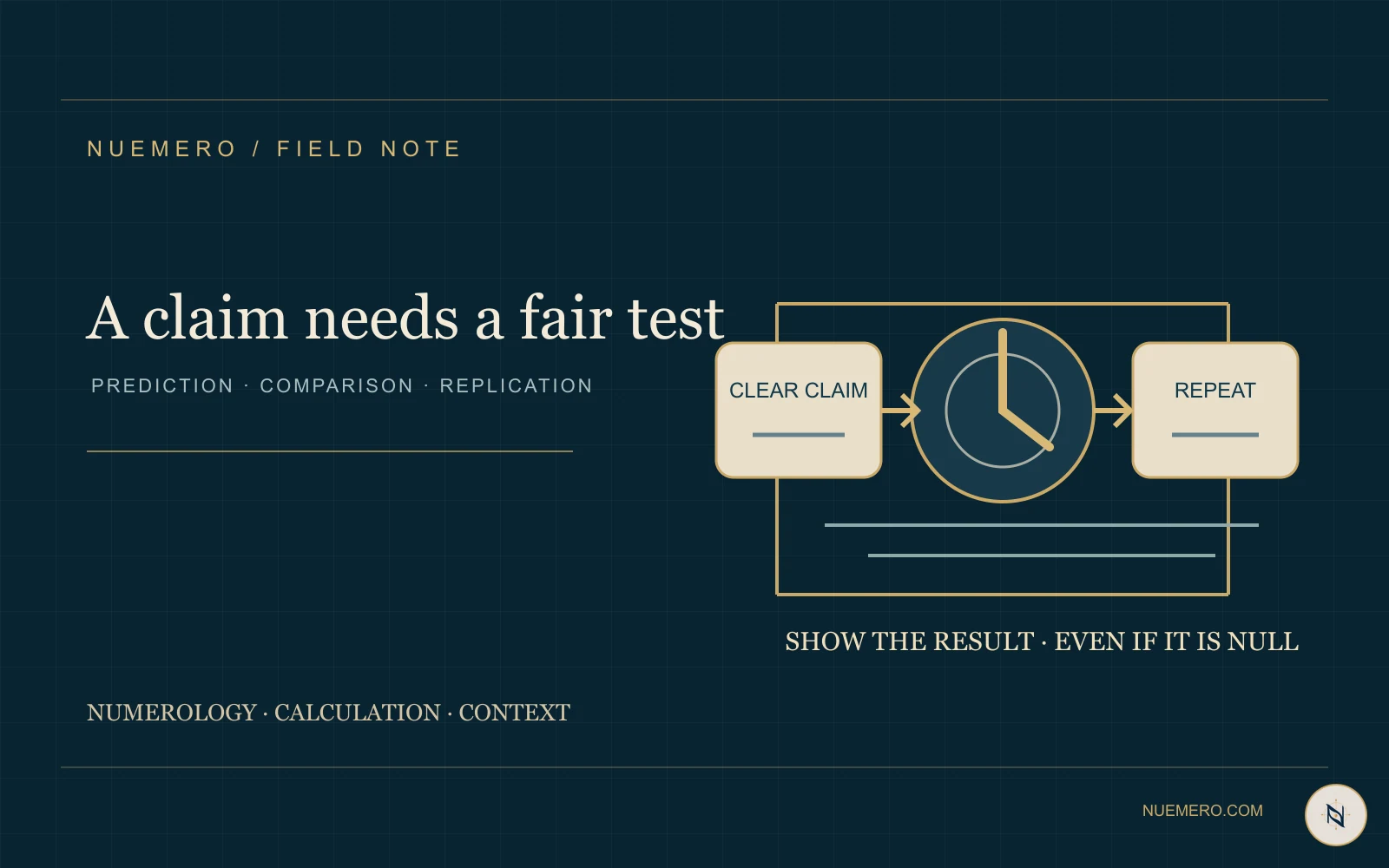
A test should define the claim before examining the data: which number, calculated by which rule, is expected to predict which measurable outcome, for whom, and over what period? Participants should not be selected after the result is known, and alternative formulas should not be swapped in only when one fails. Outcomes and analysis choices should be described clearly enough for another group to repeat them.
A useful result should survive an appropriate comparison and independent replication. One striking story, a chart with many possible interpretations, or a correct calculation for one person cannot answer a population-level prediction question. Null or mixed results should be reported too.
A five-question check for a bold claim
Ask: What exact outcome was predicted? Was the formula chosen in advance? Were readers or evaluators blinded to the number? Was the result compared with chance or an appropriate baseline? Has an independent team reproduced it? If a source cannot answer these questions, describe its statement as a tradition or proposal rather than an established finding.
For example, a paper testing one defined birth-number claim can inform that specific claim and dataset. It cannot automatically confirm every name system, Lo Shu interpretation, or daily forecast. Read a study's sample, method, and measured outcome before generalizing.
Keep meaning without overstating evidence
People use number symbolism for storytelling, ritual, identity, and reflection. A careful article can explain how a tradition interprets a number, name its source, and show the arithmetic while also saying whether predictive evidence has been established. That is more useful than either mocking a reader or promising certainty that a method has not earned.
Do not use a number to diagnose health, decide a person's employability, predict a financial return, or determine whether a relationship will succeed. For consequential questions, turn to relevant evidence and qualified support; keep numerology an optional interpretive practice.
Method and limits
This guide describes the conventions stated above and the way Nuemero’s current calculator works. Numerology interpretations are traditional beliefs, not scientific predictions. Check a source’s method before applying its meanings.
Read Nuemero’s full methodQuick answers
Frequently asked questions
Does correct numerology arithmetic prove numerology works?
No. It establishes that a stated calculation was applied correctly. Claims about personality or prediction require separate empirical evidence.
Has numerology been scientifically tested?
Individual claims have been examined, but a study of one formula or sample does not validate every numerology system. Check the exact claim, study design, and replication before drawing a broad conclusion.
Can a reading still feel meaningful without scientific proof?
Yes. Personal or cultural meaning is different from a validated prediction. You can value reflection while staying clear about that distinction.
What would stronger evidence look like?
A clearly defined claim and outcome, a suitable comparison, transparent analysis, and independent replication using the same method would be more informative than anecdotes alone.
Read further
Sources and method notes
- American Psychological Association Dictionary · NumerologyA concise disciplinary definition of the term; a dictionary entry is not a test of predictive validity.
- A Test of Numerology: Birth Numbers Do Not Predict Nobel Prize WinnersA study of one defined birth-number claim; its scope should not be generalized to every practice or question.
Sources document calculation conventions and claims made within their traditions. They are not evidence that numerology predicts real-world outcomes.
Research, evidence & responsible use·8 min
AI vs Human Numerology Readings: Compare the Work, Not the Mystique
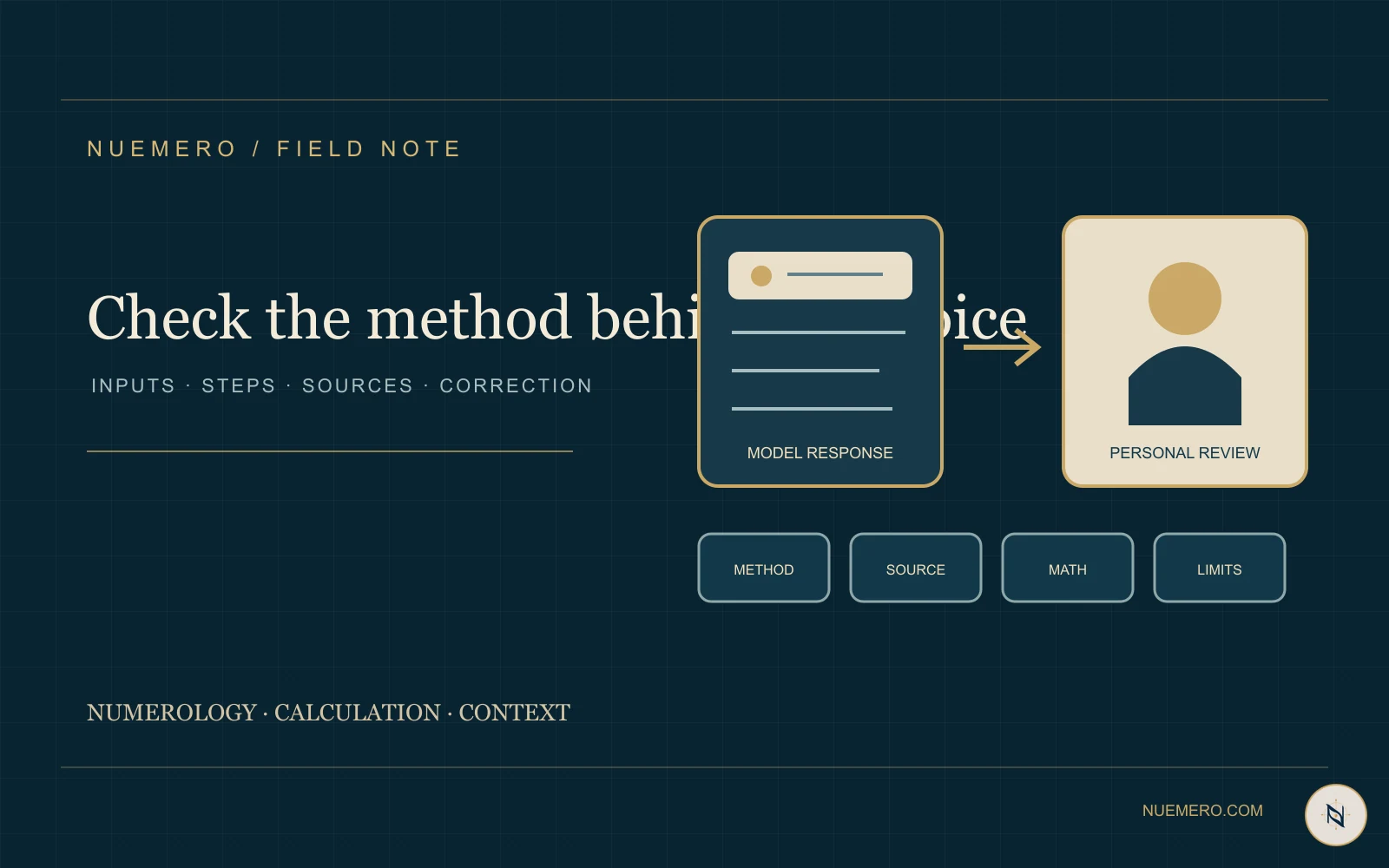
Compare calculators, AI explanations, and practitioner conversations by arithmetic, sources, clarification, privacy, and uncertainty—not by an assumed guarantee.
Read the guide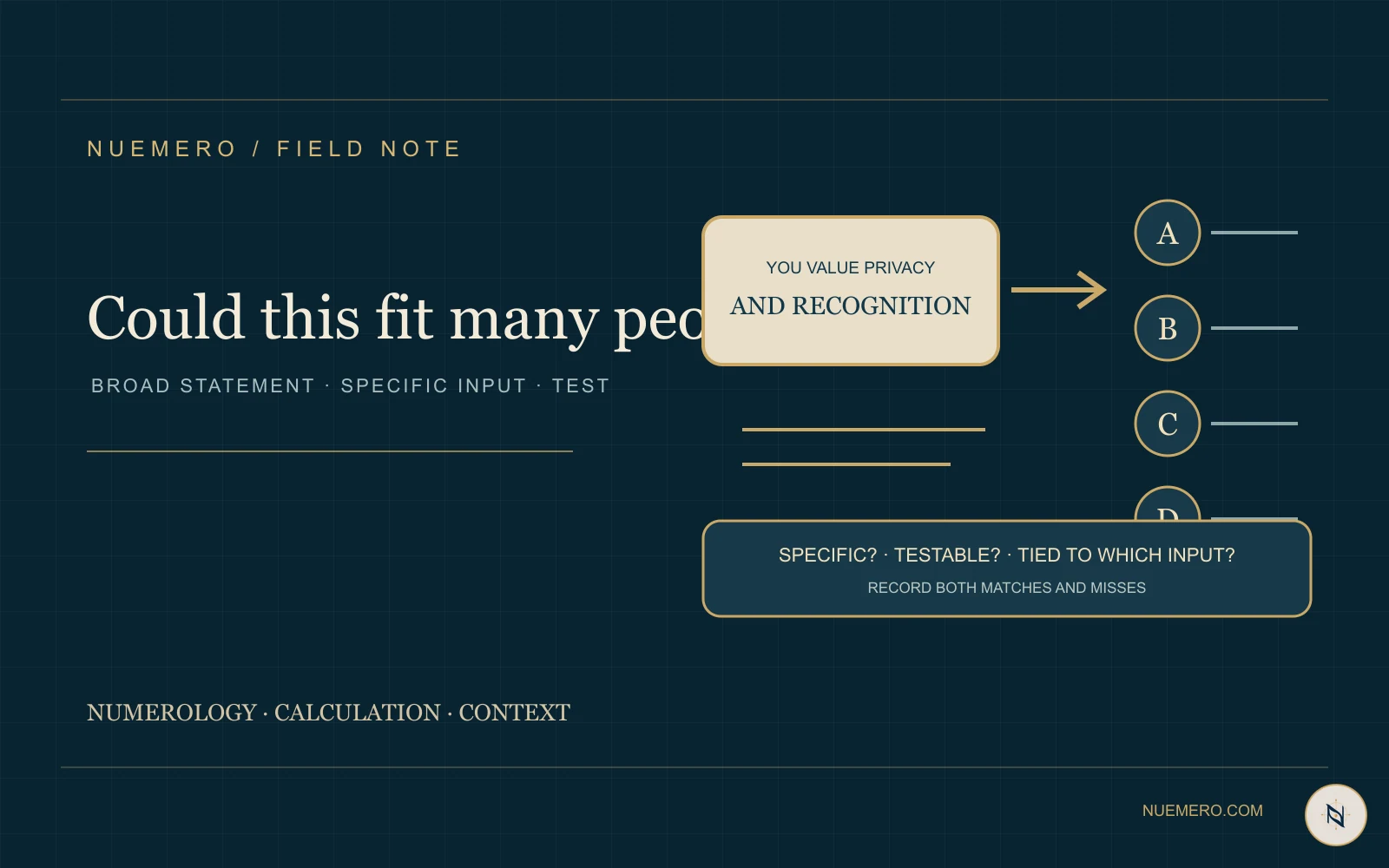
Research, evidence & responsible use·7 min
The Barnum Effect in Numerology: Why General Readings Can Feel Personal
Understand the psychology of personal validation, then test whether a reading is specific, falsifiable, and genuinely based on your stated inputs.
Read the guide