
Name numerologyNumerology guide
Chaldean Name Numerology: Letter Chart, Compound Total, and Calculation
Follow a Chaldean name calculation letter by letter, keep the compound total visible, and see why spelling and historical sources can change a reading.
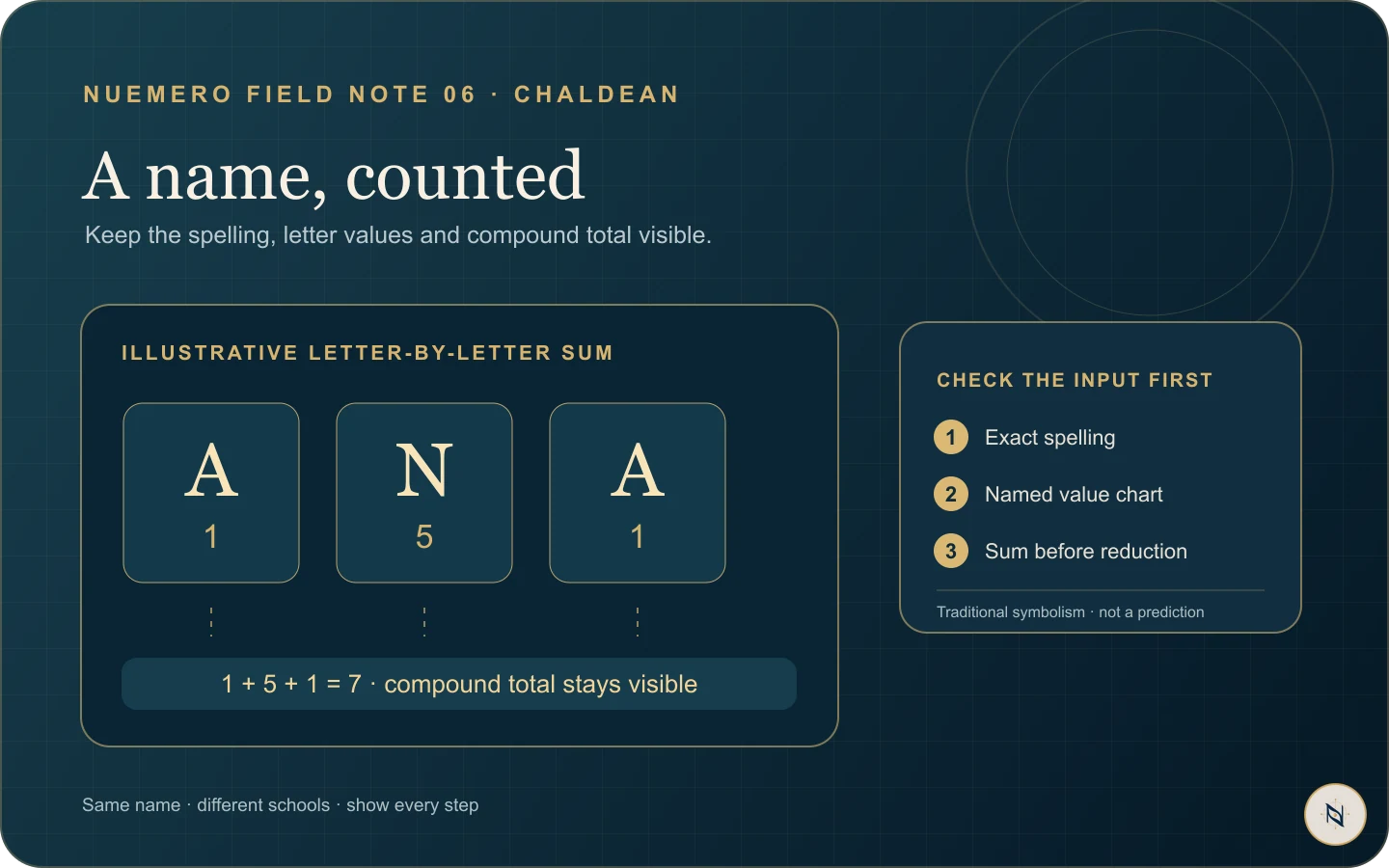
The short answer
Start here
Chaldean name numerology assigns values to Latin letters, adds the letters of a chosen name form, and commonly discusses both the compound sum and a reduced digit. The chart is not universal: sources differ in letter assignments and interpretation. Write down the exact spelling, table, total, and reduction rule before reading any meaning; treat the result as a traditional symbolic framework, not a tested prediction.
Key takeaways
Record the exact name spelling and letter table; changing either can change the sum.
Keep the unreduced compound total visible alongside any reduced digit.
Different Chaldean sources do not always use the same chart or meanings.
A name number is a traditional interpretation, not a reliable test of character or success.
On this page
First choose the name form
A calculation cannot be reproduced until the input is clear. Decide whether you are entering a birth name, current full name, professional name, or a spelling variant. Preserve spaces and punctuation in your notes even when they are not assigned values. For an Indian name written in Latin letters, state the transliteration: Sharma, Sharmā, and a regional spelling may not produce the same sequence.
This article uses a commonly printed modern Chaldean letter table as an example. Historical and contemporary books are not fully consistent, so do not silently mix one author’s table with another author’s compound-number meanings.
The Chaldean letter chart used here
These groups reproduce the letter values printed in Cheiro's Book of Numbers. Cheiro described them as an ancient Chaldean and Hebrew alphabet; that is the author's attribution, not independently established evidence of an unchanged ancient Latin-letter system. Modern tables may differ, so keep this source label with the calculation.
Cheiro's printed letter groups
A · I · J · Q · YB · K · RC · G · L · SD · M · TE · H · N · XU · V · WO · ZF · PAdd the letters and retain the compound
Using the displayed Cheiro table, JOHN gives J = 1, O = 7, H = 5, and N = 5. The compound total is 1 + 7 + 5 + 5 = 18; reducing its digits gives 1 + 8 = 9. Keep 18 visible because Cheiro discusses compound totals separately from the reduced digit. This is a reproducible example of that table, not evidence that a name predicts an outcome.
The arithmetic can be checked independently. The interpretation cannot be inferred from addition alone: authors attach different themes to totals, and those themes are part of a belief tradition rather than experimentally established effects.
JOHN · Cheiro table
J 1 · O 7 · H 5 · N 51 + 7 + 5 + 5 = 181 + 8 = 9Compare methods without blending them
Pythagorean and Chaldean systems can assign different values to the same Latin spelling. A useful comparison shows each table, each letter value, each raw sum, and each reduction step in separate columns. If your name was transliterated, compare that exact spelling in both systems rather than treating the result as a universal property of the original-script name.
Use the result as a prompt for reflection if it is meaningful to you. It should not decide a legal name change, hiring choice, relationship, medical treatment, or financial commitment; use practical evidence and qualified advice for those decisions.
Method and limits
This guide describes the conventions stated above and the way Nuemero’s current calculator works. Numerology interpretations are traditional beliefs, not scientific predictions. Check a source’s method before applying its meanings.
Read Nuemero’s full methodQuick answers
Frequently asked questions
Is there one universally accepted Chaldean chart?
No. Published tables and interpretations vary. Name the source and display its letter assignments so another reader can reproduce your result.
Should I reduce a compound number?
Follow the stated source. Many readings retain the compound total and also give a reduced digit; collapsing it too early hides information and makes comparisons hard to audit.
Does a name number predict success?
No dependable predictive ability has been established. Treat interpretations as traditional symbolism, not evidence about a person’s ability or future.
Can I calculate a Hindi name directly?
A Latin-letter chart needs a transliteration step. State which Roman spelling you used; another transliteration can yield another total. The result is therefore tied to that input convention.
Read further
Sources and method notes
- Nuemero name comparisonCompare the selected spelling with each system’s values and reduction steps.
- Cheiro · The Book of NumbersPrimary practitioner source for the reproduced chart. Cheiro's claimed ancient provenance is attributed to him and is not treated here as verified history.
- Nuemero calculation methodologySee product calculation rules and where interpretation begins.
Sources document calculation conventions and claims made within their traditions. They are not evidence that numerology predicts real-world outcomes.
Name numerology·8 min
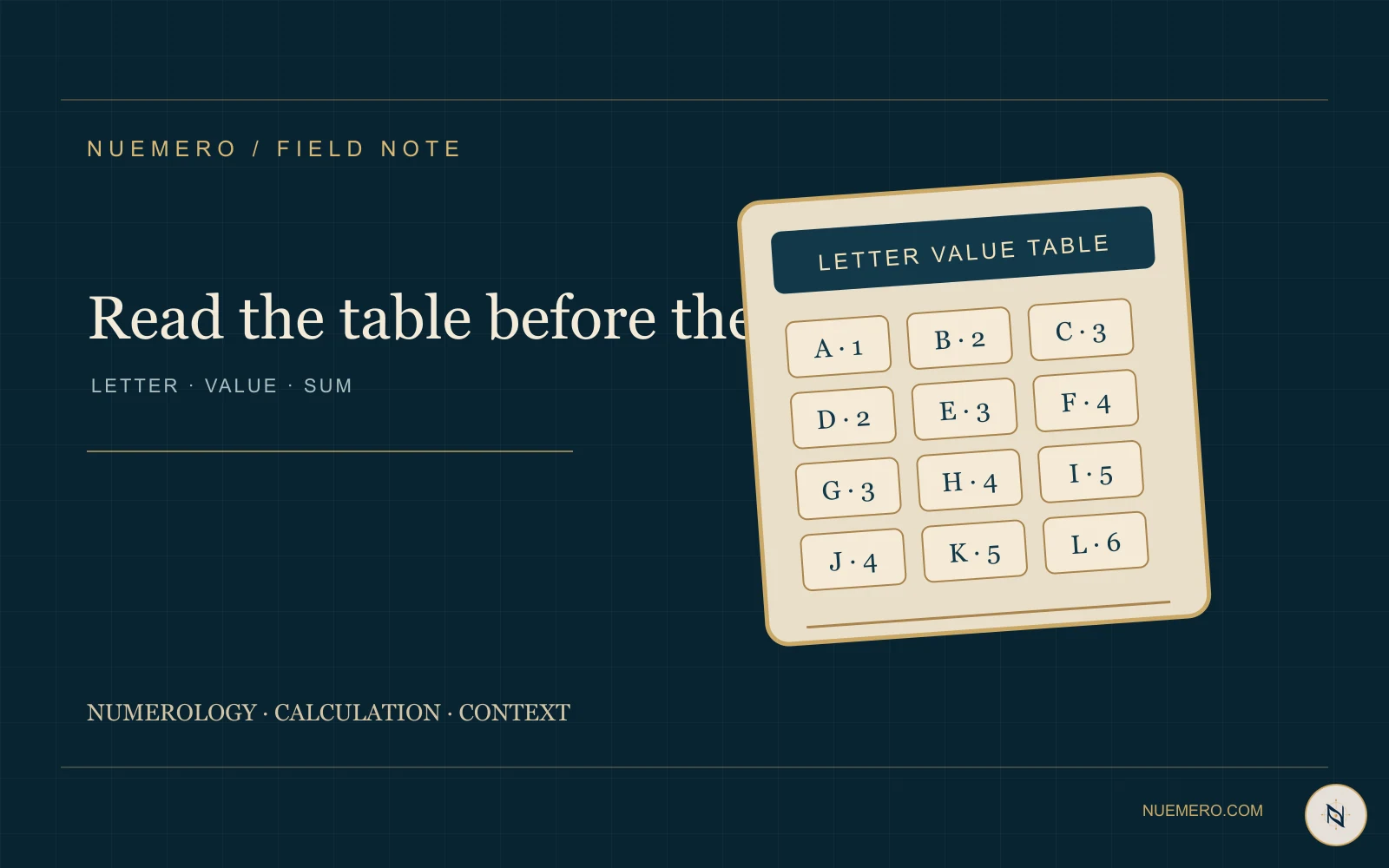
Chaldean Numerology Letter Chart A–Z: Values, Name Example, and Limits
Review the commonly printed 1–8 Chaldean-style letter table, calculate a fictional name, and distinguish Cheiro’s published scheme from claims of ancient origin.
Read the guide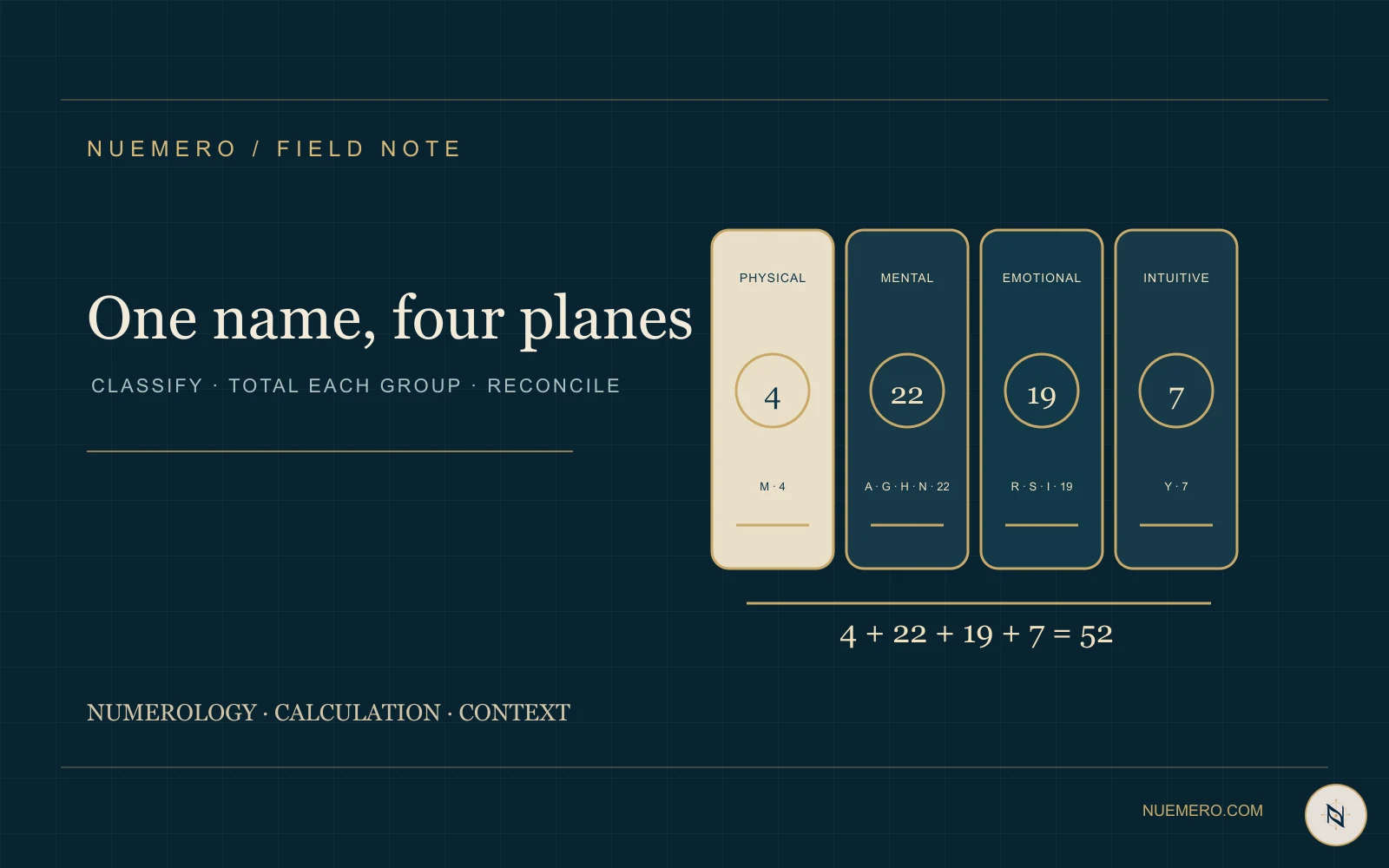
Name numerology·8 min
Planes of Expression: Build a Four-Plane Name Chart
Learn one practitioner’s letter classifications for the Physical, Mental, Emotional, and Intuitive planes, build a checkable fictional chart, and distinguish its symbolic reading from a validated assessment.
Read the guide