
Name numerologyNumerology guide
Chaldean Numerology Letter Chart A–Z: Values, Name Example, and Limits
Review the commonly printed 1–8 Chaldean-style letter table, calculate a fictional name, and distinguish Cheiro’s published scheme from claims of ancient origin.
The short answer
Start here
A common Chaldean-style English chart assigns letters to values 1–8 and leaves 9 unassigned in the table; name totals can still reduce to 9. Exact tables and compound-number interpretations should be tied to a named source and edition. The modern English chart is widely encountered through Cheiro’s writing; its publication does not establish an ancient Babylonian origin for this exact A–Z mapping.
Key takeaways
The commonly used table assigns English letters values 1–8; verify the exact edition.
A letter table, compound total, and reduced root are separate steps.
Different spellings and transliterations produce different totals.
A modern English chart is not proof of an unchanged ancient Babylonian method.
On this page
The commonly used letter table
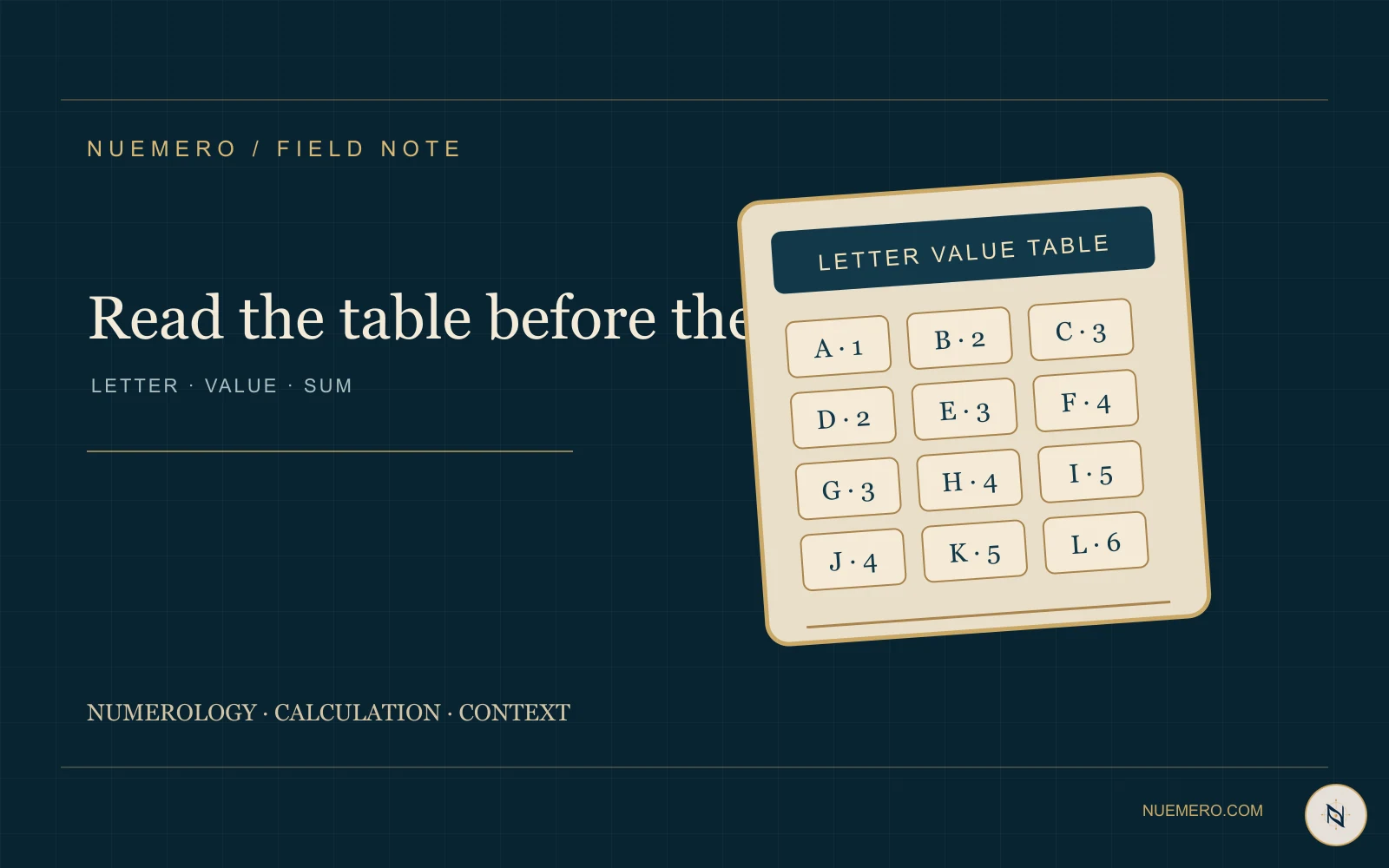
The English chart commonly attributed to the Chaldean tradition groups letters by values 1–8. A common printed arrangement is: 1=A I J Q Y; 2=B K R; 3=C G L S; 4=D M T; 5=E H N X; 6=U V W; 7=O Z; 8=F P. Check the source you use: transcriptions and later websites sometimes differ.
This is a modern English-language table as transmitted in practitioner literature, not the same thing as reading ancient Babylonian cuneiform. When discussing its history, distinguish a book’s own origin story from independent evidence about when this exact Latin alphabet mapping appeared.
Calculate one name without hiding steps
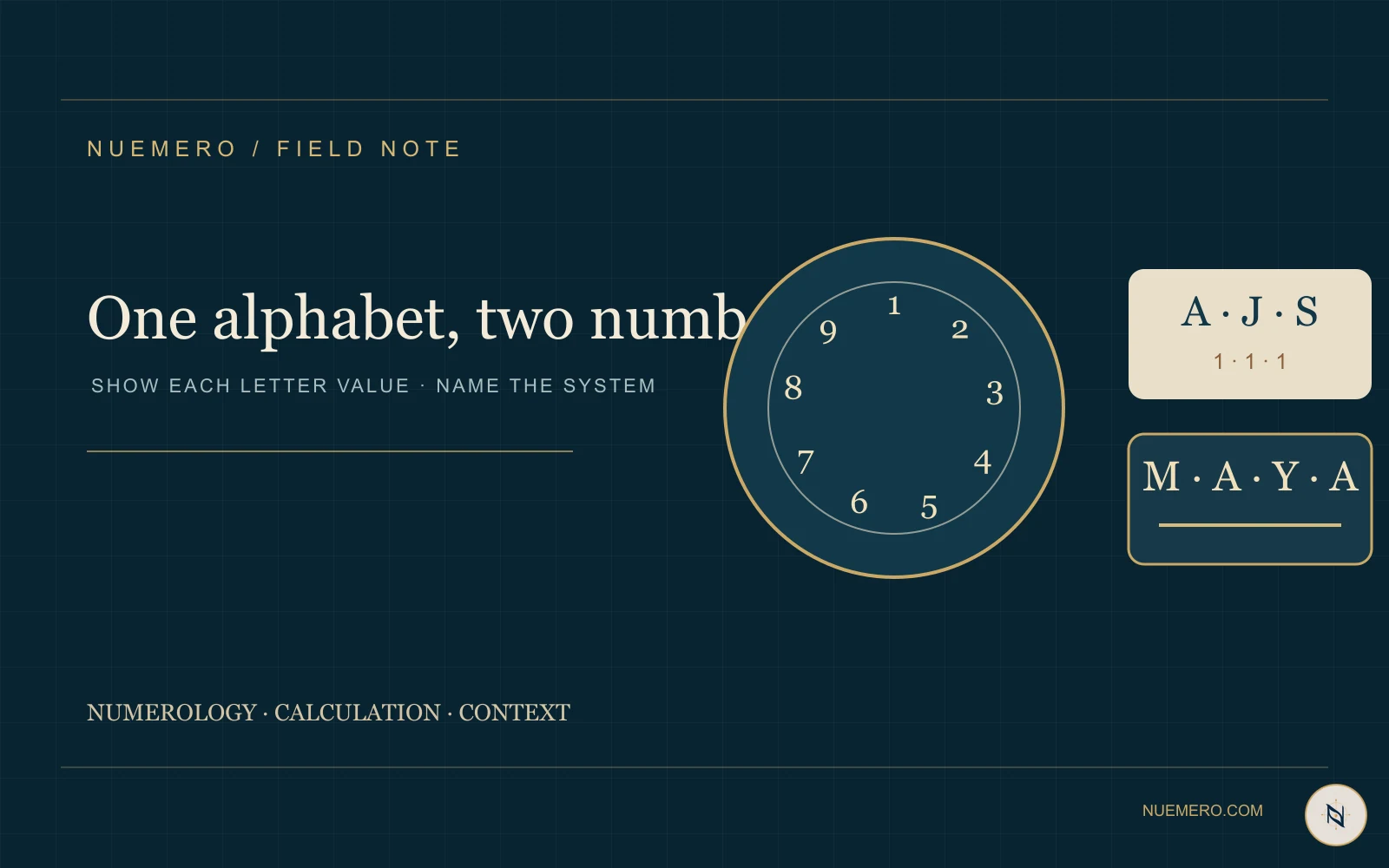
For the fictional name MAYA, the common table gives M=4, A=1, Y=1, A=1, so the total is 7. Notice that Y differs from the Pythagorean-style chart, where Y is commonly 7. That is why a calculator must name its system and display each letter value. If a school reads compound totals before reducing, preserve the original total as well as any root.
Fictional example · MAYA
M=4 · A=1 · Y=1 · A=14 + 1 + 1 + 1 = 7Check the edition, spelling, and claim
Name the edition and table, especially if a source gives a different value for a letter. Agree how to handle accented letters, transliteration, spaces, and a changed name before comparing totals. Never change someone’s official spelling solely because a symbolic reading labels one total more favorable.
A numerological interpretation is a tradition’s meaning attached to the numbers, not an outcome guaranteed by addition. Use it as optional reflection; for identity, work, money, or relationships, prioritize the person’s own preference and observable circumstances.
Method and limits
This guide describes the conventions stated above and the way Nuemero’s current calculator works. Numerology interpretations are traditional beliefs, not scientific predictions. Check a source’s method before applying its meanings.
Read Nuemero’s full methodQuick answers
Frequently asked questions
Why does Chaldean numerology leave out 9?
In the commonly printed table, no English letter is assigned value 9. Some writers attach symbolic significance to that choice; state the source rather than presenting one explanation as universal fact.
Is this the original ancient Chaldean alphabet chart?
The familiar English A–Z table is known through modern practitioner books. Its label alone does not prove that the same table was used in ancient Babylonia.
Does the compound number matter before reduction?
Some Chaldean-style readings interpret compound totals; others emphasize a reduced digit. Show both and cite the convention you follow.
Read further
Sources and method notes
- Open Library · Cheiro’s Book of Numbers edition recordBibliographic record for a practitioner text associated with the modern Chaldean-style English chart; a catalog entry documents publication details, not the method’s claimed ancient origin.
Sources document calculation conventions and claims made within their traditions. They are not evidence that numerology predicts real-world outcomes.
Name numerology·8 min
Pythagorean Numerology Letter Chart A–Z: Values and a Worked Name
See the repeating 1–9 Latin-letter table, calculate a fictional name step by step, and understand why this modern chart should not be presented as a verified teaching of Pythagoras.
Read the guide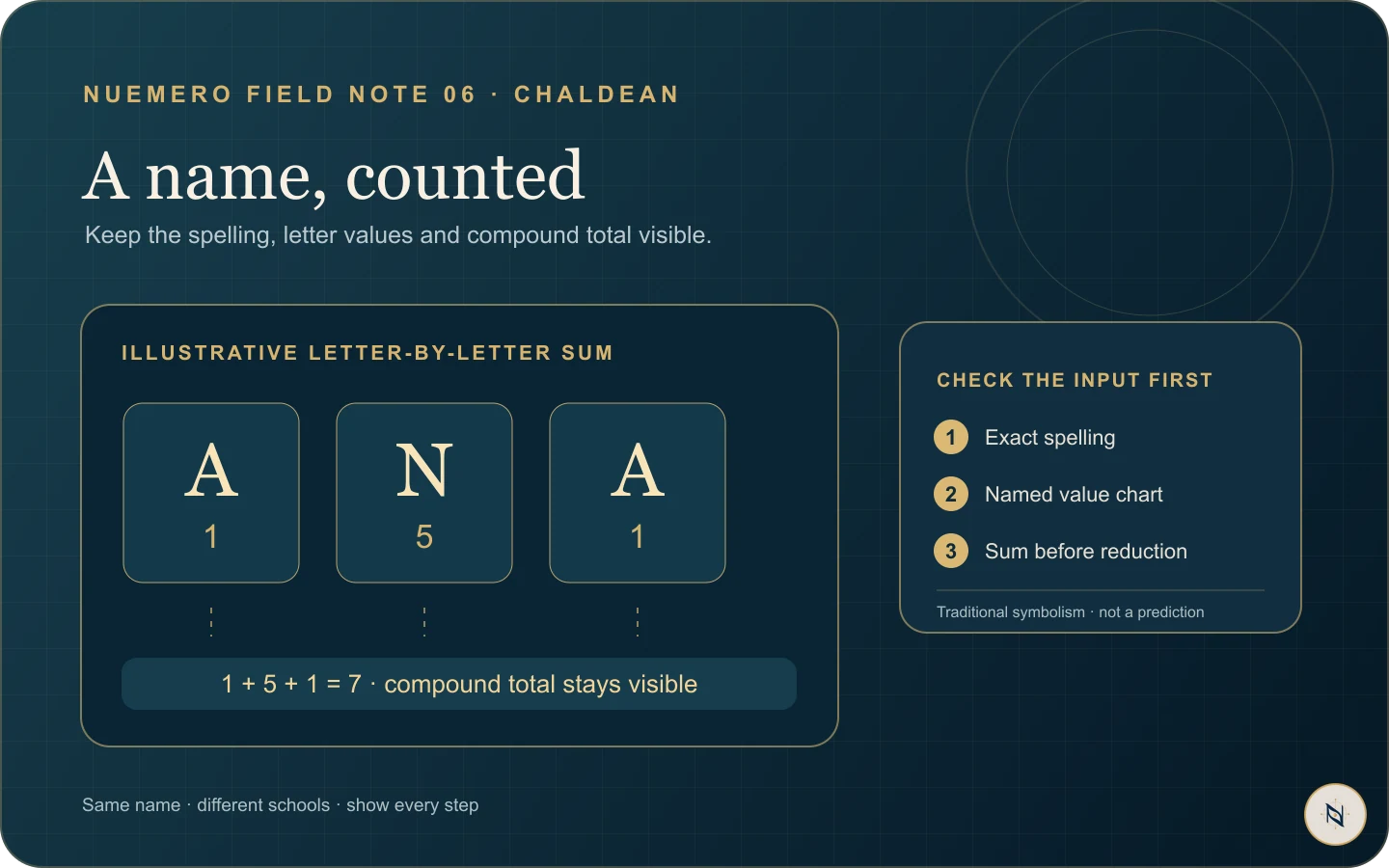
Name numerology·6 min
Chaldean Name Numerology: Letter Chart, Compound Total, and Calculation
Follow a Chaldean name calculation letter by letter, keep the compound total visible, and see why spelling and historical sources can change a reading.
Read the guide