
Name numerologyNumerology guide
Pythagorean Numerology Letter Chart A–Z: Values and a Worked Name
See the repeating 1–9 Latin-letter table, calculate a fictional name step by step, and understand why this modern chart should not be presented as a verified teaching of Pythagoras.
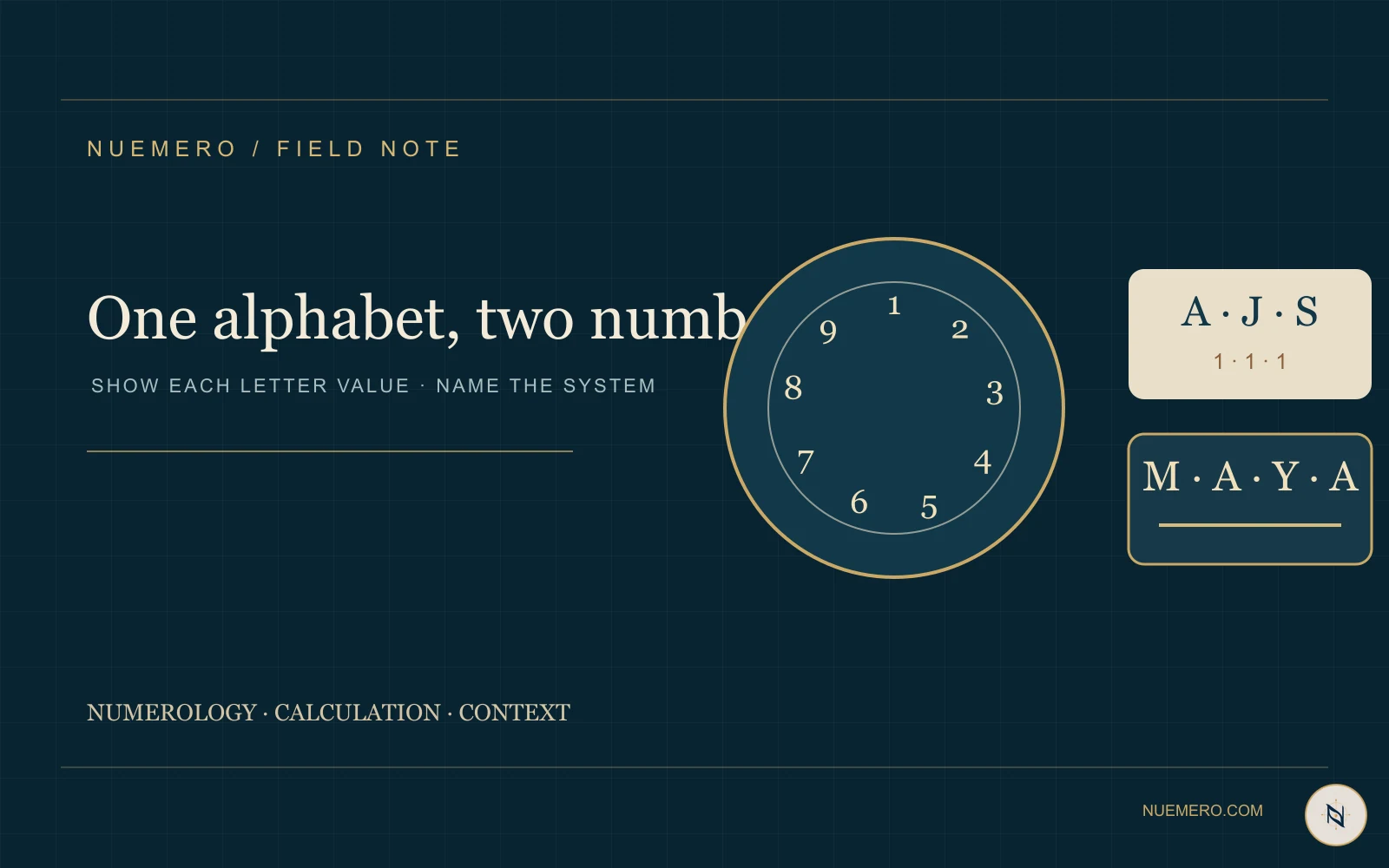
The short answer
Start here
In the common modern Pythagorean-style name chart, A–I map to 1–9, J–R repeat 1–9, and S–Z begin another cycle. This is a declared Latin-letter convention, not a universal rule or a historically verified chart from Pythagoras. State the exact spelling, show each letter value, add the total, and disclose whether and how you reduce it.
Key takeaways
The familiar chart assigns Latin letters in repeating 1–9 order.
Changing spelling, transliteration, or name form changes the arithmetic input.
Keep compound total and reduced digit visible; sources differ on reduction rules.
The modern chart is not evidence of a direct ancient Pythagorean alphabet table.
On this page
The repeating A–Z rule
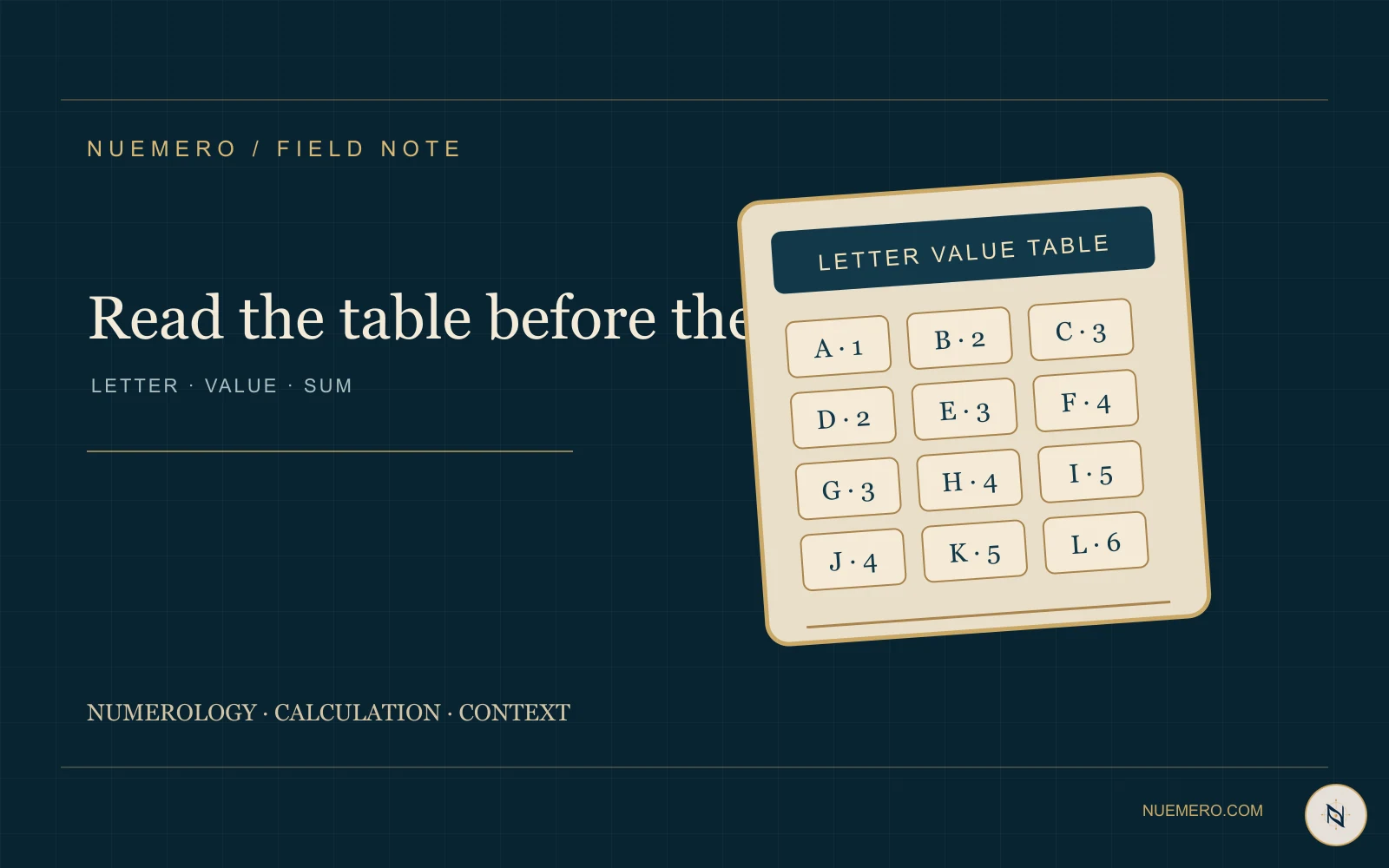
Write the alphabet in order and cycle through 1 to 9: A=1, B=2 … I=9, then J=1 and continue. In the familiar mapping, S starts the third cycle at 1 and Z ends at 8. Tables can be printed in rows or columns, so check the letters rather than relying on visual alignment.
This chart operates on the chosen Latin spelling. Transliteration from Hindi or another script is not unique: a sound may be written in more than one way. Record the exact spelling and do not silently switch between a birth certificate, nickname, and professional name.
A transparent name example
Use the fictional name MAYA. Under this table, M=4, A=1, Y=7, A=1, so 4+1+7+1=13. If the chosen convention reduces totals, 1+3=4. The arithmetic gives a total and a reduced value; meanings attached to 13 or 4 are tradition-specific interpretations, not facts established by the sum.
Fictional example · MAYA
M=4 · A=1 · Y=7 · A=14 + 1 + 7 + 1 = 131 + 3 = 4Use the chart carefully
Before comparing two names, match the alphabet, spelling, punctuation rule, and reduction convention. If one source preserves 11 or 22 while another reduces them, the reported core number may differ even when letter values match. Ask the calculator to show its table and steps.
A useful interpretation should invite a question you can check in lived experience. It should not dictate a career, judge a person, promise a result, or pressure you to alter a legally important name. Keep identity, consent, and practical consequences first.
Method and limits
This guide describes the conventions stated above and the way Nuemero’s current calculator works. Numerology interpretations are traditional beliefs, not scientific predictions. Check a source’s method before applying its meanings.
Read Nuemero’s full methodQuick answers
Frequently asked questions
Is the Pythagorean alphabet chart actually from Pythagoras?
The familiar A–Z table is documented in modern Western numerology sources; an ancient source establishing this exact Latin-letter chart as Pythagoras’s teaching has not been identified. Name it as a modern Pythagorean-style convention.
Do I count spaces or punctuation?
Usually letter values are added and spaces are ignored, but calculators can differ on hyphens, diacritics, and transliteration. State the rule and keep it consistent.
Should I reduce 13 to 4?
That depends on the number being calculated and the source’s stated convention. Show both 13 and 4, and explain whether a compound number is retained.
Read further
Sources and method notes
- Library of Congress · L. Dow Balliett, How to Attain Success Through the Strength of VibrationA 1905 copyright-era primary source showing the letter-number method in print; it records a practitioner’s system, not evidence that its interpretations predict outcomes.
Sources document calculation conventions and claims made within their traditions. They are not evidence that numerology predicts real-world outcomes.
Name numerology·8 min
Chaldean Numerology Letter Chart A–Z: Values, Name Example, and Limits
Review the commonly printed 1–8 Chaldean-style letter table, calculate a fictional name, and distinguish Cheiro’s published scheme from claims of ancient origin.
Read the guide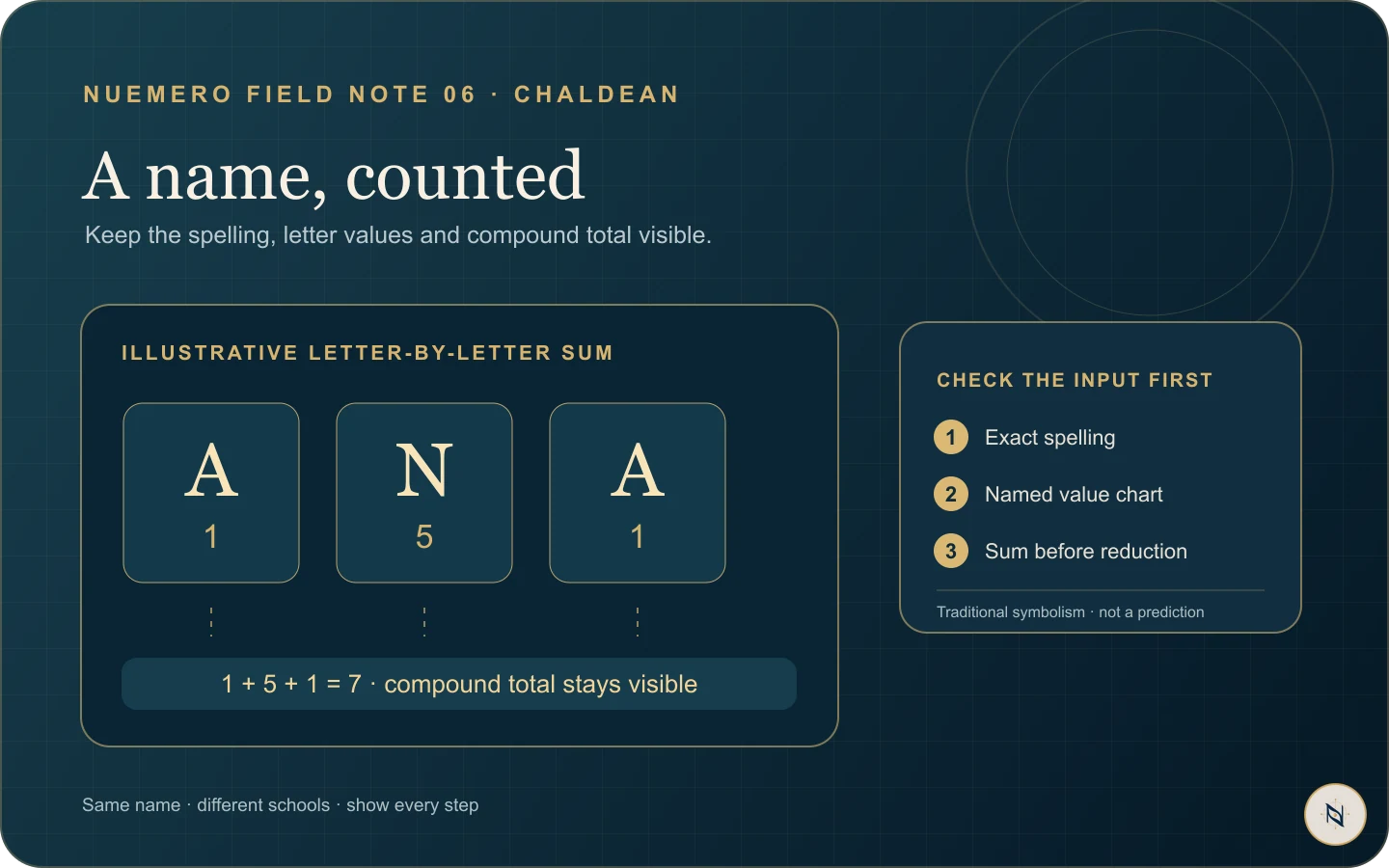
Name numerology·6 min
Chaldean Name Numerology: Letter Chart, Compound Total, and Calculation
Follow a Chaldean name calculation letter by letter, keep the compound total visible, and see why spelling and historical sources can change a reading.
Read the guide