
Core numbers & calculationsNumerology guide
Challenge Numbers in Numerology: Four Subtractions, One Worked Date
Calculate four Challenge Numbers from a birth date using a named practitioner convention, see why zero can appear, and keep approximate cycle themes separate from fixed life predictions.
The short answer
Start here
In Hans Decoz’s practitioner method, reduce birth month, day, and year to single digits, including master numbers, then take absolute differences: month–day, day–year, first–second, and month–year. A difference can be zero; this source says zero is common. The chart’s arithmetic is reproducible, but its themes and approximate life periods are traditional interpretations, not evidence that a particular obstacle or event is destined to occur.
Key takeaways
Reduce month, day, and year first, then subtract the smaller digit from the larger in this convention.
The third or Main Challenge is the difference between the first two; a zero result is allowed.
Challenge periods are described as overlapping and approximate in the cited source, not exact calendar deadlines.
A chart value does not prove a weakness or predict a specific hardship.
On this page
The four differences in the cited method
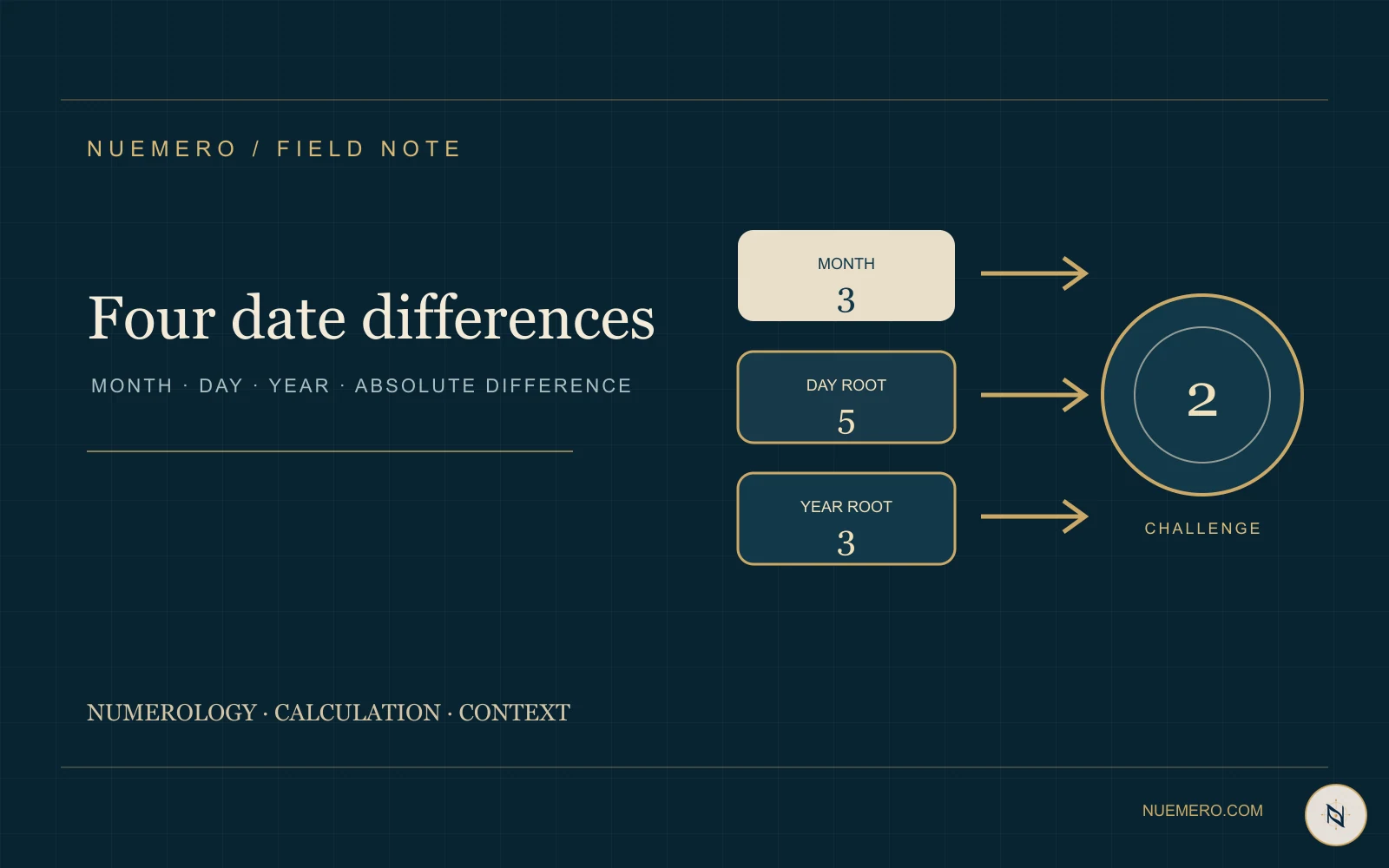
Hans Decoz’s Challenge-number guide starts by reducing the birth month, day, and year separately to single digits. It reduces 11, 22, and other master values for this calculation. The first Challenge is the absolute difference between month and day; the second, day and year; the third or Main Challenge, the first and second; the fourth, month and year. Subtract smaller from larger so the result is never negative.
Use a fictional date, 14 March 1992: month = 3; day 14 → 5; year 1992 → 21 → 3. The four differences are |3−5| = 2, |5−3| = 2, |2−2| = 0, and |3−3| = 0. Zero is a valid result under this method; do not replace it with another number unless the cited rule tells you to.
14 March 1992 · fictional example
Month 3 · Day 5 · Year 3|3 − 5| = 2 · |5 − 3| = 2|2 − 2| = 0 · |3 − 3| = 0Challenge periods are not precise age forecasts
The same practitioner describes four Challenges as periods with fluid, overlapping influence rather than tightly fixed dates. The source offers approximate age ranges for the first, second, and fourth, and says the Main Challenge is considered throughout life. Those are descriptions within one numerology framework; a chart cannot establish when a life event will occur.
If a cycle label is useful, treat it as a prompt to examine habits and choices you can observe. Do not treat a zero or any other Challenge value as a diagnosis, a fixed character flaw, or a reason to avoid an opportunity.
Compare the convention before comparing the result
Record the exact date order, how month/day/year are reduced, whether master numbers are retained, whether subtraction means absolute difference, and how the source describes timing. These details help explain why two calculators may show different challenge sets even when each follows its own documented rule.
For decisions about work, money, relationships, health, or education, use real-world information and qualified advice where relevant. A numerology reading can be optional reflection, but it is not an evidence-based risk assessment.
Method and limits
This guide describes the conventions stated above and the way Nuemero’s current calculator works. Numerology interpretations are traditional beliefs, not scientific predictions. Check a source’s method before applying its meanings.
Read Nuemero’s full methodQuick answers
Frequently asked questions
How do you calculate the four Challenge Numbers?
In the cited method, reduce month, day, and year to single digits; then take absolute differences for month/day, day/year, first/second, and month/year. Master numbers are reduced for this calculation.
Can a Challenge Number be zero?
Yes. Equal values produce a difference of zero, which the cited practitioner says is common. Keep zero if that follows the method you selected.
Are Challenge Number periods exact ages?
The cited source describes the periods as approximate and overlapping. It does not define a precise event date, and other numerology authors may use different timing language.
Does a zero Challenge mean I have no obstacles?
No. It is an arithmetic difference in one chart method. It cannot guarantee an obstacle-free life or measure a person’s circumstances.
Read further
Sources and method notes
- Hans Decoz: The ChallengesPractitioner source for the four difference formulas, reduction of master numbers, zero values, and approximate/overlapping periods; interpretive claims are attributed to the tradition.
- Hans Decoz: How to Do Your Own ReadingA second source listing the Challenge calculation steps and its timing caveat.
Sources document calculation conventions and claims made within their traditions. They are not evidence that numerology predicts real-world outcomes.
Core numbers & calculations·7 min
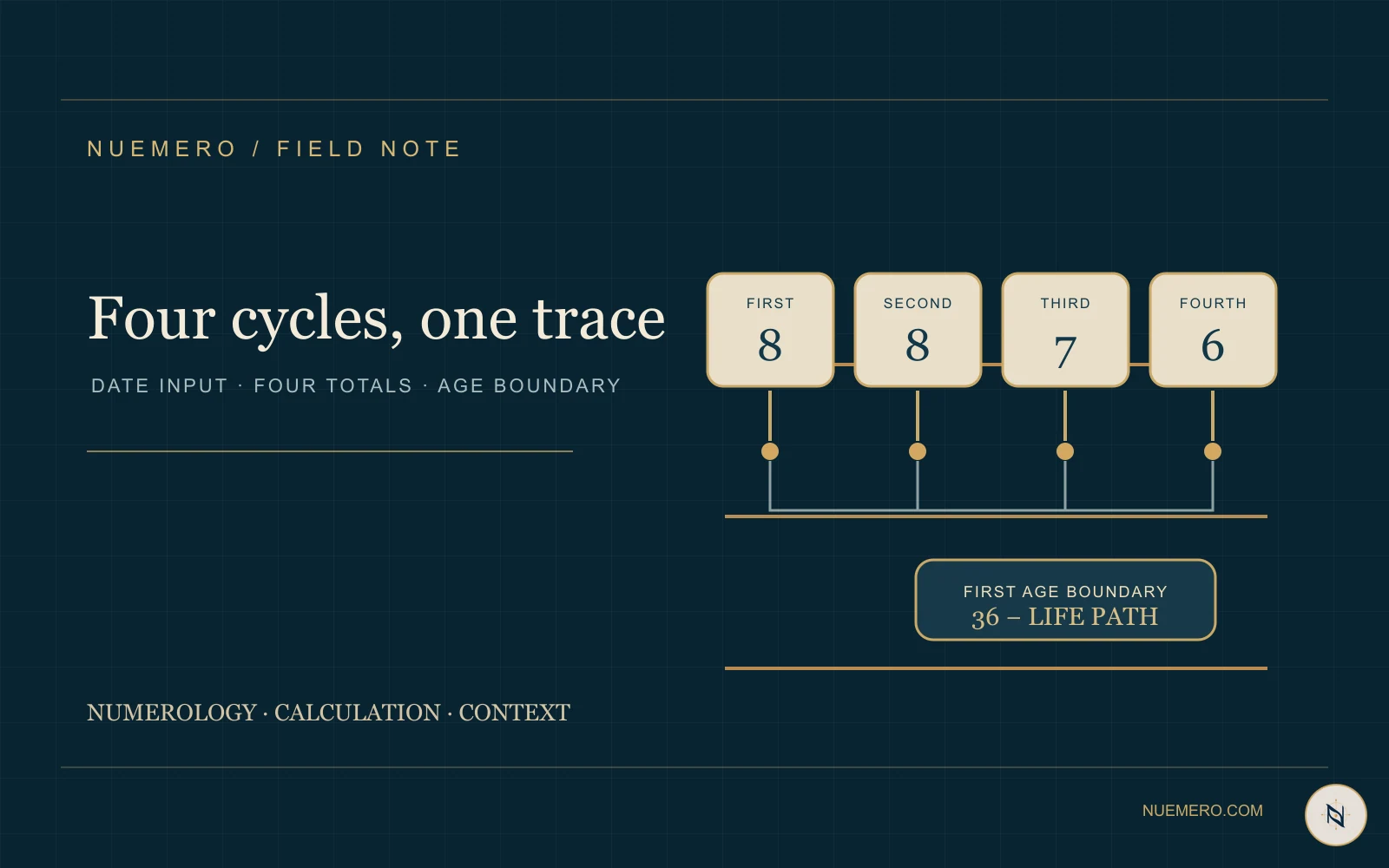
Pinnacle Numbers: Calculate the Four Cycles and Their Timing
Follow one published Pinnacle-cycle convention from birth month, day, and year through all four totals and age boundaries; compare the arithmetic without treating cycle themes as guaranteed events.
Read the guide
Core numbers & calculations·6 min
How to Calculate a Life Path Number (and Why Formulas Differ)
Calculate a Life Path number from a birth date, see every addition in a worked example, and learn how master-number conventions change the display.
Read the guide