
Birth-date numerologyNumerology guide
How to Calculate a Life Path Number (and Why Formulas Differ)
Calculate a Life Path number from a birth date, see every addition in a worked example, and learn how master-number conventions change the display.
The short answer
Start here
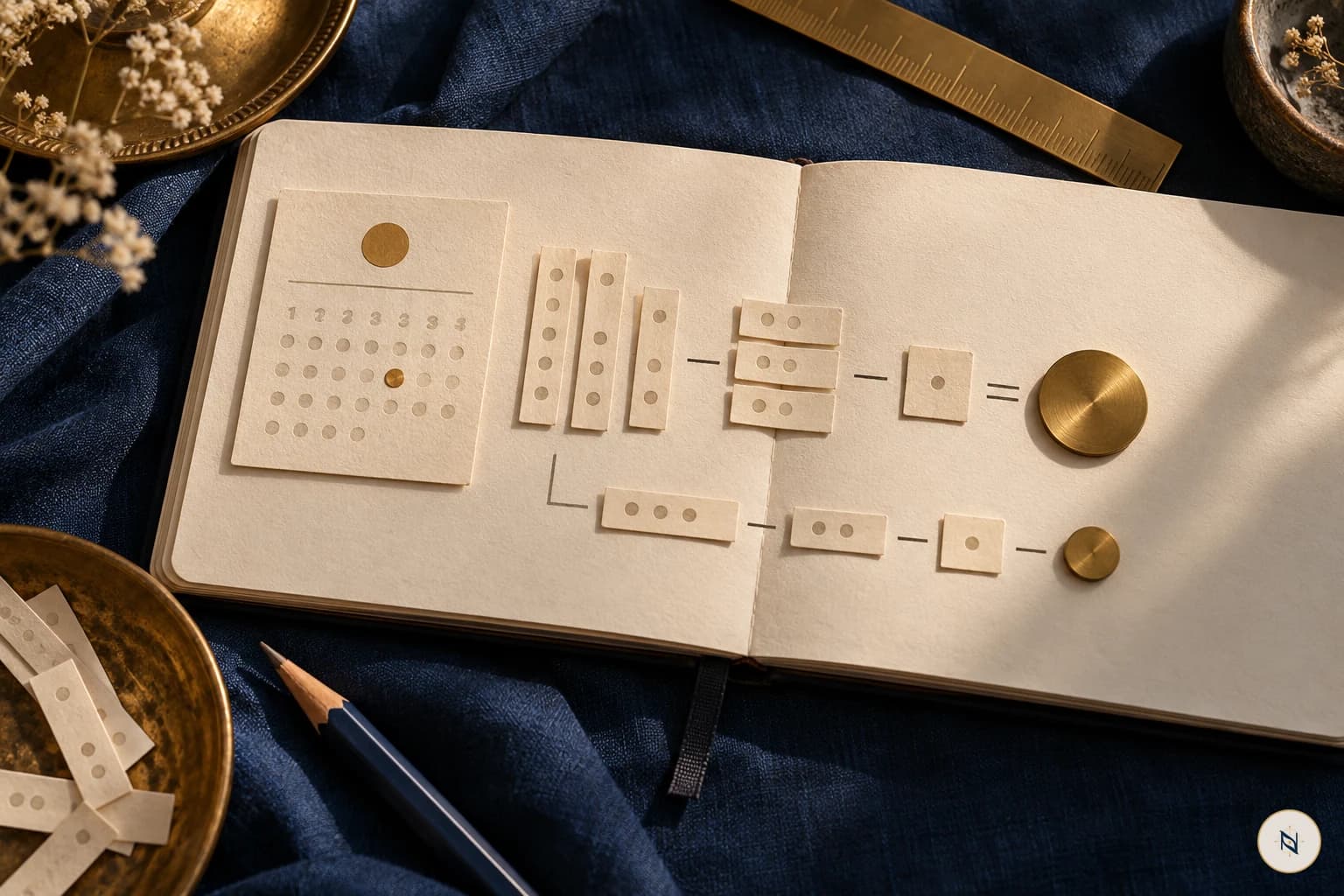
To calculate a Life Path number using Nuemero’s current full-date method, add every digit in the Gregorian birth date and keep reducing the sum until it is 1–9 or a preserved master number, 11, 22, or 33. Write down the date format and the master-number rule, because other numerology calculators may reduce date components in a different order.
Key takeaways
Use the complete Gregorian date: day, month, and year.
Nuemero adds all date digits together, then reduces the sum; 11, 22, and 33 are preserved only if reached at the final reduction.
The birth day alone is a different input and is used for Mulank in Nuemero’s modern Indian profile.
A Life Path number is a numerology convention for reflection, not a scientific prediction or career test.
On this page
What a Life Path number uses
In modern Western numerology, the Life Path number is calculated from the complete date of birth. It is different from a name number, which depends on a letter-mapping table, and from Mulank, which uses only the day of the month in Nuemero’s modern Indian profile.
Different writers describe the interpretation in different ways. The calculation below focuses on the arithmetic and names the exact convention, so you can reproduce the result without relying on a vague label like “destiny number.”
Worked example: 14 March 1992
Take a fictional example date, 14 March 1992. Keep the date in day–month–year order for readability; the calculation uses every digit once. Do not add a reduced birth-day number to this sum—the full date already includes those digits.
Full-date digit-sum method
1 + 4 + 0 + 3 + 1 + 9 + 9 + 2= 292 + 9 = 1111 is preserved at the final step → Life Path 11/2When do you keep 11, 22, or 33?
Many modern numerology practitioners call 11, 22, and sometimes 33 master numbers. The set and the point at which a number is preserved vary by author. Some preserve them during intermediate month, day, and year reductions; others reduce each part fully and only preserve a master number if it appears at the final step.
Nuemero follows a clear operational rule: sum the full date digits, reduce the total, and preserve 11, 22, or 33 if one appears at that final stage. For the example above, the final reduction is 11, so the result is displayed as 11/2. If a tool uses a different rule, its label should say so.
Common calculation mistakes
Most mismatches come from an input or convention difference. Check these before redoing the reading.
- Mixing date orders: 03/04 can mean 3 April or March 4. Use an unambiguous written month or YYYY-MM-DD.
- Using the day only: that calculates a birth-day number such as Mulank, not a full-date Life Path.
- Adding twice: do not add a reduced day or year after already including every original date digit.
- Changing master-number rules mid-calculation: decide when to preserve a master number and apply that rule consistently.
- Mixing calendar systems or time zones: use the birth date as recorded in the declared calendar and locale; do not silently shift the date.
What this number can—and cannot—tell you
Numerology interpretations are traditional or spiritual frameworks. The arithmetic can be verified; claims that a number reliably predicts personality, success, marriage, health, or a specific event are not established by the calculation itself.
If you enjoy the framework, use the result as a question rather than a verdict: what habit would you like to build, what kind of work gives you energy, and what real-world evidence could you gather before making a decision? A number should not replace professional advice or your own judgment.
Method and limits
This guide describes the conventions stated above and the way Nuemero’s current calculator works. Numerology interpretations are traditional beliefs, not scientific predictions. Check a source’s method before applying its meanings.
Read Nuemero’s full methodQuick answers
Frequently asked questions
How do I calculate my Life Path number?
Add every digit in your full Gregorian date of birth, then reduce the sum under a stated rule. In Nuemero’s current method, 11, 22, or 33 is preserved only when reached at the final reduction.
Is Life Path the same as Mulank?
No. In Nuemero’s modern Indian profile, Mulank uses the day of the month and reduces it to 1–9. Life Path / Bhagyank uses the complete date. They answer different calculation questions.
Does everyone preserve 11, 22, and 33?
No. Numerology writers use different master-number sets and stopping points. A clear calculator names its policy and shows its arithmetic.
Can a Life Path number tell me the best career?
It cannot establish which career will suit or guarantee success. You can use traditional themes as reflection prompts, then weigh your interests, skills, constraints, training, and actual job information.
Read further
Sources and method notes
- Nuemero calculation methodologyThe exact full-date digit-sum and final master-number rule implemented by Nuemero.
- World Numerology course: calculating a Life PathA practitioner source illustrating component reductions and master-number handling; methods differ across schools.
- Nuemero numerology learning libraryCompare the product’s date-based and name-based traditions.
Sources document calculation conventions and claims made within their traditions. They are not evidence that numerology predicts real-world outcomes.
Cycles & timing·8 min
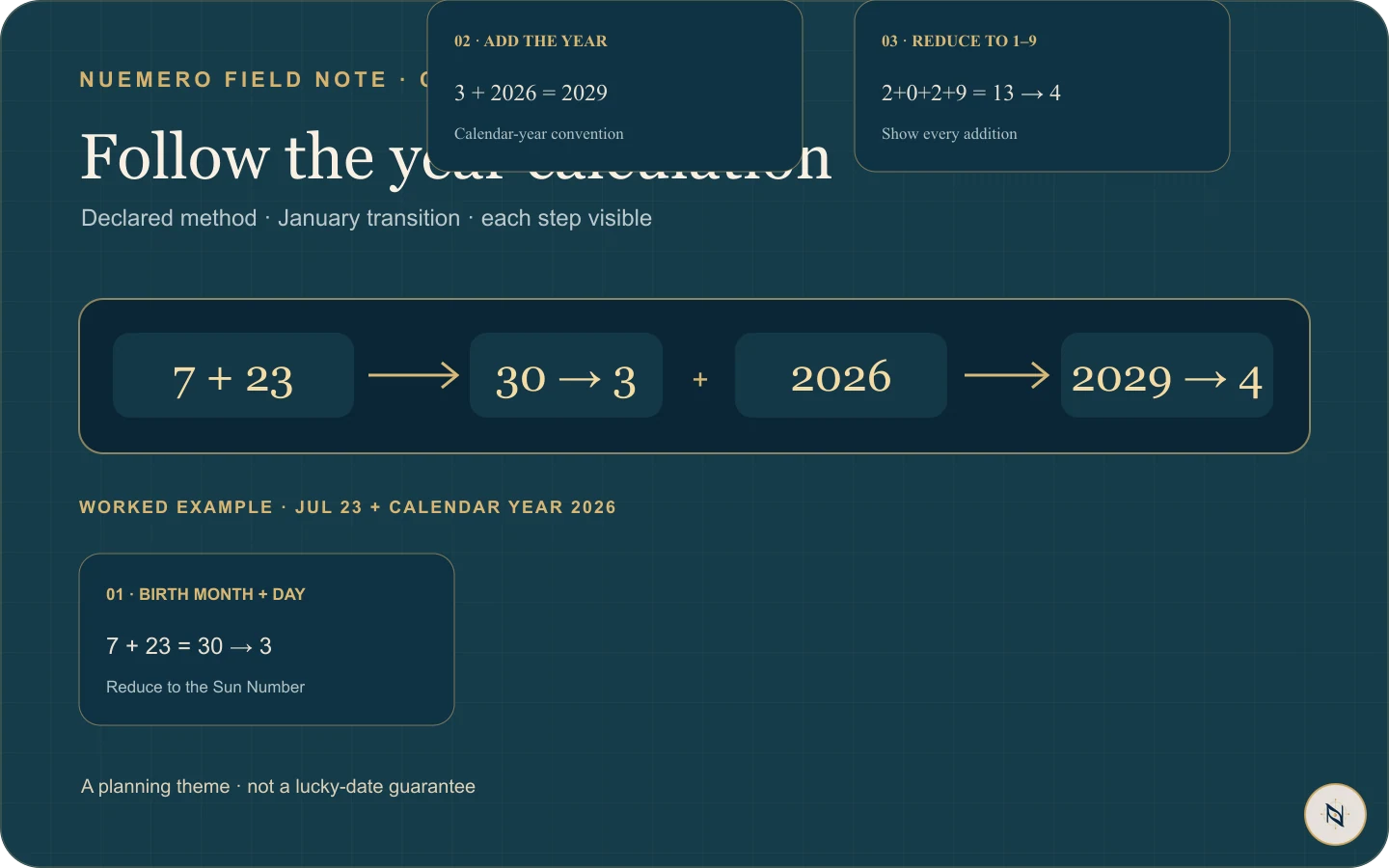
Personal Year Number: Calculation, Example, and January-to-December Timing
Follow Nuemero’s declared calendar-year calculation from birth month and day to the year total, check a worked example, and use timing themes as planning prompts rather than lucky-date guarantees.
Read the guide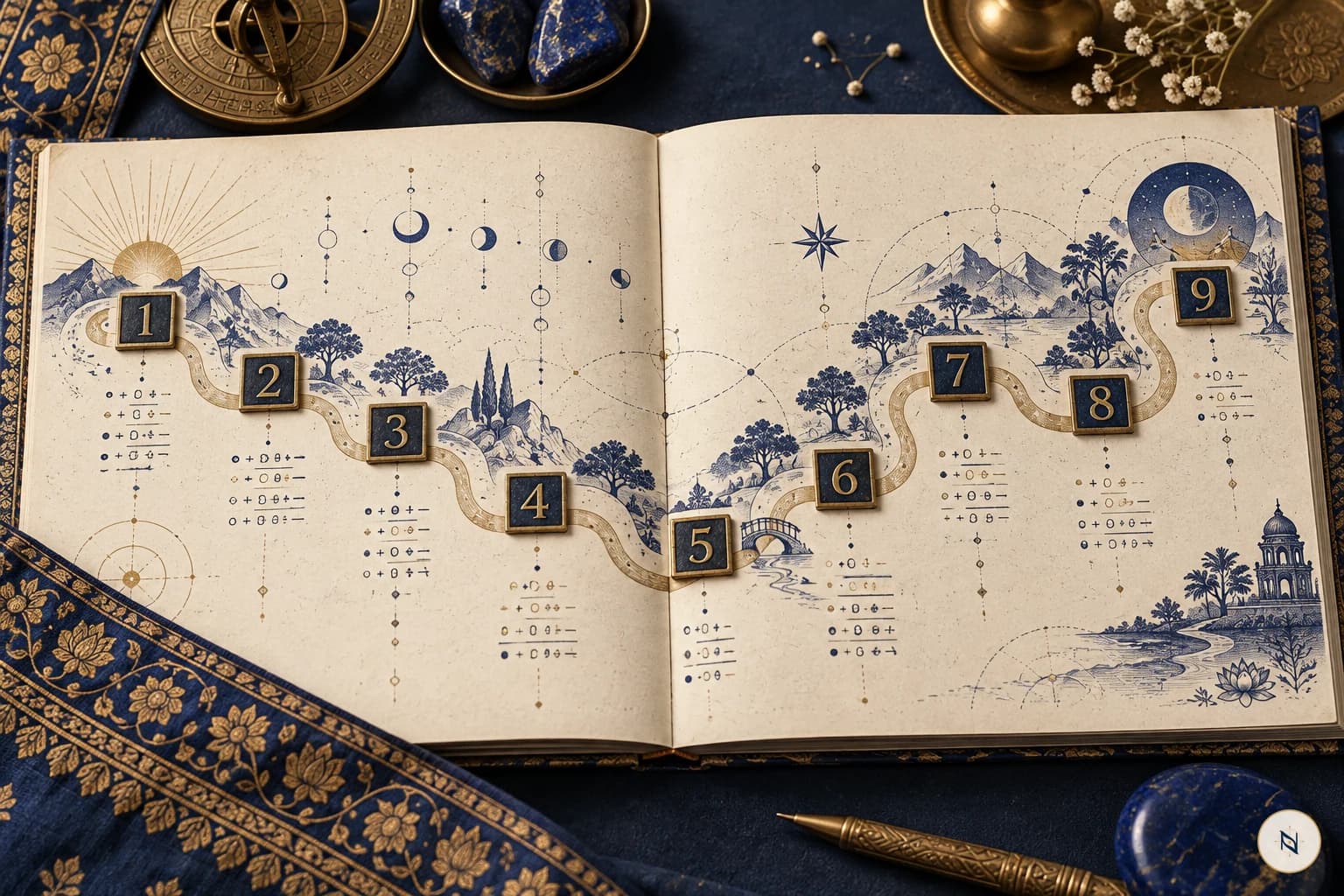
Core numbers & calculations·7 min
Life Path Numbers 1 to 9: Themes, Calculation, and Reflection
Explore traditional Life Path themes for 1–9, check how the full birth-date calculation works, and keep symbolic descriptions separate from claims about your future.
Read the guide