
Cycles & timingNumerology guide
Personal Year Number: Calculation, Example, and January-to-December Timing
Follow Nuemero’s declared calendar-year calculation from birth month and day to the year total, check a worked example, and use timing themes as planning prompts rather than lucky-date guarantees.
The short answer
Start here
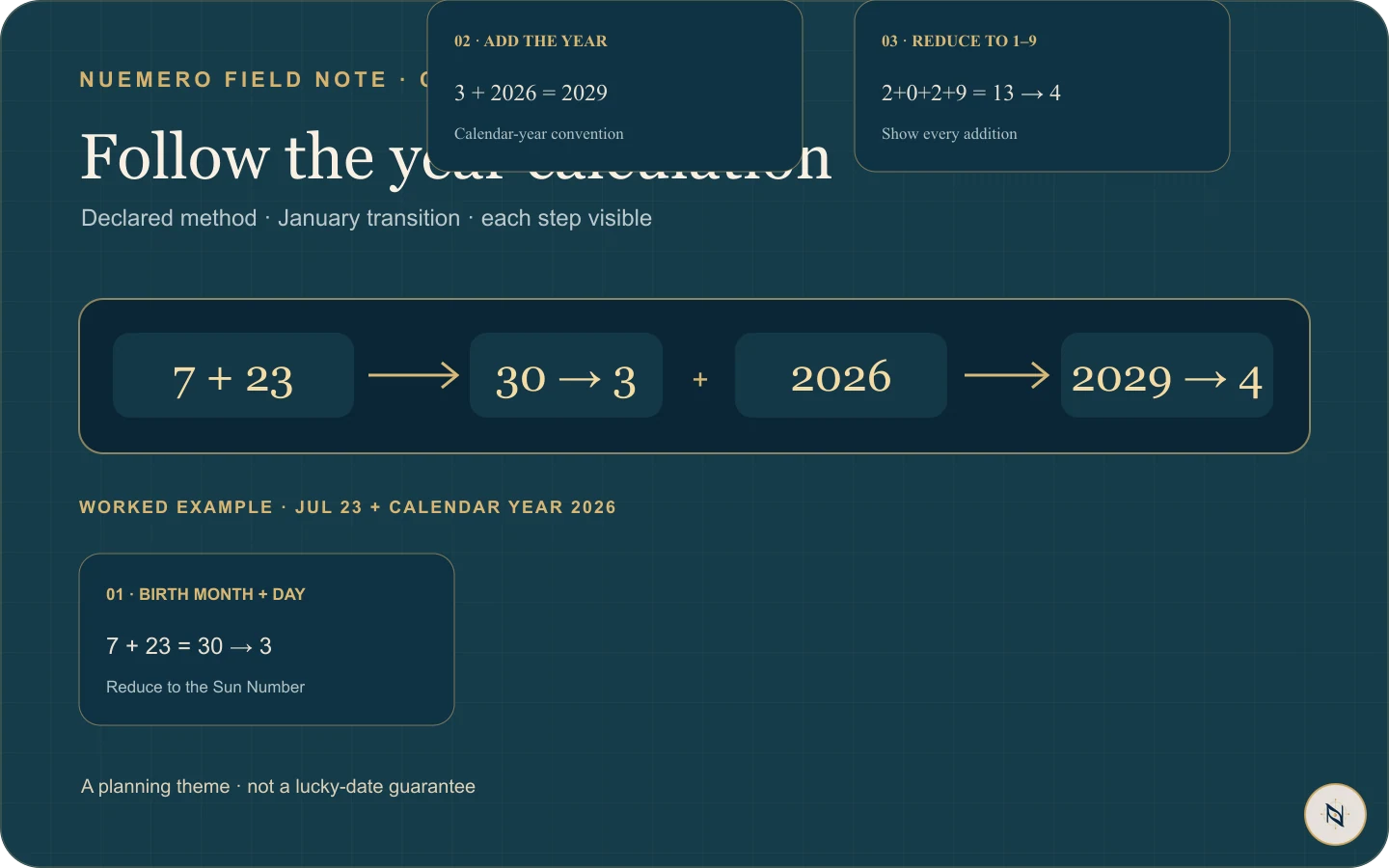
Nuemero’s personal-cycle tool uses a January 1 transition and reduces timing cycles to 1–9. It first adds birth month and day and reduces that sum; then adds the calendar year and reduces again. For July 23, the month-plus-day sum is 30 → 3; for 2026, 3 + 2026 = 2029 → 13 → 4. This is the app’s declared convention, not the only convention used everywhere. The number is a traditional planning theme, not a prediction of events or a guarantee that a date is lucky.
Key takeaways
This product’s Personal Year changes on January 1, not on your birthday.
The app reduces the birth month-plus-day value, adds the calendar year, then reduces to 1–9.
Other numerology sources may use a different transition date or reduction sequence.
Use a cycle as a reflection and planning prompt, not as an event forecast or lucky-date promise.
On this page
Check the year-transition rule first
“Personal Year” is not calculated identically by every numerology source. Some describe a calendar-year cycle; others use a birthday-to-birthday transition, or arrange intermediate reductions differently. Nuemero states its product rule openly: the cycle changes on January 1, the birth date’s month and day produce a reduced Sun Number, and timing values reduce to 1–9. Knowing that rule makes a result reproducible and helps explain why another website can differ.
Worked example: July 23 for calendar year 2026
Add the birth month and day: 7 + 23 = 30, then reduce 3 + 0 = 3. Add that reduced value to the calendar year: 3 + 2026 = 2029. Reduce the digits: 2 + 0 + 2 + 9 = 13, then 1 + 3 = 4. Under this convention, the Personal Year is 4. The calculator can display its trace so each step can be checked.
If your source reduces the day and month separately, starts the cycle on your birthday, or retains a compound number, the result can change. Compare the formulas before comparing the interpretations; never assume a difference proves one calculation was hidden or wrong.
Nuemero calendar-year example
7 + 23 = 30 → 33 + 2026 = 20292 + 0 + 2 + 9 = 13 → 4Use the number to plan, not to surrender your judgment
If the traditional theme resonates, turn it into one practical intention for the year—such as reviewing a budget, learning a skill, or making time for a project. Then check progress against your real calendar, resources, and priorities. The number cannot tell you that a particular month guarantees a promotion, marriage, investment return, or recovery.
For an important meeting or purchase, use practical readiness checks: agenda, comparison, cash flow, contract terms, and advice from someone qualified. A timing reading can be a personal ritual, but it should not replace those checks or create pressure to act on a supposedly lucky day.
Method and limits
This guide describes the conventions stated above and the way Nuemero’s current calculator works. Numerology interpretations are traditional beliefs, not scientific predictions. Check a source’s method before applying its meanings.
Read Nuemero’s full methodQuick answers
Frequently asked questions
Does my Personal Year change on my birthday?
Nuemero’s current personal-cycle tool uses a January 1 calendar-year transition. Other sources may use different conventions, so check the method label.
What is the Personal Year formula in Nuemero?
Reduce birth month + birth day to 1–9, add the calendar year, then reduce that total to 1–9. The calculator shows the intermediate sums.
Does a Personal Year predict the best month to get married or invest?
No reliable event-timing ability is established. Use relevant planning, financial, legal, and relationship information; regard the number only as a traditional reflection theme.
Why is my result different on another site?
The site may use a birthday-year transition, combine date parts differently, or reduce each component in another order. Compare the written input and trace to locate the difference.
Read further
Sources and method notes
- Nuemero Personal Year calculatorCalculate nested calendar cycles with a visible reduction trace.
- Nuemero methodologyRead the declared calendar transition and reduction policies.
Sources document calculation conventions and claims made within their traditions. They are not evidence that numerology predicts real-world outcomes.
Cycles & timing·9 min
How Numerology Forecasts for 2027 Are Calculated
Follow the arithmetic behind a 2027 Universal Year and a sample Personal Year, see where conventions differ, and treat forecasts as reflection rather than prediction.
Read the guide
Core numbers & calculations·6 min
How to Calculate a Life Path Number (and Why Formulas Differ)
Calculate a Life Path number from a birth date, see every addition in a worked example, and learn how master-number conventions change the display.
Read the guide