
Name numerologyNumerology guide
Expression Number, Soul Urge, and Personality Number: What Changes When You Split a Name?
Understand the full-name total, vowel-only Soul Urge, and consonant-only Personality calculations in common Pythagorean-style numerology, with clear limits and a fictional example.
The short answer
Start here
In common Pythagorean-style practice, the Expression (Destiny) number uses all letters of a selected full name; the Soul Urge often uses vowels and the Personality number consonants. The exact name form, alphabet, treatment of Y, and reduction convention matter. These are tradition-based symbolic calculations, not independently verified measures of personality or destiny.
Key takeaways
Expression uses all letters; Soul Urge commonly uses vowels; Personality commonly uses consonants.
The exact name and spelling must stay consistent across all three calculations.
Authors may differ on Y, accents, compound totals, and master-number reductions.
Treat the labels as reflection prompts rather than measured personality facts.
On this page
Three calculations, three letter sets
The Expression or Destiny calculation usually totals every letter in the selected full name. Soul Urge (also called Heart’s Desire) commonly totals vowels; Personality commonly totals consonants. This split is a convention used by particular modern numerology schools, so identify the source and spelling instead of treating the labels as universal.
The letter table assigns values before any split. Then the same name is separated according to the school’s vowel rule. Y is the classic ambiguity: depending on pronunciation and the author’s convention it may be treated as a vowel or consonant. State your rule and apply it consistently.
A fictional example with visible steps
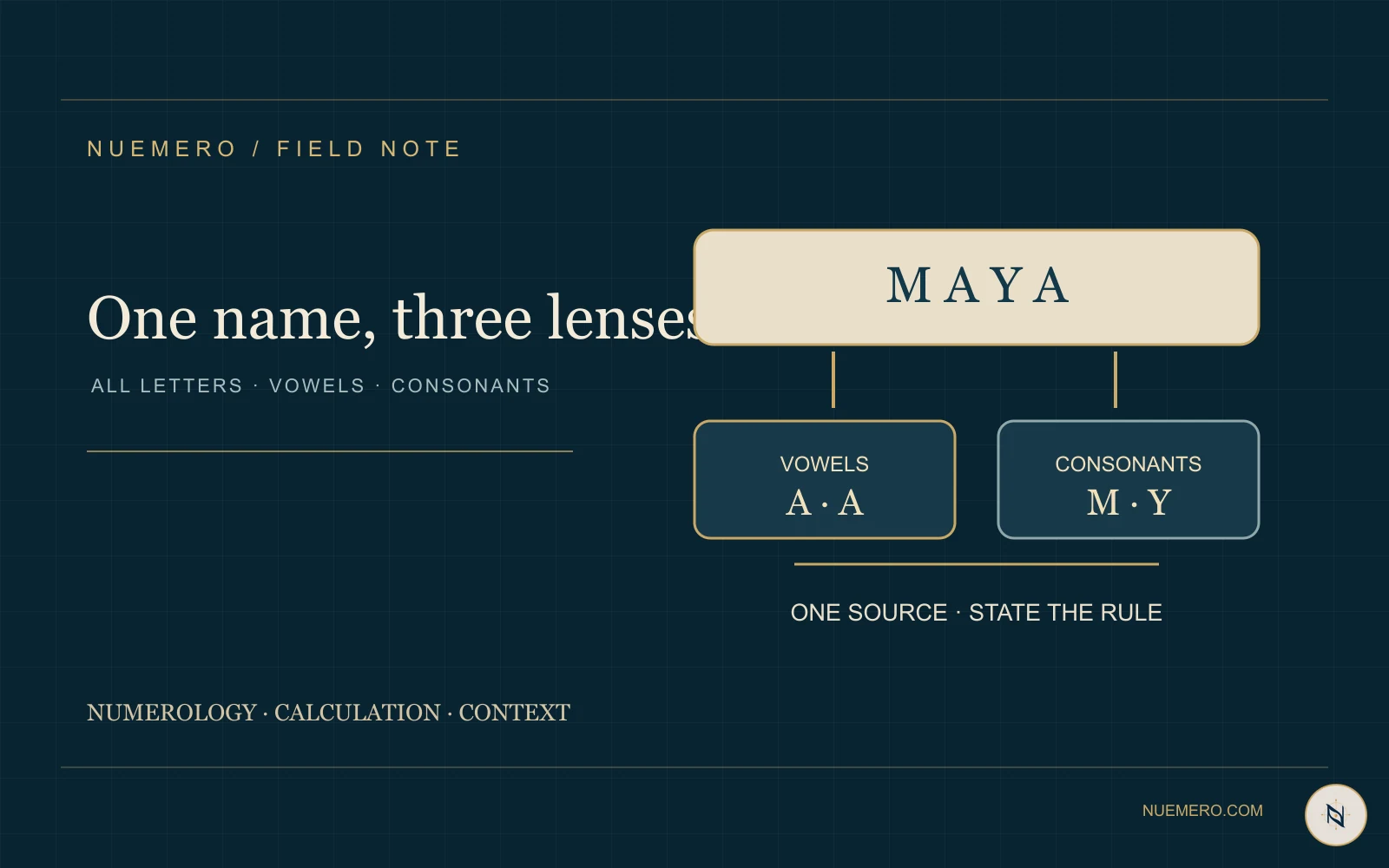
For fictional MAYA under the common Pythagorean table, M=4, A=1, Y=7, A=1. The all-letter Expression total is 13 → 4. If this source treats A as the only vowel in this example, Soul Urge is 1+1=2; consonants M+Y give 4+7=11. A system may retain 11 or reduce it to 2. The example exposes the method choice; it does not establish anyone’s inner nature.
Fictional name · MAYA
4 + 1 + 7 + 1 = 13 → 41 + 1 = 24 + 7 = 11 (some reduce to 2)Choose a name form and read with context
A full legal name, birth name, current name, and nickname can produce different calculations. Choose the one the source asks for and say why. Do not combine pieces of several spellings just to obtain a preferred number. If a tool hides Y handling or reductions, the result cannot be reproduced reliably.
Use the three labels as optional questions—what do I express, what do I value, and what do others notice? Check the answers against your own experience and feedback. They are not clinical assessments, hiring tools, or grounds to judge another person.
Method and limits
This guide describes the conventions stated above and the way Nuemero’s current calculator works. Numerology interpretations are traditional beliefs, not scientific predictions. Check a source’s method before applying its meanings.
Read Nuemero’s full methodQuick answers
Frequently asked questions
Is the Expression number the same as Life Path?
No. In common systems Expression is calculated from name letters, while Life Path is calculated from birth-date digits. State the specific convention for each.
Is Y a vowel for Soul Urge?
Sources vary. Some decide by sound in the name; others use a fixed letter rule. Show the decision and explain how it affects the count.
Which name should I calculate?
Use the exact form required by the named method—often a full birth name in some books—and label any comparison clearly. The conventions are not universal.
Read further
Sources and method notes
- Nuemero method note · Name-number conventionsNuemero discloses the alphabet table and reduction convention used by its calculator; other authors may use different rules.
Sources document calculation conventions and claims made within their traditions. They are not evidence that numerology predicts real-world outcomes.
Name numerology·7 min
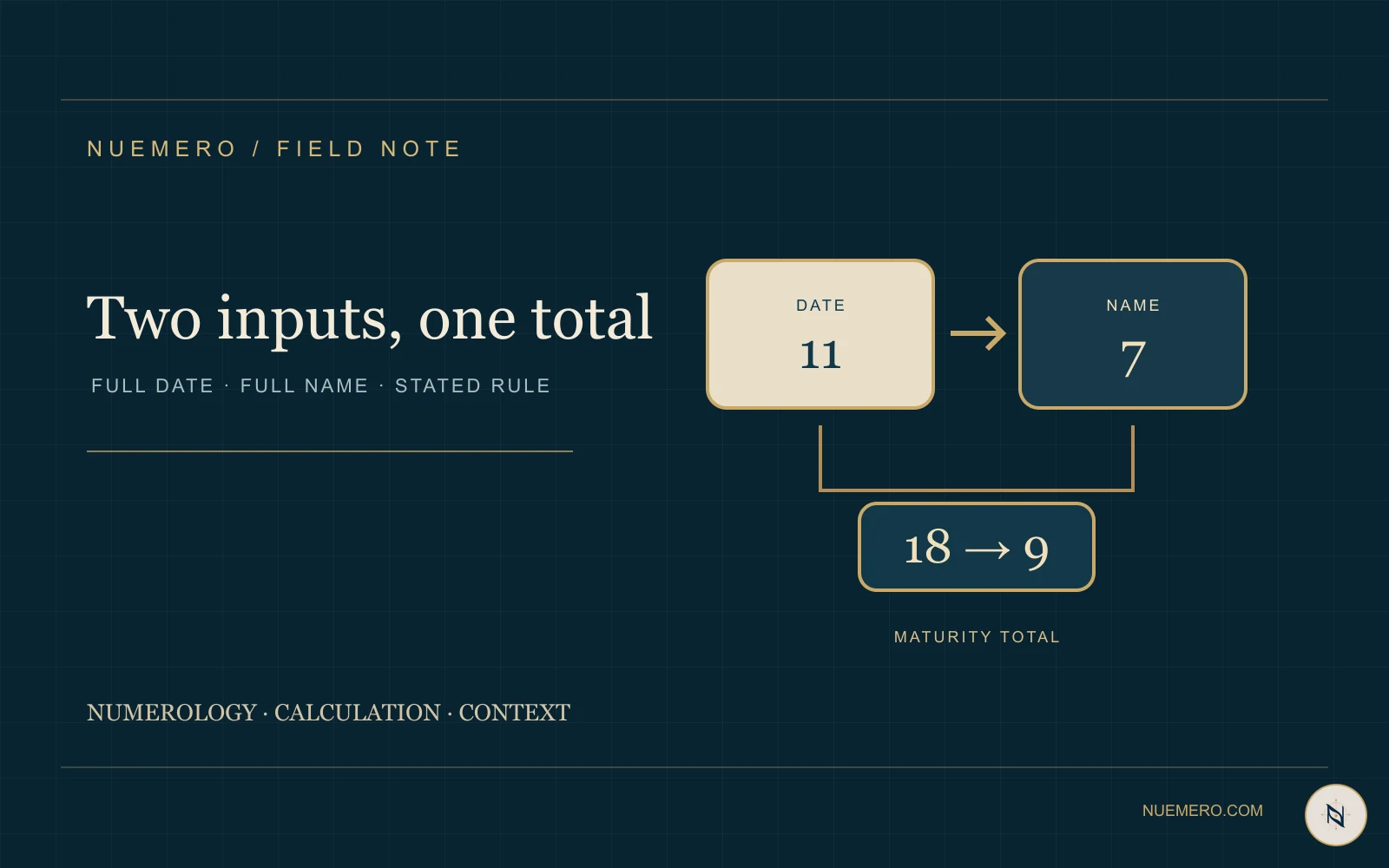
Maturity Number: Add Life Path and Expression with a Worked Example
Calculate a Maturity Number from a declared Life Path and Expression method, verify the example for a fictional birth date and name, and understand why chart conventions change the inputs.
Read the guide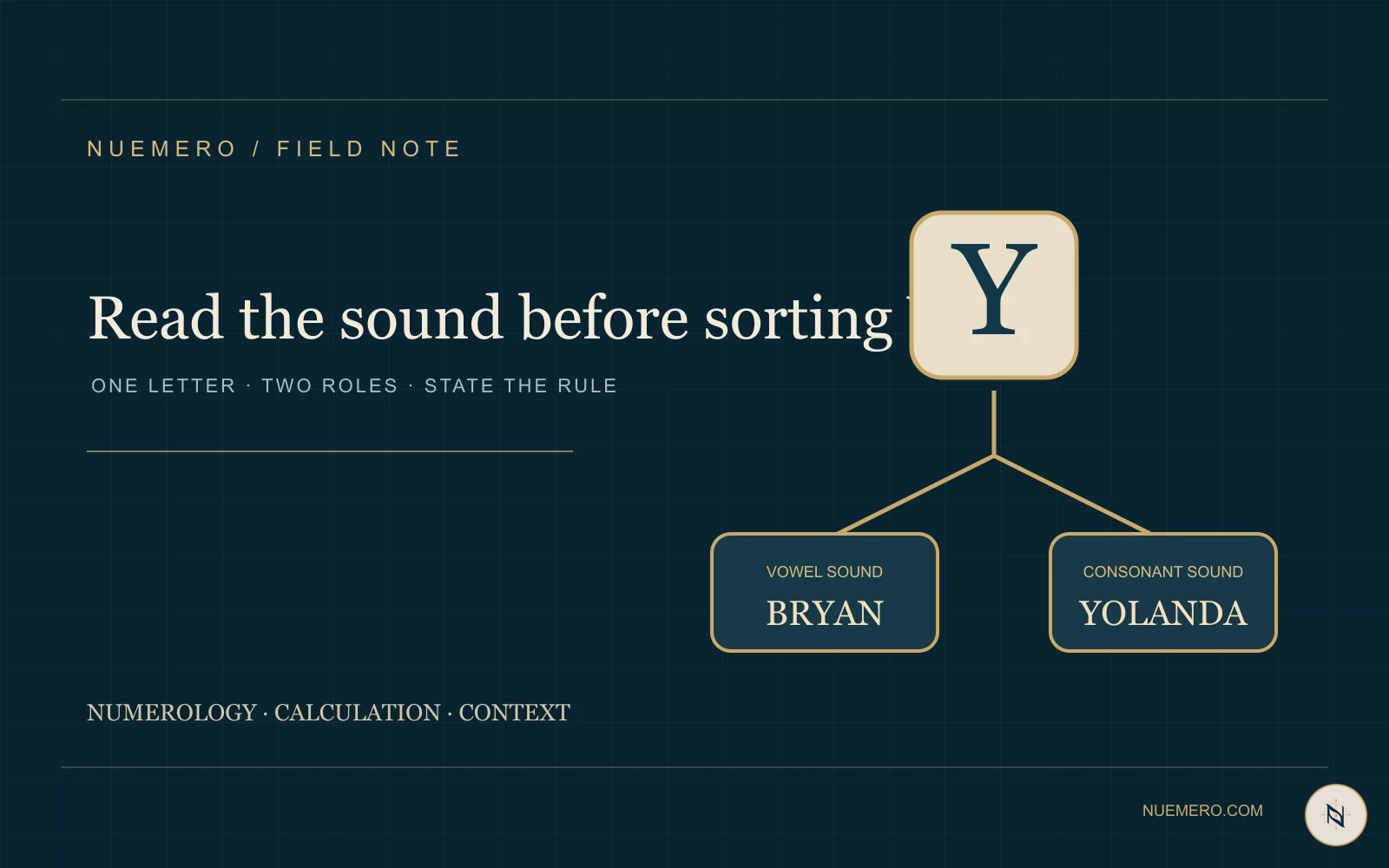
Name numerology·7 min
Is Y a Vowel or Consonant in Name Numerology? Check the Sound Rule
See how one practitioner convention classifies Y by its spoken role, why that changes vowel and consonant totals, and why a Latin-letter rule should not replace linguistic analysis.
Read the guide