
Name numerologyNumerology guide
Hindi Name Numerology: Devanagari, Roman Spelling, and the Chosen Table
Learn why Latin-letter Pythagorean and Chaldean charts cannot be applied directly to Devanagari, how transliteration changes a name input, and what to document before comparing totals.
The short answer
Start here
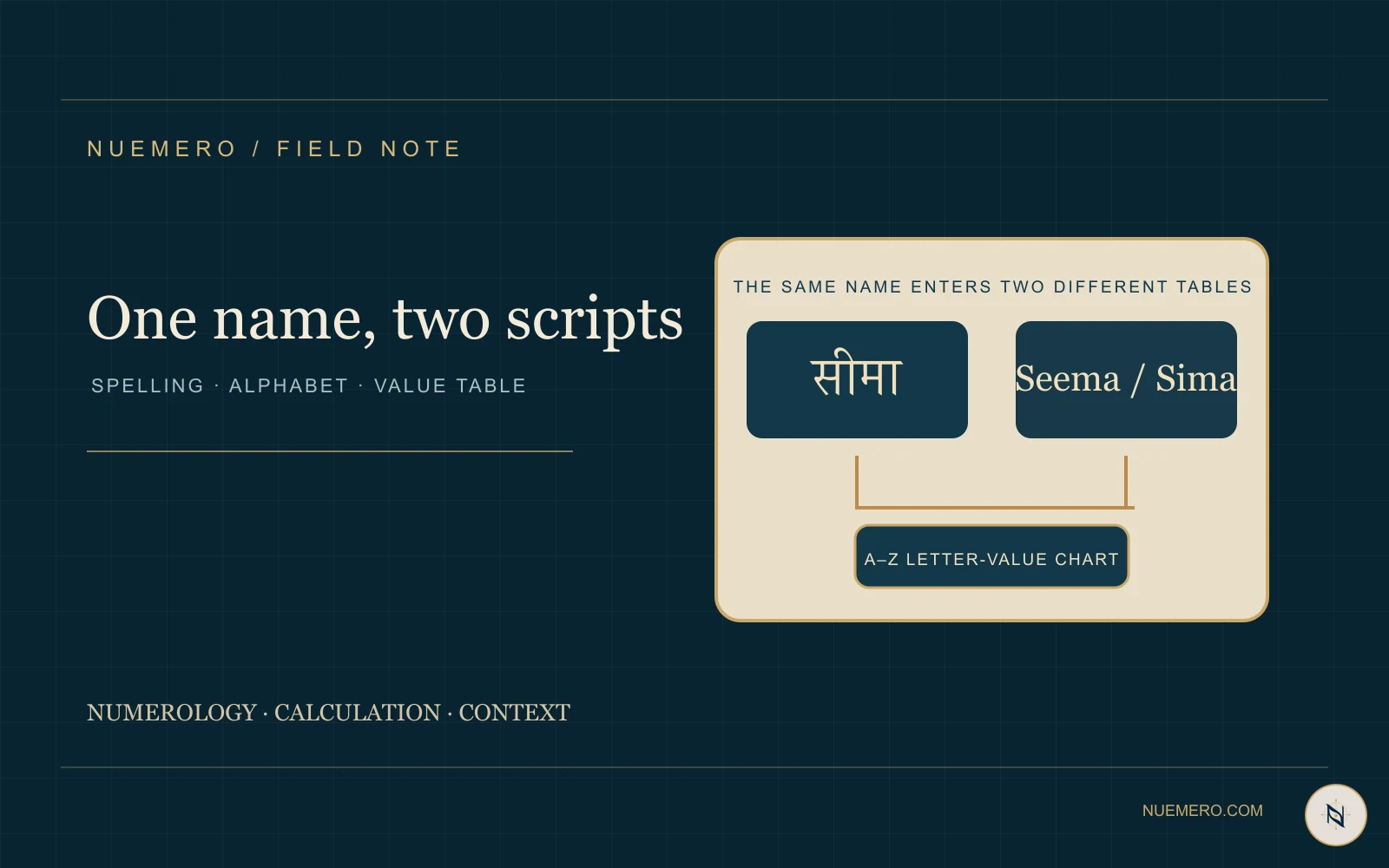
A Latin-letter numerology chart assigns values to Roman letters; it does not automatically define values for Devanagari characters. If a Hindi name is transliterated first, choices such as long-vowel spelling, doubled consonants, or a familiar versus technical romanization can change the letters and therefore the total. Record the original script, the exact Roman spelling, the alphabet table, and the reduction rule. Treat the result as specific to that declared spelling and system.
Key takeaways
A Pythagorean or Chaldean A–Z table is a Roman-alphabet mapping, not a universal script-independent name formula.
Different valid transliterations of one Hindi name can produce different Roman-letter inputs.
Record the chosen spelling and table before comparing a name number across tools.
A changed total reflects changed input or rules; it does not prove one spelling is better for a person.
On this page
A letter table only works for its stated alphabet
Modern Western Pythagorean charts and common Chaldean charts map Roman A–Z letters to numbers. To use one with a Hindi name, a calculator generally needs a Roman spelling first. Unless a tool declares a separate Devanagari mapping, typing or displaying the name in Devanagari does not explain how those Roman-letter values were assigned.
The Library of Congress Hindi romanization table documents one formal way to represent Hindi in Roman script for cataloging. Everyday spellings often use other conventions. That reference is useful for understanding why spellings vary; it is not a numerology rule and does not choose the spelling a family must use.
A spelling change changes the calculation input
Take the Hindi name सीमा. Common Roman renderings include “Seema” and “Sima.” In the Pythagorean A–Z table, Seema is 1 + 5 + 5 + 4 + 1 = 16 → 7, while Sima is 1 + 9 + 4 + 1 = 15 → 6. The totals differ even though the Devanagari name and intended pronunciation have not changed. Another letter table can produce another pair of totals.
A transparent report should show the exact spelling it counted, the system’s letter values, the unreduced compound total, and every reduction. If a service shows only one final digit, ask whether it used a transliteration rule or silently normalized the spelling.
Compare inputs before meanings
सीमाSeema → S · E · E · M · ASima → S · I · M · ASeema: 16 → 7 · Sima: 15 → 6Compare names without prescribing a spelling
For a useful comparison, keep a small record: the name in its original script, the exact Roman spelling entered, the chosen system, the source of the letter table, and the reduction rule. Compare like with like. Do not treat transliteration as a neutral clerical step when it changes the letters a calculator processes.
A numerology result cannot establish that a person should alter a culturally meaningful name. Consider pronunciation, identity, family preference, documents, and real-world consequences first. If you explore the tradition, keep the calculation an optional reflection—not a verdict about a name or its bearer.
Method and limits
This guide describes the conventions stated above and the way Nuemero’s current calculator works. Numerology interpretations are traditional beliefs, not scientific predictions. Check a source’s method before applying its meanings.
Read Nuemero’s full methodQuick answers
Frequently asked questions
Can I calculate a Hindi name directly in Devanagari?
Only if the calculator clearly defines a Devanagari character-to-number system. Standard A–Z Pythagorean and Chaldean tables need a Roman-letter input; a Devanagari display alone does not reveal that mapping.
Why do Seema and Sima get different results?
They contain different Roman letters. A letter-value chart counts the spelling entered, so an added or changed vowel changes the sum. State the transliteration and chart before interpreting a result.
Which spelling should I use for numerology?
Use the exact spelling convention specified by the method you are comparing, and document it. There is no calculation-based proof that one transliteration is inherently better for a person.
Is transliteration the same as translation?
No. Transliteration represents a word from one script in another script; translation expresses its meaning in another language. Numerology letter tables generally process the written letters, so the distinction matters.
Read further
Sources and method notes
- Library of Congress: Hindi Romanization TableA formal Hindi-to-Roman-script reference; it is linguistic documentation, not a numerology letter-value convention.
- Library of Congress: Romanization and search strategiesExplains that technical and conventional South Asian romanizations can differ, including the use of diacritics.
- Nuemero name-number methodologyCheck the Roman-letter tables and spelling inputs currently implemented in Nuemero.
Sources document calculation conventions and claims made within their traditions. They are not evidence that numerology predicts real-world outcomes.

Name numerology·7 min
How Indian Names Are Transliterated for Latin-Letter Numerology
Learn why one Devanagari or regional-script name can have multiple Latin spellings, how that changes a letter-based total, and how to document the choice fairly.
Read the guide
Name numerology·9 min
Should You Change Your Name Spelling for Numerology? A Practical Decision Guide
See how a spelling change alters a name-number calculation, what numerology cannot promise, and which identity, legal, cultural, and everyday checks matter before you decide.
Read the guide