
Lo Shu numerologyNumerology guide
Lo Shu Grid Calculator: Build a Grid From Your Birth Date
Build a Lo Shu grid from a sample birth date. See the fixed 4–9–2 / 3–5–7 / 8–1–6 layout, repeated digits, zero rule, and every step of the count.
The short answer
Start here
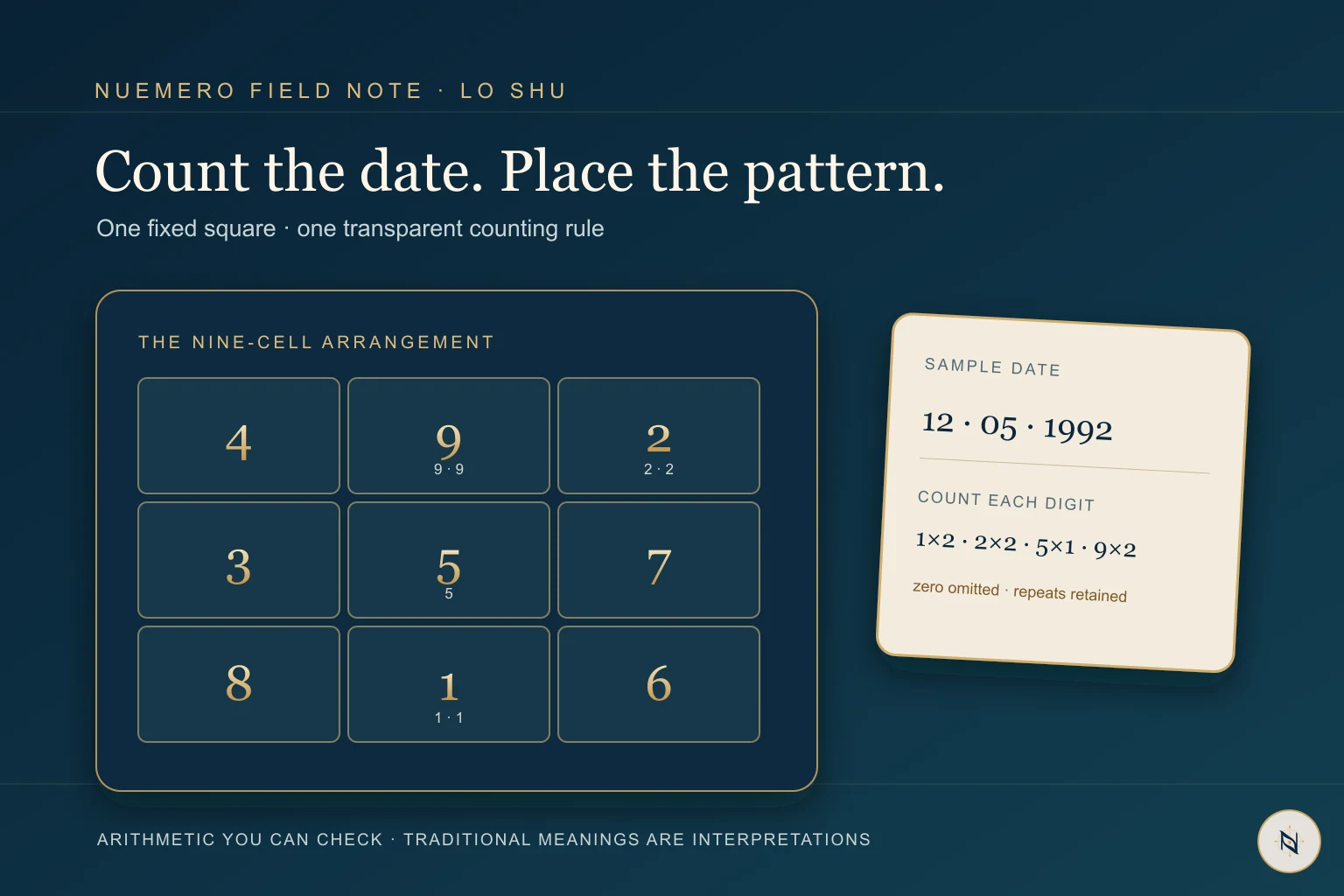
A Lo Shu grid places the non-zero digits of a birth date into a fixed nine-cell square: 4–9–2 / 3–5–7 / 8–1–6. Count every occurrence rather than placing digits in date order. For the fictional date 12 May 1992, this convention gives two 1s, two 2s, one 5, and two 9s. Different practitioners may use different date or zero rules, so name the convention when comparing grids.
Key takeaways
Use the fixed arrangement 4–9–2 / 3–5–7 / 8–1–6; the grid is not filled in birth-date order.
Under Nuemero’s stated convention, count each non-zero digit in the Gregorian date and show repeats as repeated entries.
Zero is omitted from the nine cells in this calculator; other authors may explain or handle it differently.
The grid is a numerology tradition for reflection, not a validated measure of personality, ability, or future events.
On this page
Start with the fixed nine-cell layout
A Lo Shu grid is commonly shown as a three-by-three square with the positions 4–9–2 across the top, 3–5–7 in the middle, and 8–1–6 along the bottom. Each position belongs to a number; a birth date supplies the entries. Keep this arrangement fixed when you draw or compare a grid.
The layout comes from the Lo Shu magic-square tradition, while the practice of mapping birth-date digits into it is a later numerology use. Authors vary in their counting, zero, and interpretation rules. This guide states Nuemero’s operational convention so the arithmetic can be reproduced.
Worked example: 12 May 1992
Use this fictional date in day–month–year order. Write the digits as 1, 2, 0, 5, 1, 9, 9, 2. Count each occurrence. In this convention, zero is not placed in a cell, repeated digits are retained, and no digit is reduced to a single root first.
Count, then place in the fixed grid
1 · 2 · 0 · 5 · 1 · 9 · 9 · 21 × 2 · 2 × 2 · 5 × 1 · 9 × 2 · zero omitted4: — | 9: 9, 9 | 2: 2, 23: — | 5: 5 | 7: —8: — | 1: 1, 1 | 6: —Make your own grid in four steps
Keep the date input, counting rule, and layout separate. That makes it easier to spot an input mistake before discussing any traditional interpretation.
- Write the full Gregorian birth date with an unambiguous month; do not infer whether a numeric date is day–month or month–day.
- List the date’s digits and apply one declared zero rule. Nuemero omits zero from the nine cells.
- Count each occurrence of 1 through 9. Keep repeats; do not add or reduce repeated entries.
- Place the counts in 4–9–2 / 3–5–7 / 8–1–6 order, then compare the result with the calculator’s visible trace.
What the grid can show—and what it cannot establish
The grid gives a compact picture of which digits appear, repeat, or are absent under a chosen rule. Numerology authors attach traditional themes to those patterns, but the themes differ and are not conclusions measured by the arithmetic. An absent cell does not diagnose a weakness, and a repeated digit does not prove a fixed talent.
If you use the grid for reflection, turn a theme into a question you can check against your lived experience. Avoid buying a remedy or making health, money, education, career, or relationship decisions because of a grid. For a comparison, first confirm both people used the same birth date, zero convention, and cell layout.
Method and limits
This guide describes the conventions stated above and the way Nuemero’s current calculator works. Numerology interpretations are traditional beliefs, not scientific predictions. Check a source’s method before applying its meanings.
Read Nuemero’s full methodQuick answers
Frequently asked questions
What is the correct Lo Shu grid order?
The commonly used arrangement is 4–9–2 across the top, 3–5–7 in the middle, and 8–1–6 across the bottom. State the tradition or source you follow because interpretations and some construction rules vary.
Do I put my birth-date digits into the grid from left to right?
No. Count the date digits, then place each number in its fixed cell. The order of digits in the written date does not change the grid layout.
Should zero go into a Lo Shu grid?
Nuemero’s calculator omits zero from the nine cells. Other writers may discuss zero differently, so check the stated rule before comparing results.
Should repeated digits be reduced or removed?
In Nuemero’s convention, each occurrence is counted and repeated digits remain visible. Do not reduce the date to one number before making the grid.
Can a Lo Shu grid tell me my personality or future?
The grid is a numerology tradition, not a validated personality test or reliable forecast. Treat meanings as optional reflection prompts, not as a diagnosis or a decision rule.
Read further
Sources and method notes
- Nuemero Lo Shu calculatorThe product’s current cell order, date-digit counting, repeat handling, and zero convention.
- Nuemero calculation methodologyProduct-specific calculation rules and the distinction between arithmetic and interpretation.
- W. S. Andrews, Magic Squares and Cubes (1908)A historical mathematical treatment of magic squares; it does not validate modern birth-date interpretations.
Sources document calculation conventions and claims made within their traditions. They are not evidence that numerology predicts real-world outcomes.
Lo Shu numerology·9 min
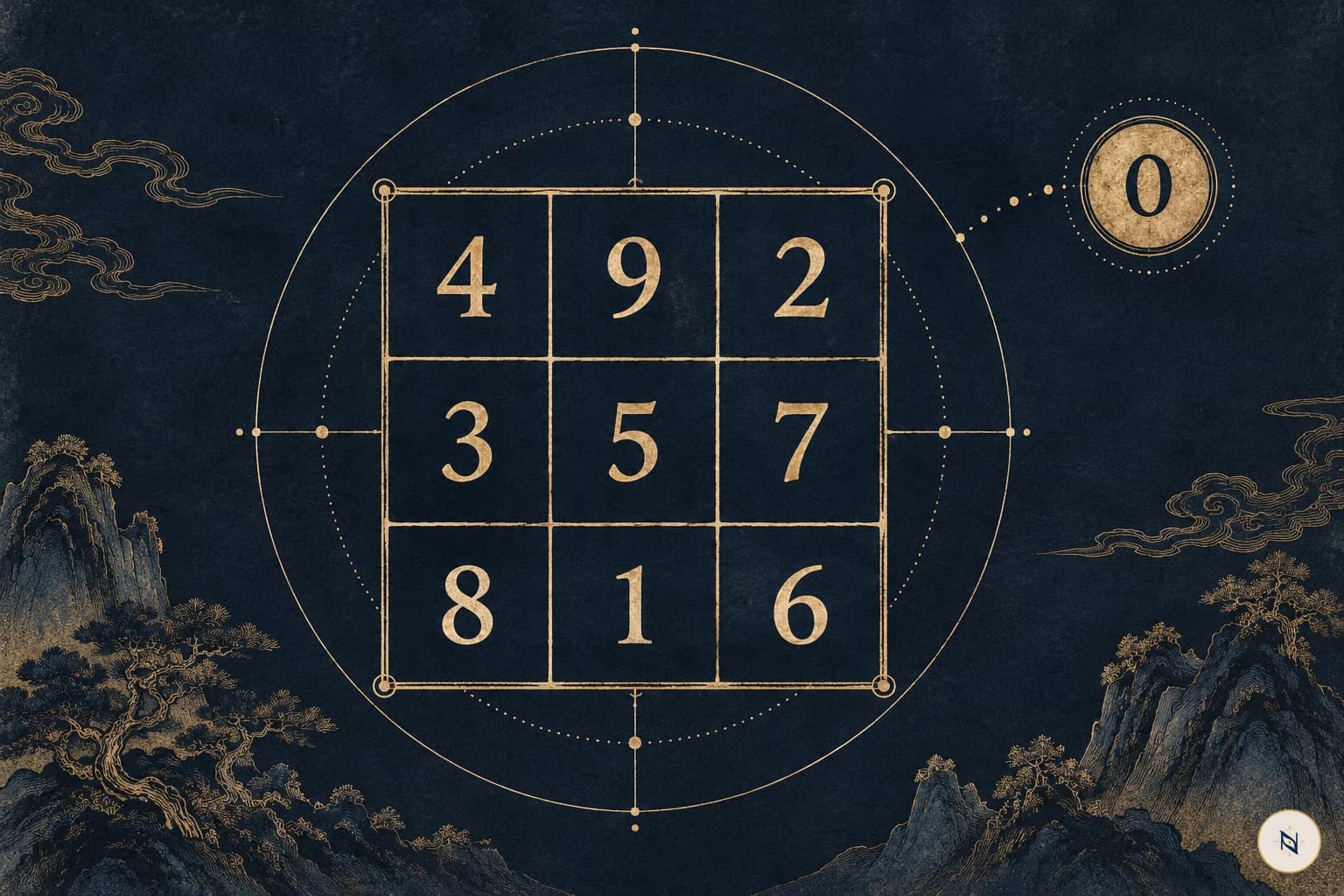
Zero in a Lo Shu Grid: What to Do With It
See why many birth-date Lo Shu layouts omit zero from the nine cells, how to keep the rule consistent, and why zero is not a missing 10th position.
Read the guide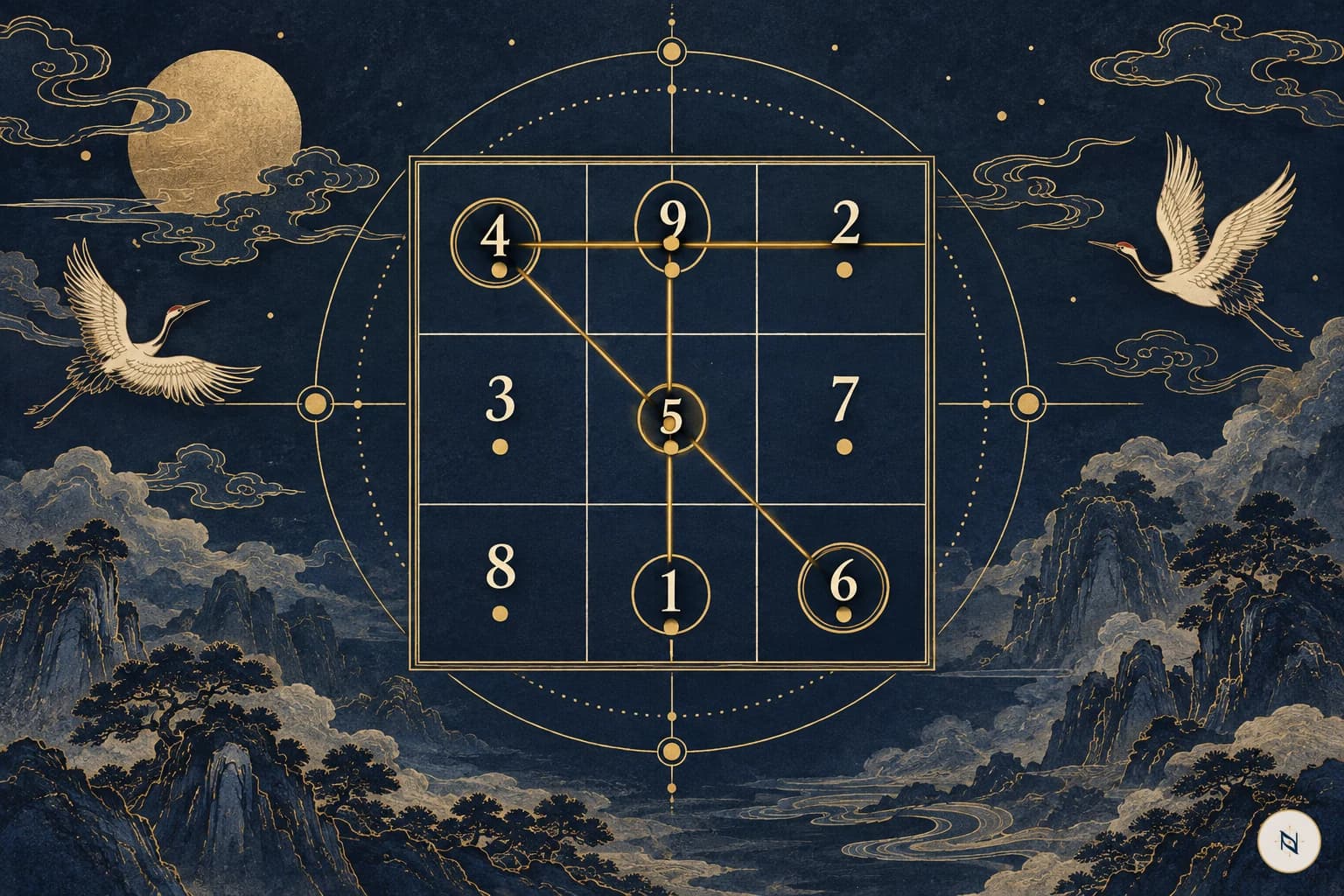
Lo Shu numerology·8 min
Lo Shu Grid Lines: Rows, Columns, and Diagonals Explained
Map the nine-cell arrangement, identify its eight geometric lines, and separate a complete line from the traditional labels attached to it.
Read the guide