
Lo Shu numerologyNumerology guide
Zero in a Lo Shu Grid: What to Do With It
See why many birth-date Lo Shu layouts omit zero from the nine cells, how to keep the rule consistent, and why zero is not a missing 10th position.
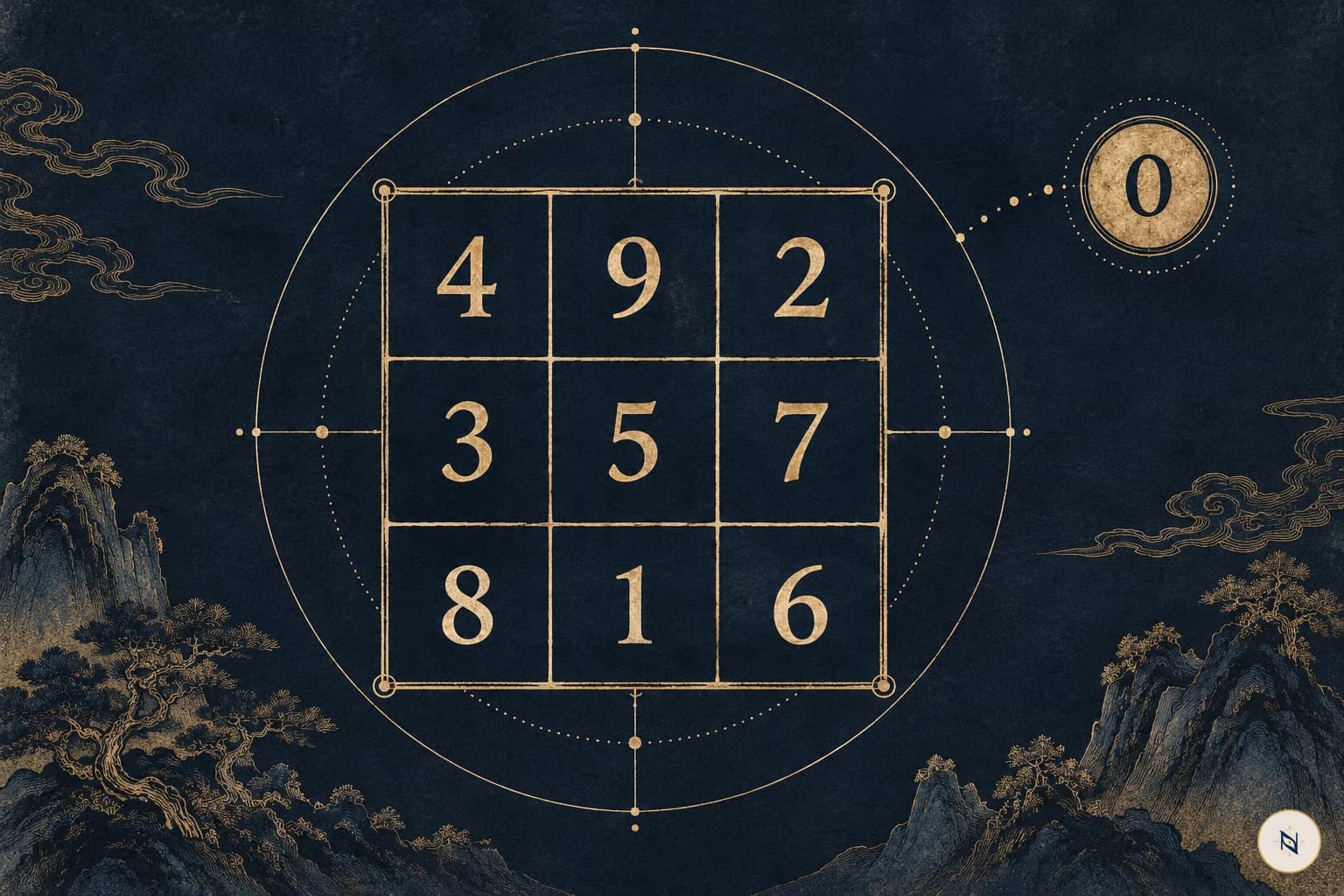
The short answer
Start here
The familiar Lo Shu birth-date grid has nine cells for digits 1 through 9. In the convention used here, zero is retained in the written date but is not placed in a cell or counted as a missing cell. Some practitioners add other calculations, so name the construction rule before comparing results. The choice is a convention, not evidence about a person.
Key takeaways
The nine-cell square represents 1–9; this convention does not assign zero a cell.
Keep the full date visible, even when zero is omitted from the grid tally.
Compare zero and repeat policies before comparing two charts.
A zero rule is a construction choice, not a personal prediction.
On this page
Why the square has no zero cell
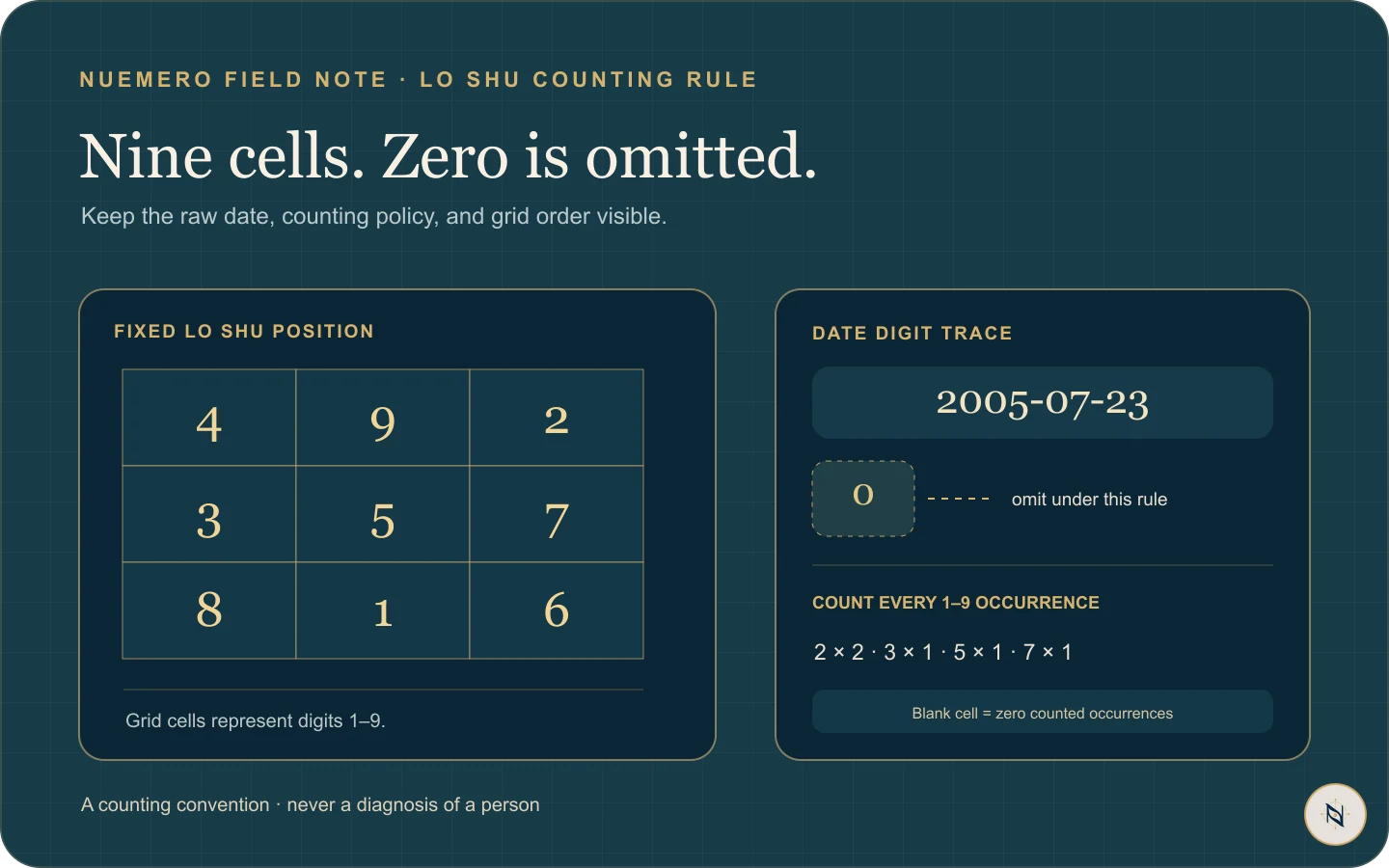
The standard square has nine positions: 4–9–2 / 3–5–7 / 8–1–6. Since zero has no position in that arrangement, a common date-grid convention records it in the source date but leaves it out of cell counts. State whether your tool follows this convention or adds a separate zero treatment.
Keep zero visible in the example
For 10 October 2001, write the full date digits as 1, 0, 1, 0, 2, 0, 0, 1. Under the stated convention, the grid receives 1 three times and 2 once; zeros remain in the input record but not in the square. Another calculator may make a different choice—check its rules rather than silently merging the outputs.
Compare the rule, not the label
Keep three items together: the unaltered date, the cell order, and the zero/repetition policy. That makes a chart reproducible. Do not interpret a zero as an empty cell, a hidden trait, or a reason to buy a correction.
- Open the Lo Shu calculator and confirm the order and zero treatment it displays.
- If another source includes zero, ask what extra formula it applies.
- Save the rule beside the chart so later readings use the same construction.
Method and limits
This guide describes the conventions stated above and the way Nuemero’s current calculator works. Numerology interpretations are traditional beliefs, not scientific predictions. Check a source’s method before applying its meanings.
Read Nuemero’s full methodQuick answers
Frequently asked questions
Does zero go in a Lo Shu cell?
In the nine-cell birth-date convention used here, no. The square represents 1–9; state any alternate rule explicitly.
Should I remove zero from my written birth date?
Keep the original date intact. The convention may omit zero only from the cell tally, not from your source record.
Is zero the same as a missing number?
No. Zero is not one of the nine cells in this layout. A missing cell refers to a digit from 1–9 with no count.
Why do calculators handle zero differently?
They may use different construction rules or add derived values. Compare the documented input and formula before comparing grids.
Read further
Sources and method notes
- Mathematical Association of America · History of magic squaresHistorical context for the 3×3 square; it does not validate modern numerology interpretations.
Sources document calculation conventions and claims made within their traditions. They are not evidence that numerology predicts real-world outcomes.
Lo Shu numerology·7 min
What Does Zero Do in a Lo Shu Grid? The Counting Rule Explained
See how Nuemero handles zero when building a Lo Shu grid, why a blank cell is not the same as a missing birth date, and what to compare when two tools differ.
Read the guide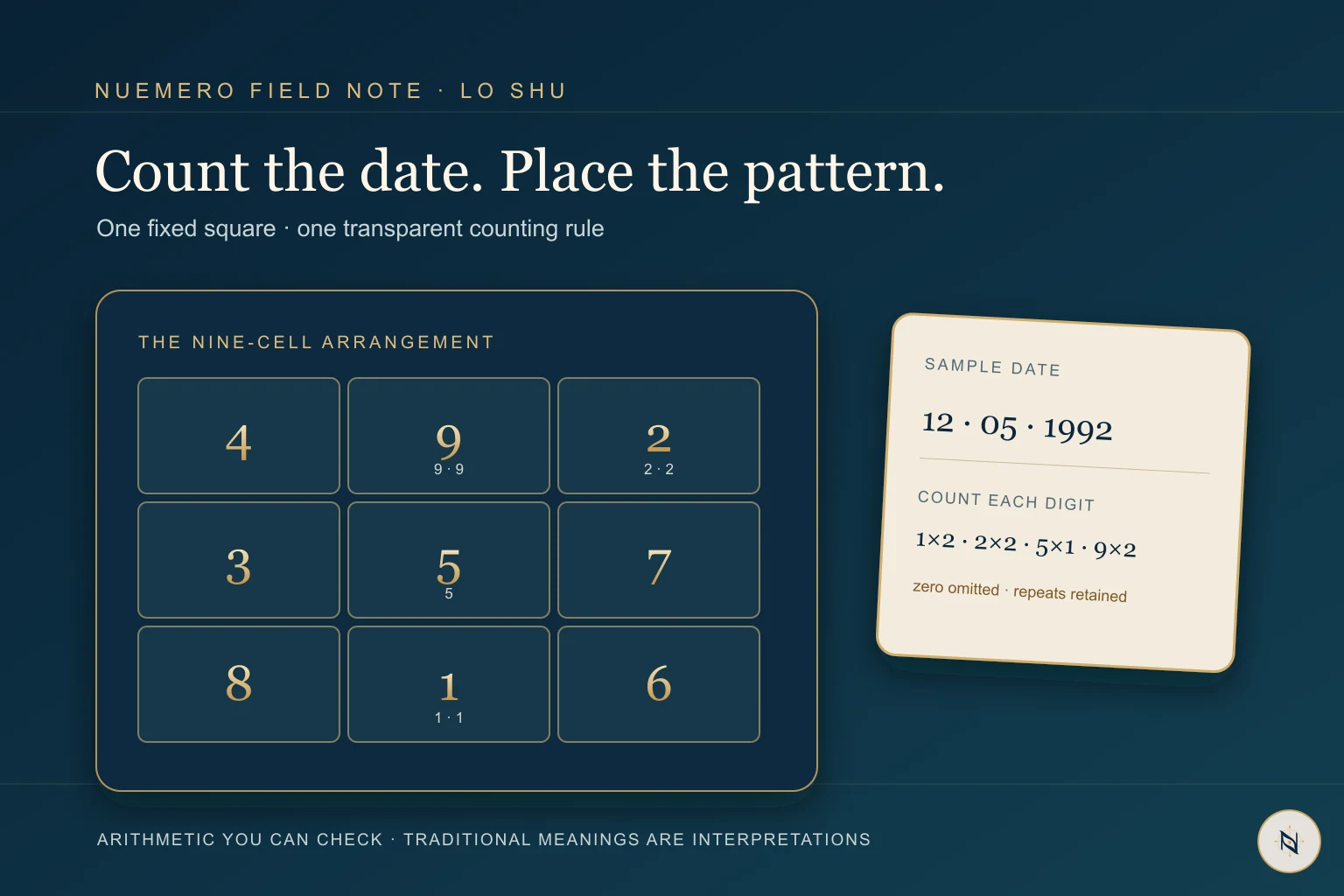
Lo Shu numerology·6 min
Lo Shu Grid Calculator: Build a Grid From Your Birth Date
Build a Lo Shu grid from a sample birth date. See the fixed 4–9–2 / 3–5–7 / 8–1–6 layout, repeated digits, zero rule, and every step of the count.
Read the guide