
Lo Shu numerologyNumerology guide
What Does Zero Do in a Lo Shu Grid? The Counting Rule Explained
See how Nuemero handles zero when building a Lo Shu grid, why a blank cell is not the same as a missing birth date, and what to compare when two tools differ.
The short answer
Start here
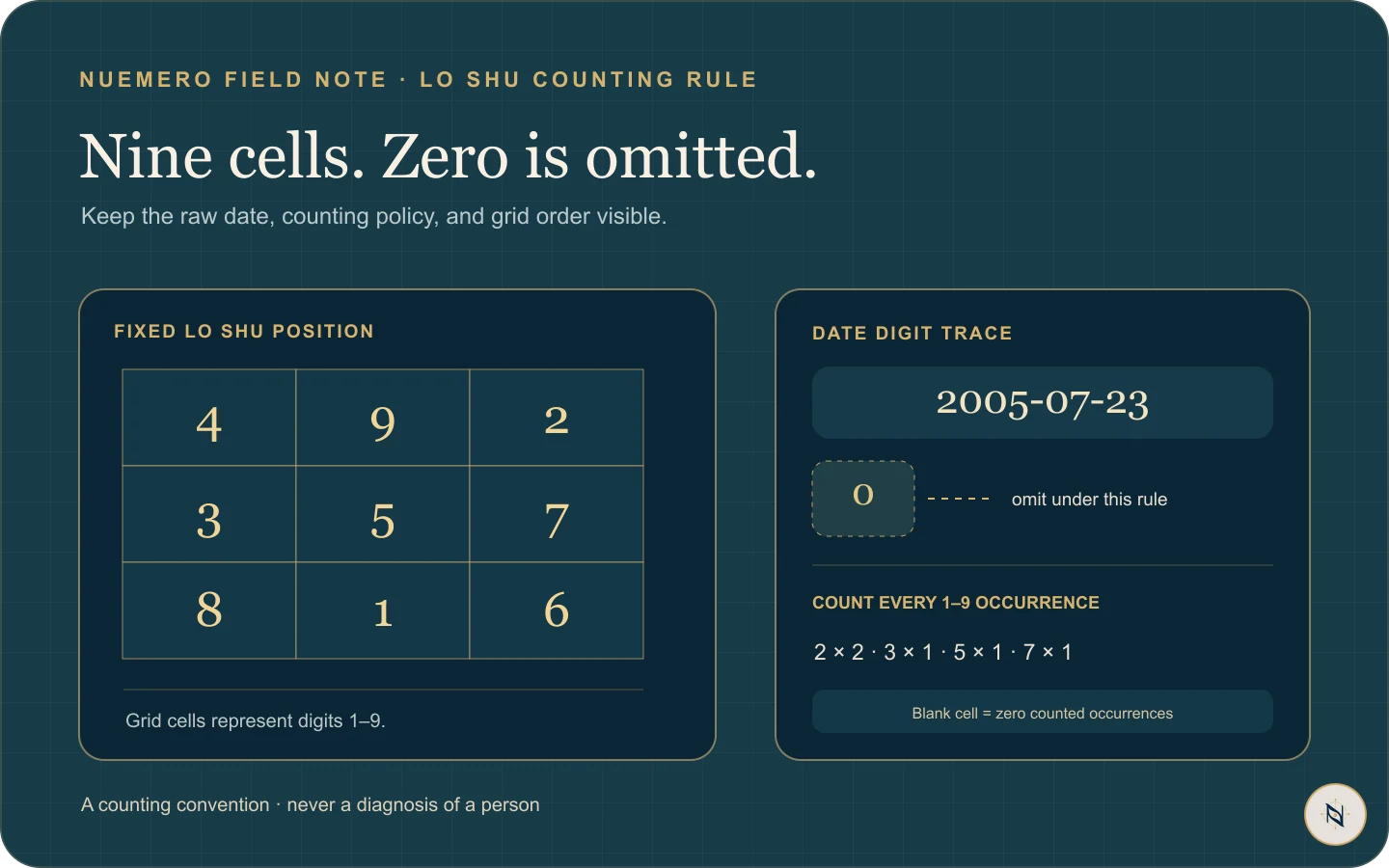
A Lo Shu grid has nine cells associated with digits 1 through 9, so zero has no numbered cell in that layout. Nuemero omits zero, counts every occurrence of digits 1–9, and keeps repeats visible. This is a product convention; if another teacher or calculator handles zero differently, compare the stated rules and the raw date digits. An empty cell means no counted occurrence of that digit under the chosen rule—it does not mean the date is incomplete or that a person lacks a proven quality.
Key takeaways
The fixed nine-cell layout has positions for 1–9; this Nuemero calculator omits zero.
A zero in the date does not create a tenth cell or shift the other digits.
An empty cell is a zero count under one rule, not a diagnosis or defect.
When tools disagree, compare date format, zero policy, repeat policy, and grid order.
On this page
Why the nine-cell grid has no zero position
The common Lo Shu arrangement uses nine numbered places in a fixed order: 4–9–2 / 3–5–7 / 8–1–6. Because the cells correspond to 1 through 9, a practitioner must state what happens to a zero in the written birth date. Nuemero’s rule is to omit it; zero is not turned into 9 or placed outside the grid as a counted digit.
This rule concerns grid construction only. It does not erase the zero from the actual date, alter a calendar date, or carry a judgment about the person whose date is entered.
Keep the raw digits and the grid tally separate
Write the birth date in an unambiguous format, list its digits, and mark each zero as omitted under this convention. Then count each occurrence of 1–9 without reducing the complete date to one root. For example, 2005-07-23 contains three zeroes; none occupies a cell, while each occurrence of 2, 3, 5, and 7 is counted. The product displays repeated digits rather than collapsing them.
Do not confuse an absent digit with zero as a written character. If a date contains no 6, the 6 cell has no counted entry; that is a different observation from seeing zero in the date string. The first is a grid tally, the second is an input digit handled by the declared policy.
Example under Nuemero’s current rule
2005-07-23Omit all four zeroes2 × 2 · 3 × 1 · 5 × 1 · 7 × 14–9–2 / 3–5–7 / 8–1–6Compare conventions before comparing meanings
If two grids differ, check the exact date format and calendar first. Then compare whether zero is omitted or mapped, how repeated digits are handled, and whether the calculator reduces any date component before placement. Finally check that both use the same cell order. The digits and trace should be available before interpreting a line or empty position.
Treat any traditional meaning assigned to zero or an empty cell as an interpretation, not proof of a personal strength, weakness, or fate. Be cautious when someone uses fear or guaranteed paid remedies to sell a correction for a blank position.
Method and limits
This guide describes the conventions stated above and the way Nuemero’s current calculator works. Numerology interpretations are traditional beliefs, not scientific predictions. Check a source’s method before applying its meanings.
Read Nuemero’s full methodQuick answers
Frequently asked questions
Does the Lo Shu grid count zero?
Nuemero’s current grid has cells for digits 1–9 and omits zero. Other practitioners may state a different convention, so inspect the rules before comparing.
Does a zero in my date mean I have a missing Lo Shu number?
No. Zero is a character in the written date and is omitted by this product’s rule. A missing number is a 1–9 cell with no counted occurrences after applying the chosen counting rule.
Should I reduce the whole date before making the grid?
Not under Nuemero’s Lo Shu convention. It counts eligible date digits individually, omits zero, retains repeated occurrences, and places the counts in the fixed grid.
What should I check if another calculator shows a different grid?
Compare the full date, date order, calendar, zero policy, repeat-count rule, any prior reduction, and nine-cell order. A displayed digit trace makes this much easier.
Read further
Sources and method notes
- Nuemero Lo Shu calculatorView the date digits, fixed grid order, zero policy, and repeated entries.
- Nuemero methodologyRead the current product convention and its interpretation boundary.
Sources document calculation conventions and claims made within their traditions. They are not evidence that numerology predicts real-world outcomes.
Lo Shu numerology·9 min
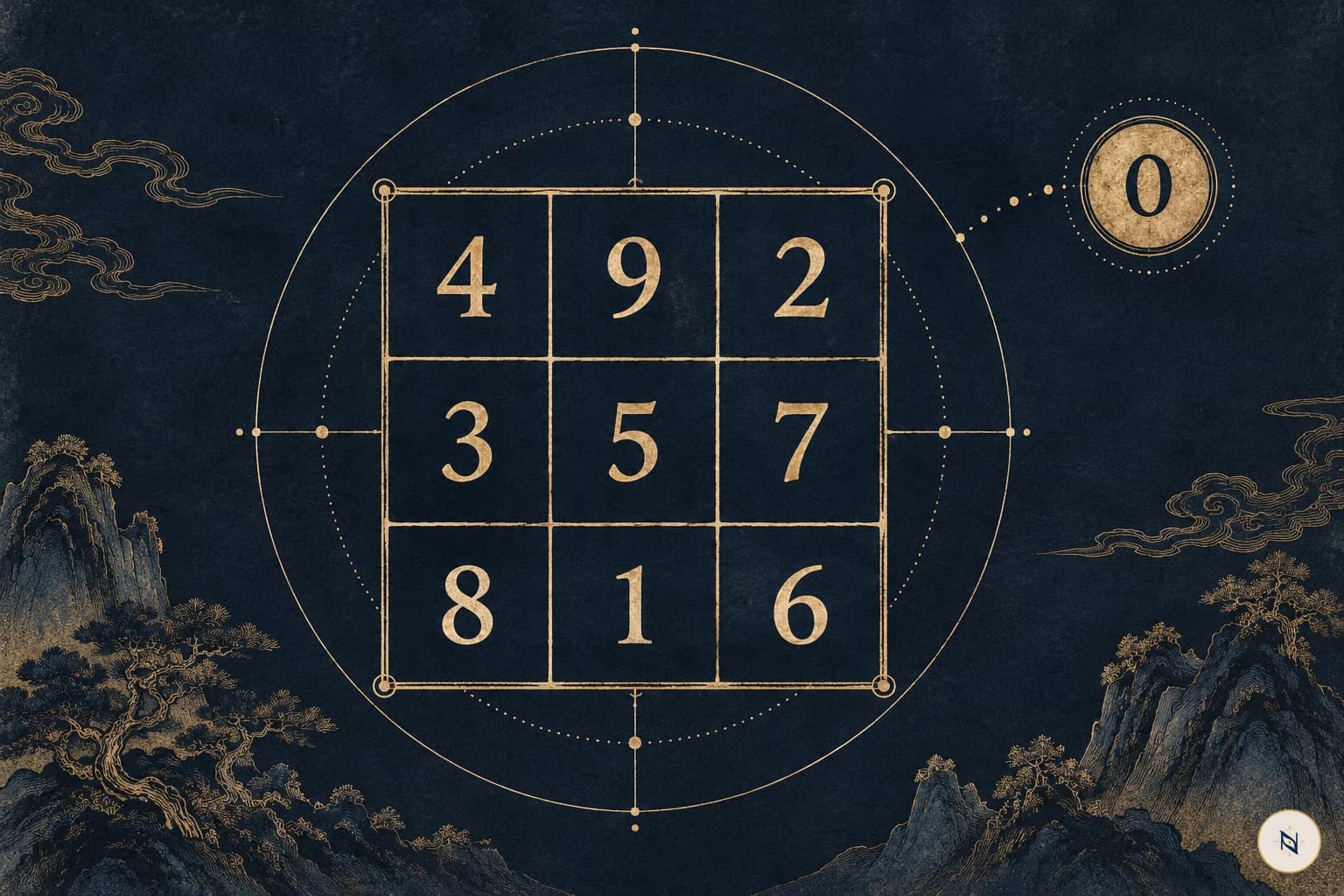
Zero in a Lo Shu Grid: What to Do With It
See why many birth-date Lo Shu layouts omit zero from the nine cells, how to keep the rule consistent, and why zero is not a missing 10th position.
Read the guide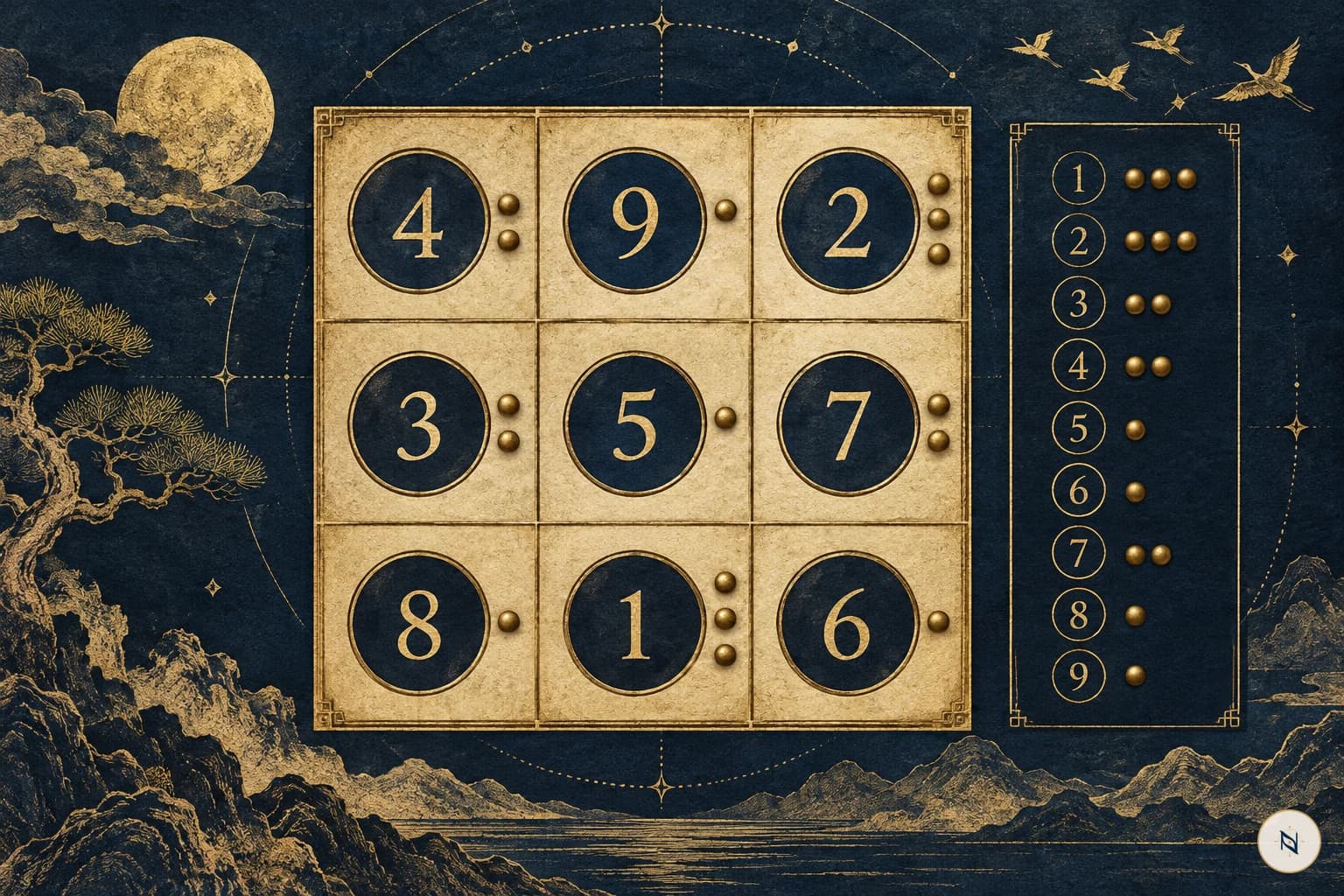
Lo Shu numerology·7 min
Repeated Numbers in a Lo Shu Grid: How the Counts Work
Learn why repeated date digits stay visible, how to check a cell tally, and why a larger count is not proof of a stronger trait.
Read the guide