
Lo Shu numerologyNumerology guide
Repeated Numbers in a Lo Shu Grid: How the Counts Work
Learn why repeated date digits stay visible, how to check a cell tally, and why a larger count is not proof of a stronger trait.
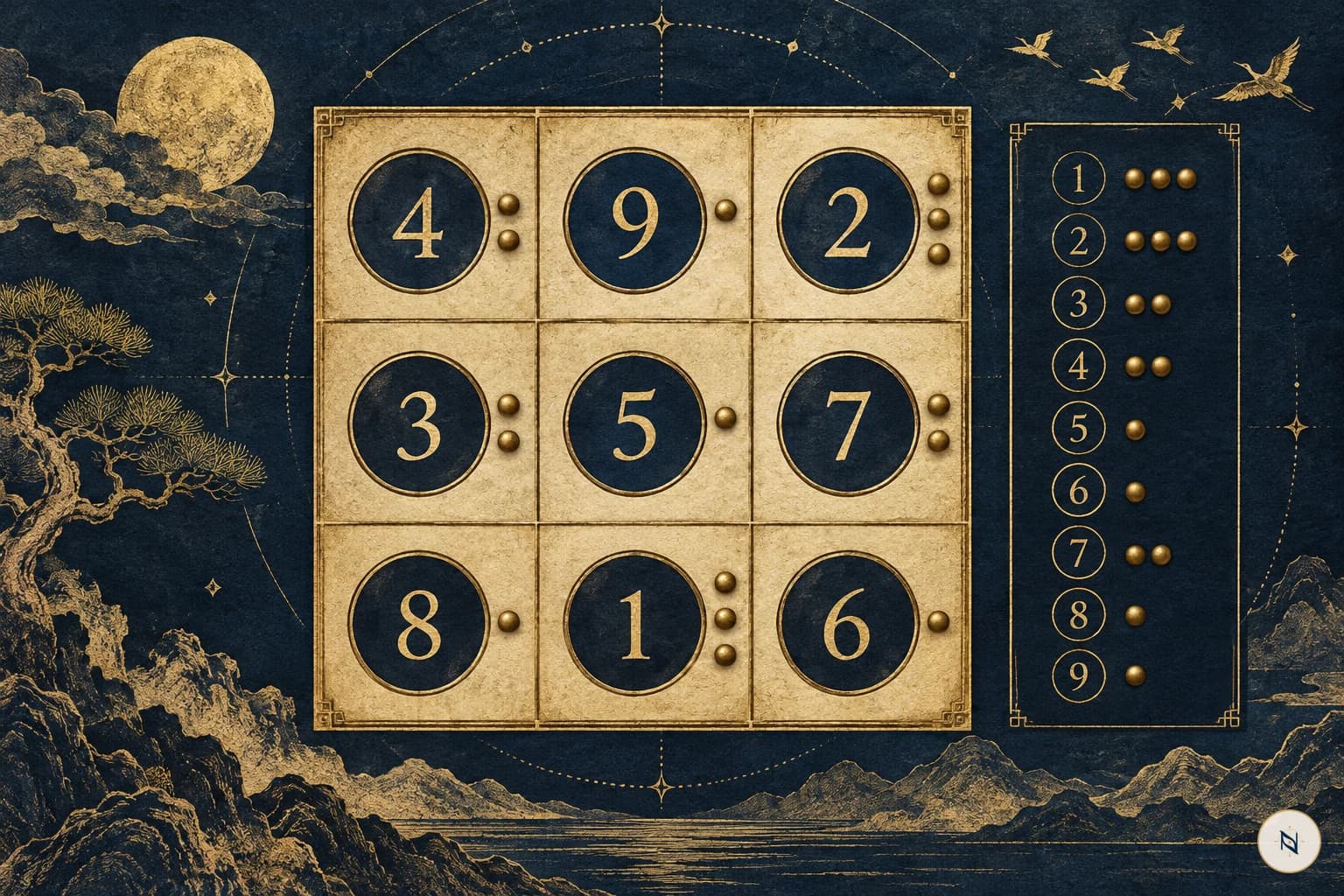
The short answer
Start here
Under a repeat-counting rule, each occurrence of a digit from 1 to 9 is placed in its corresponding Lo Shu cell. Repetition changes the tally, not the square's fixed order. Sources may describe repeated digits symbolically in different ways; the count itself cannot prove intensity, ability, or destiny.
Key takeaways
Count every eligible occurrence when the stated convention says repetitions are retained.
A repeated digit stays in one cell; it does not create a new cell or line.
Verify the date and zero policy before interpreting a repeat count.
Counts are arithmetic; claims about a person remain interpretations.
On this page
Place every occurrence
Write the eligible date digits, then place each occurrence in the fixed 4–9–2 / 3–5–7 / 8–1–6 square. If 1 appears three times, the 1 cell has a count of three. The 1 remains in that cell; repetition does not shift other numbers or alter the layout.
Check a repeated-digit tally
For the fictional date 11 February 1991, the eligible sequence is 1, 1, 2, 1, 9, 9, 1. The tally is 1×4, 2×1, and 9×2. A chart that shows only one copy per digit is using a different display or count convention; compare its settings before interpreting it.
Separate count from interpretation
An author may attach a traditional theme to a repeated digit, but another school may phrase it differently. Keep the verifiable statement—how many occurrences, in which cell—separate from a judgment that someone has too much or too little of a quality.
- Use the Lo Shu calculator to inspect the visible frequency in each cell.
- Check whether another source drops duplicates or changes the zero rule.
- Keep any symbolic reading optional and grounded in your own experience.
Method and limits
This guide describes the conventions stated above and the way Nuemero’s current calculator works. Numerology interpretations are traditional beliefs, not scientific predictions. Check a source’s method before applying its meanings.
Read Nuemero’s full methodQuick answers
Frequently asked questions
Do repeated digits count more than once?
Under a repeat-counting rule, yes: each eligible occurrence goes in the same digit's cell. Some displays simplify duplicates, so check the tool's convention.
Does a repeated number mean a stronger quality?
That is a symbolic interpretation, not something established by the arithmetic count. Sources may disagree.
Can repeated digits create an arrow?
A line depends on whether its required cells are occupied under the chosen rule, not on the number of copies within one cell.
What should I check if counts differ?
Compare the exact date, calendar, zero handling, repetition policy, and cell order.
Read further
Sources and method notes
- Mathematical Association of America · History of magic squaresHistorical background on the square's arrangement; repeat-counting is stated as this guide's modern convention.
Sources document calculation conventions and claims made within their traditions. They are not evidence that numerology predicts real-world outcomes.
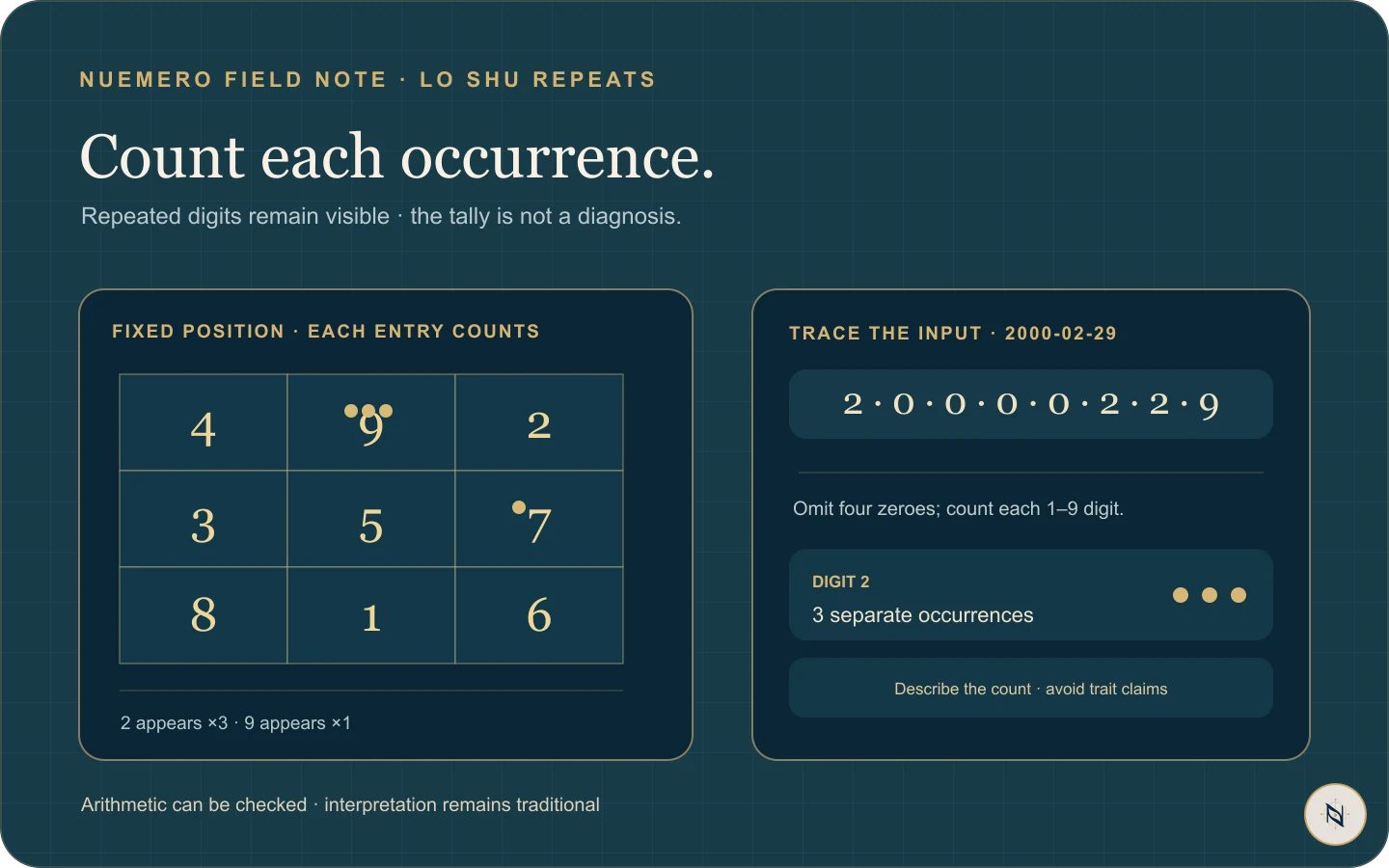
Lo Shu numerology·7 min
Repeated Numbers in a Lo Shu Grid: Count Each Digit, Then Check the Rule
Follow a birth-date example with repeated digits, see why repetitions should stay visible under Nuemero’s rule, and separate a count from claims about personality.
Read the guide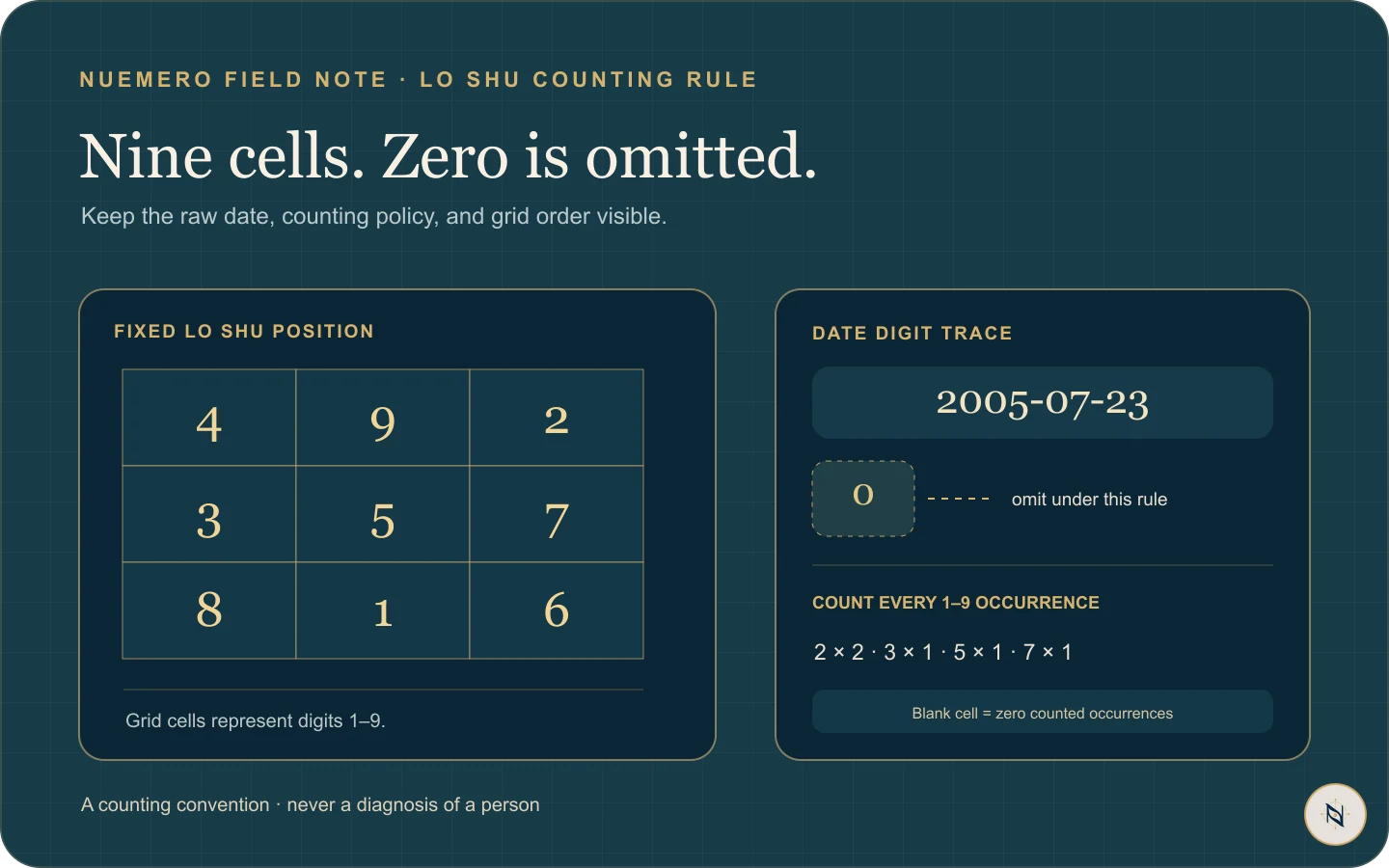
Lo Shu numerology·7 min
What Does Zero Do in a Lo Shu Grid? The Counting Rule Explained
See how Nuemero handles zero when building a Lo Shu grid, why a blank cell is not the same as a missing birth date, and what to compare when two tools differ.
Read the guide