
Lo Shu numerologyNumerology guide
Repeated Numbers in a Lo Shu Grid: Count Each Digit, Then Check the Rule
Follow a birth-date example with repeated digits, see why repetitions should stay visible under Nuemero’s rule, and separate a count from claims about personality.
The short answer
Start here
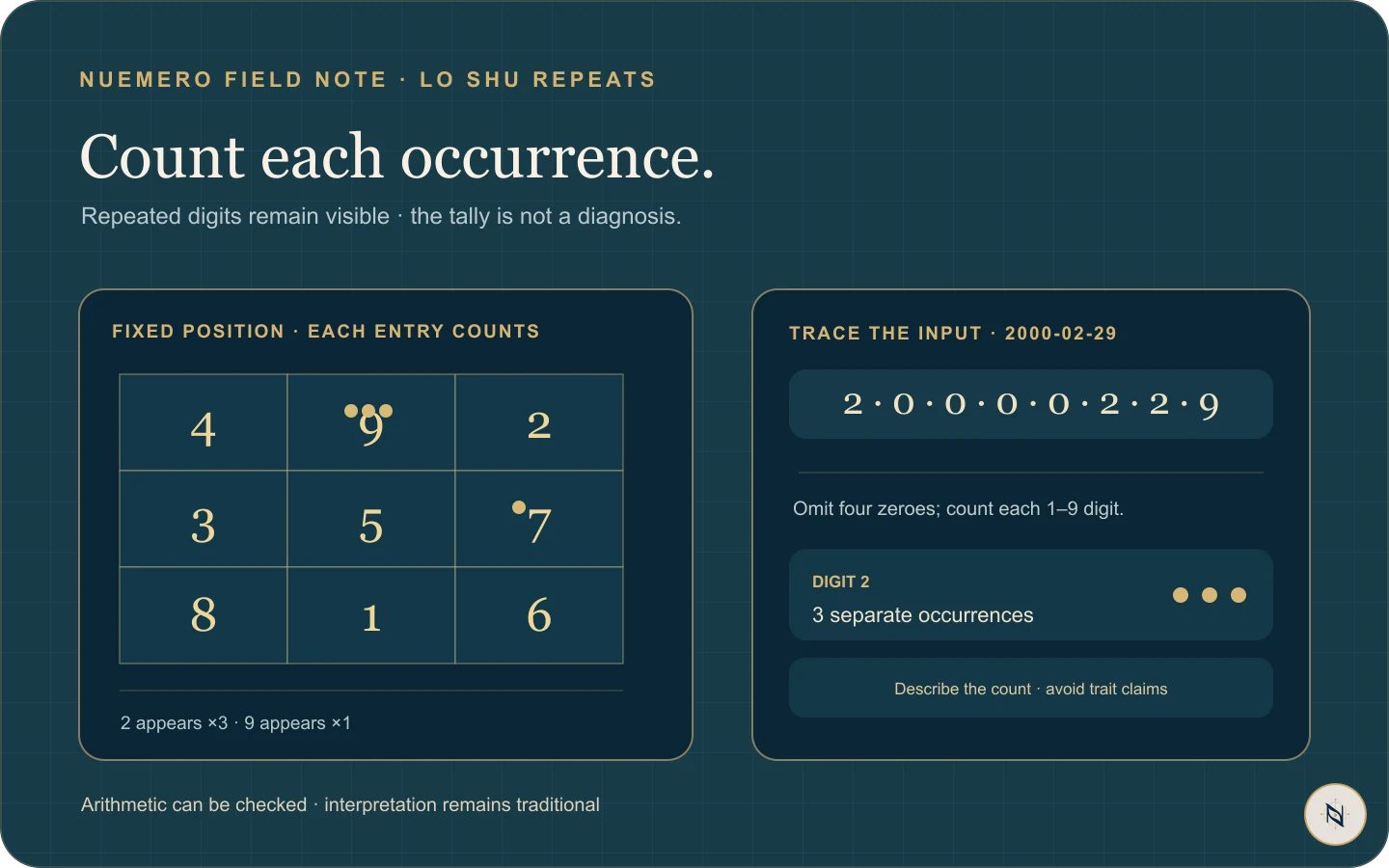
Nuemero’s Lo Shu calculator counts every occurrence of an eligible birth-date digit from 1 through 9, omits zero, and keeps repetitions visible in the fixed 4–9–2 / 3–5–7 / 8–1–6 grid. For 2000-02-29, the digit 2 occurs three times and 9 once. That tally is a reproducible description of the input under the chosen rule. Traditional writers may interpret repeated digits differently; the count does not prove a person has a stronger trait or predict an outcome.
Key takeaways
A repeated digit contributes a separate count for each time it appears in the eligible date digits.
Nuemero shows repeated entries, omits zero, and keeps the fixed nine-cell order.
Check the raw date, zero rule, and counting rule before interpreting a repeated pattern.
A repetition count is not evidence that a trait is stronger or guaranteed to appear.
On this page
What the repeated entry records
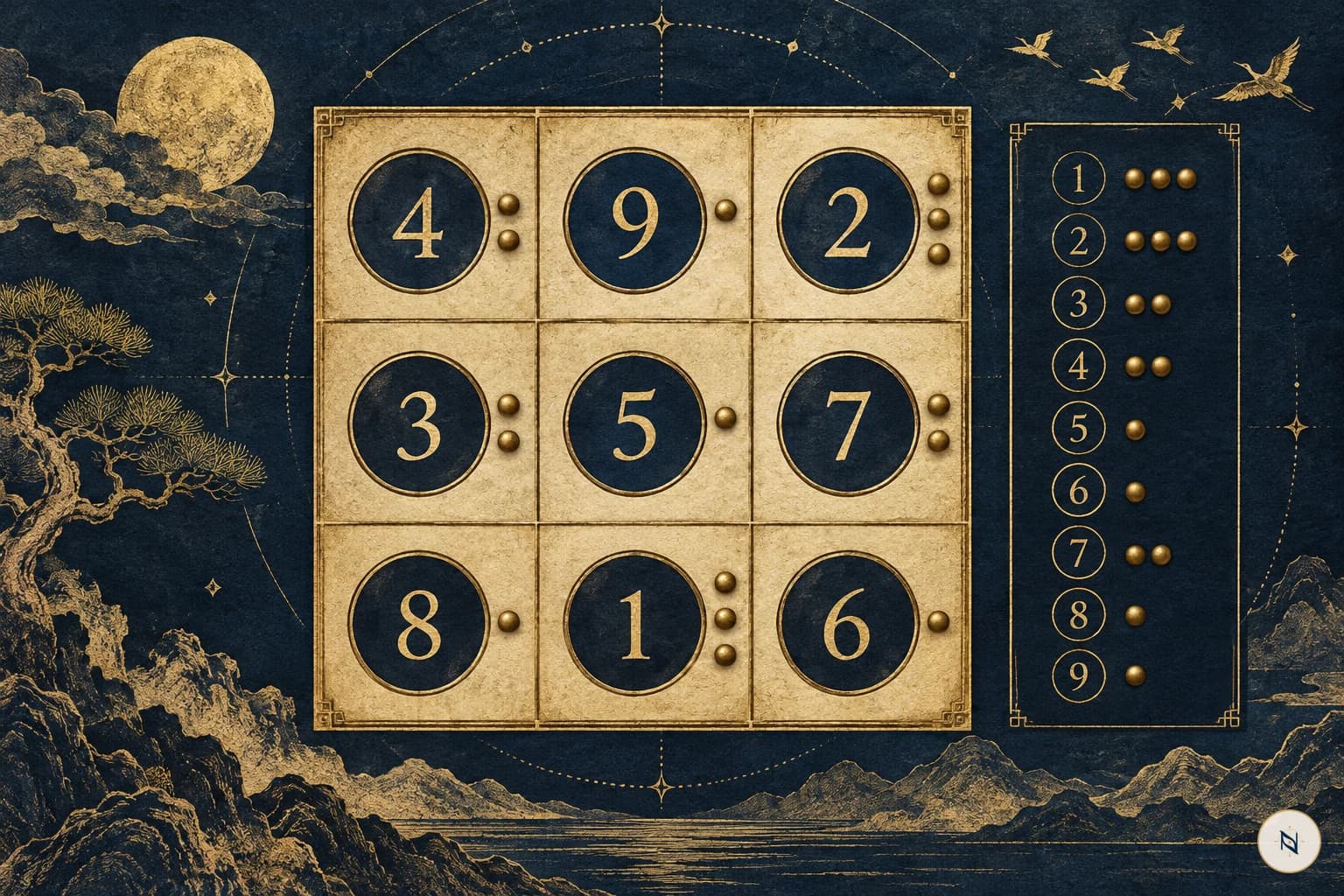
A Lo Shu grid is a tally arranged into fixed cells, not a list where each digit is allowed only once. Under Nuemero’s current convention, write the full Gregorian date, omit zero, and place every occurrence of digits 1–9 into the cell for that digit. If a digit appears three times in the eligible date digits, the cell shows three entries.
A calculator that reduces the full date to a single root before placing digits is answering a different construction question. Compare that preliminary step and its rule before deciding that either grid is wrong.
Worked count: 2000-02-29
List the date digits: 2, 0, 0, 0, 0, 2, 2, 9. Under Nuemero’s zero-omission rule, remove the four zeroes from the grid count. Digit 2 remains three times and digit 9 once; digits 1, 3, 4, 5, 6, 7, and 8 do not appear in this input. The same tally is then placed into the fixed cells without reducing repeated 2s to one entry.
The example explains the tally only. Different books may attach a line, plane, or symbolic theme to a pattern, and those interpretations are not calculations. State which source’s interpretation you are describing and avoid turning it into a fixed personality label.
Each eligible occurrence stays visible
2 · 0 · 0 · 0 · 0 · 2 · 2 · 92 · 2 · 2 · 93 occurrences1 occurrenceDescribe the pattern without claiming it diagnoses someone
A repeated count may be interesting to a practitioner, but the arithmetic alone does not establish greater confidence, ambition, sensitivity, or any other trait. Interpretive sources disagree, and numerology is not a validated personality or hiring assessment. Do not use the grid to screen a candidate, label a child, judge a partner, or make a consequential decision.
Method and limits
This guide describes the conventions stated above and the way Nuemero’s current calculator works. Numerology interpretations are traditional beliefs, not scientific predictions. Check a source’s method before applying its meanings.
Read Nuemero’s full methodQuick answers
Frequently asked questions
Are repeated numbers counted more than once in a Lo Shu grid?
Under Nuemero’s convention, yes. Every occurrence of each 1–9 date digit is counted; zero is omitted and repeats stay visible.
Do repeated digits prove that a quality is stronger?
No. They show how many times a digit appears under the chosen date-count rule. Trait meanings are traditional interpretations, not established by the tally.
Why are repeated digits different across two Lo Shu calculators?
Check that both use the same full date, zero policy, repeat rule, calendar, and grid position order. Some tools reduce or filter input digits before making the grid.
What should I do if a digit appears many times?
First verify the date and tally. If you use a traditional interpretation, treat it as a reflection prompt and compare how your real experience fits; do not regard it as a diagnosis or fixed trait.
Read further
Sources and method notes
- Nuemero Lo Shu calculatorSee every counted occurrence and the fixed nine-cell order.
- Nuemero methodologyReview the zero and repetition conventions applied by the product.
Sources document calculation conventions and claims made within their traditions. They are not evidence that numerology predicts real-world outcomes.
Lo Shu numerology·7 min
Repeated Numbers in a Lo Shu Grid: How the Counts Work
Learn why repeated date digits stay visible, how to check a cell tally, and why a larger count is not proof of a stronger trait.
Read the guide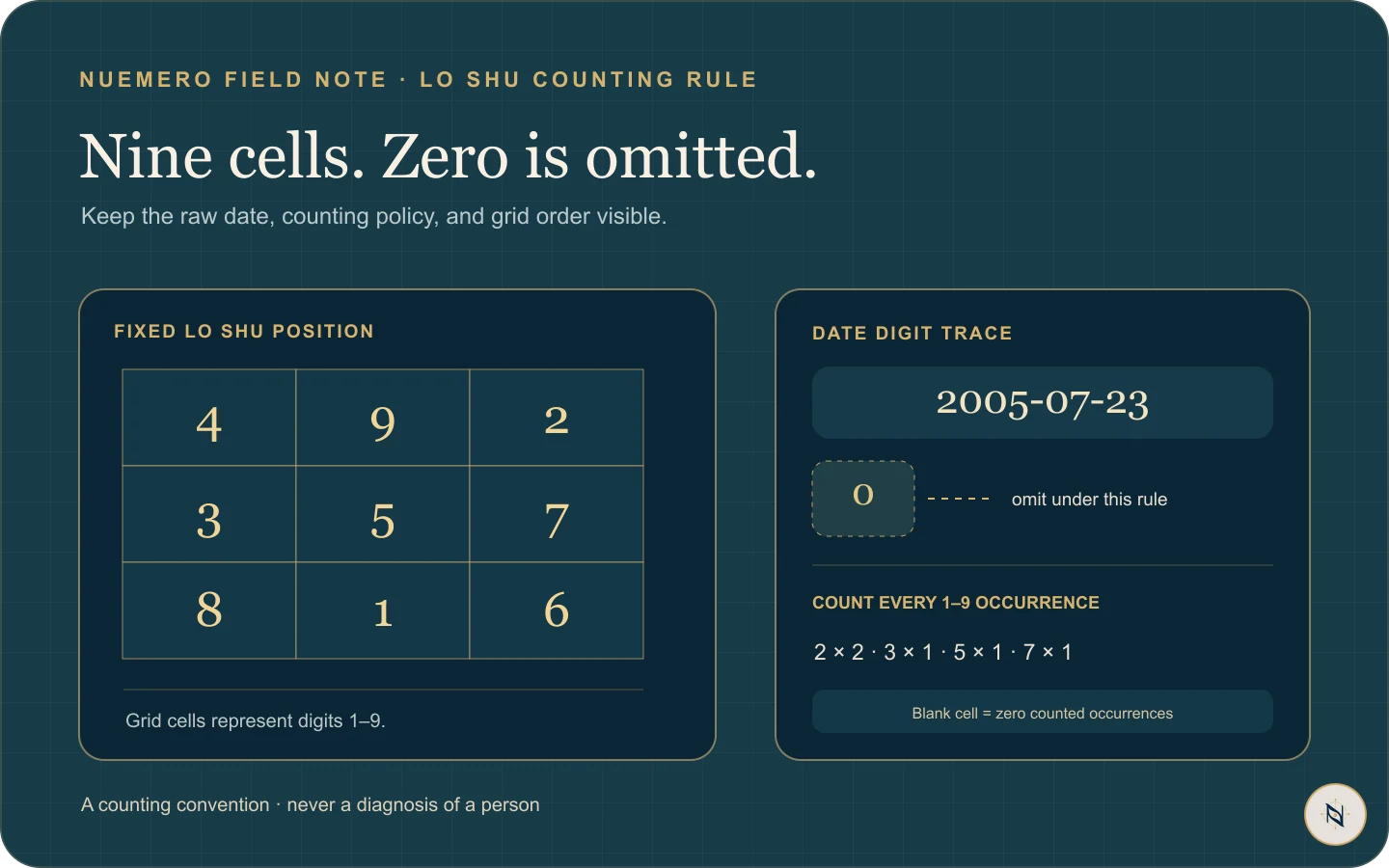
Lo Shu numerology·7 min
What Does Zero Do in a Lo Shu Grid? The Counting Rule Explained
See how Nuemero handles zero when building a Lo Shu grid, why a blank cell is not the same as a missing birth date, and what to compare when two tools differ.
Read the guide