
Lo Shu numerologyNumerology guide
Missing Numbers in a Lo Shu Grid: Meaning, Limits, and a Worked Example
Learn how a missing Lo Shu digit is identified, build a transparent example, and separate a traditional interpretation from a factual conclusion or promised remedy.
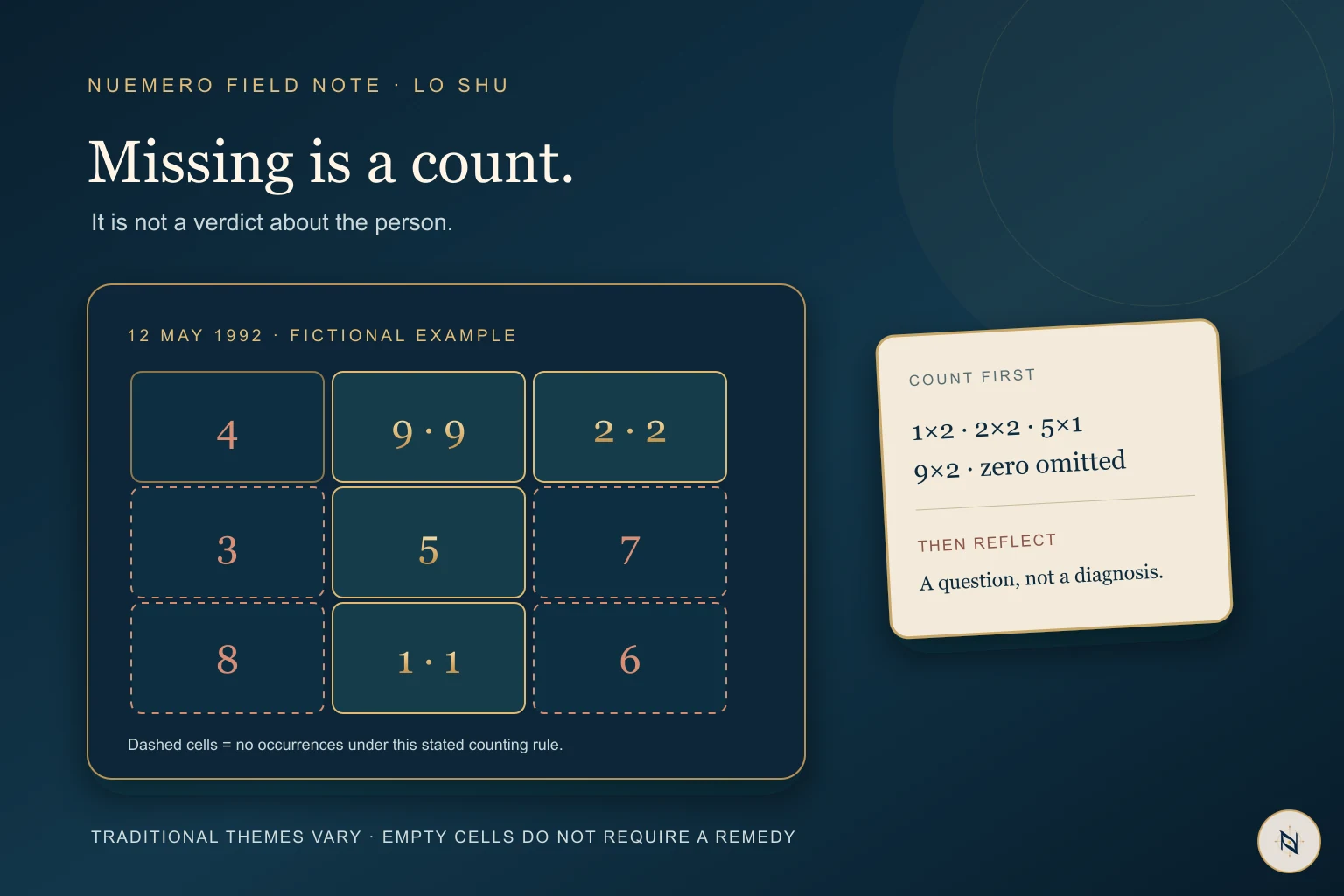
The short answer
Start here
A “missing number” means that a digit from 1 to 9 does not appear in the birth-date count under a particular Lo Shu rule. It describes the grid, not a proven personal weakness. Confirm the date, zero policy, and fixed layout first; then treat any traditional meaning as a reflection prompt, not a diagnosis or a reason to buy a remedy.
Key takeaways
A missing digit is a count-based description of one grid, not a diagnosis.
Use one stated birth-date, zero, and repeat-counting convention before interpreting the cells.
Traditional meanings vary by author and are not established by the arithmetic.
Be cautious of fear-based claims or guaranteed paid remedies for an empty cell.
On this page
What “missing” means in the grid
In a birth-date Lo Shu grid, each cell is associated with one digit from 1 to 9. A practitioner counts the eligible digits in the date and places them in the corresponding cells. If a count is zero, that cell is called empty or missing under that construction rule. The label describes the tally only.
It does not show that a person lacks a real-world skill, trait, or capacity. Those claims are interpretations attached by particular authors, and different schools can explain the same pattern differently. Nuemero keeps the visible count separate from those traditional readings.
A worked count before interpretation
Take the fictional date 12 May 1992 and use Nuemero’s stated rule: retain each occurrence of 1–9, omit zero from the cells, and use the fixed 4–9–2 / 3–5–7 / 8–1–6 order. The count is 1 twice, 2 twice, 5 once, and 9 twice. The other five cells have no entries for this example.
That is the complete arithmetic statement. Calling an empty cell a “lesson” or a “weakness” adds a traditional interpretation; it is not another calculation step. If a calculator gives a different grid, compare its input date and counting convention before discussing meaning.
Example count · 12 May 1992
1 · 2 · 0 · 5 · 1 · 9 · 9 · 21×2 · 2×2 · 5×1 · 9×23 · 4 · 6 · 7 · 8What one practitioner associates with each digit
A published Lo Shu overview by Dr J. C. Chaudhry associates 1 with career and planning, 2 with marriage, happiness and initiative, 3 with health and education, 4 with wealth and prosperity, 5 with strength, stability and communication, 6 with helpfulness and social or material opportunities, 7 with peace, creativity and children, 8 with knowledge, prosperity and memory, and 9 with name, recognition and energy. This is one practitioner's symbolic vocabulary; it is not a consensus table or evidence about what a person who is missing a digit will experience.
Some practitioner pages go further and describe an absent digit as a deficiency or recommend paid remedies. We do not present those statements as fact: an empty cell is a count, not a diagnosis, and no purchase is needed to make a grid valid. Keep the source's interpretation separate from the arithmetic and from evidence about real-world skills or outcomes.
- 1 · Career and planning
- 2 · Marriage, happiness, and initiative
- 3 · Health and education
- 4 · Wealth and prosperity
- 5 · Strength, stability, and communication
- 6 · Helpfulness and social or material opportunities
- 7 · Peace, creativity, and children
- 8 · Knowledge, prosperity, and memory
- 9 · Name, recognition, and energy
Check the rule before comparing grids
Confirm that both calculations use the same full date, calendar, fixed cell order, and rule for zero and repeated digits. Some systems use only selected date digits or add extra numbers; a result is not comparable until the input and construction rules are aligned.
If a source offers a remedy, ask what evidence supports it, what it costs, and whether the same action would be useful without the numerology claim. You do not need to correct an empty cell to make a grid valid.
Use a pattern as a question, not a verdict
If a traditional reading resonates, translate it into a practical question you can answer from experience: “What habit would I like to practise?” or “What would I like to learn next?” Then choose one small action that remains worthwhile even if you set the numerology aside.
Numerology is not a validated personality test. Do not use an absent digit to label a child, screen a job candidate, judge a partner, or make a health or money decision. Use evidence and qualified advice for consequential choices.
Method and limits
This guide describes the conventions stated above and the way Nuemero’s current calculator works. Numerology interpretations are traditional beliefs, not scientific predictions. Check a source’s method before applying its meanings.
Read Nuemero’s full methodQuick answers
Frequently asked questions
Does a missing Lo Shu number mean I lack that quality?
No. It means the digit was not present in the grid under the chosen birth-date counting rule. A quality claim is an interpretation, not a conclusion established by the count.
How do I find missing numbers?
Count the eligible birth-date digits under one stated rule, place them in the fixed cells, and note which cells have a zero count. Nuemero omits zero and keeps repeated digits visible.
Should I buy a remedy for a missing number?
There is no need to correct an empty cell. Be cautious of fear-based sales claims or guaranteed outcomes; evaluate cost and evidence independently.
Why do two Lo Shu calculators show different missing digits?
They may use a different date format, calendar, zero policy, repeat rule, or grid construction. Compare those rules and the raw digit list first.
Read further
Sources and method notes
- Nuemero Lo Shu calculatorThe product’s current fixed order, date-digit counting, and zero/repeat conventions.
- Dr J. C. Chaudhry · Lo Shu GridOne practitioner's published number associations. Personal claims and remedies are attributed tradition, not established evidence; this article does not endorse them.
- Nuemero calculation methodologyProduct calculation rules and the distinction between arithmetic and interpretation.
Sources document calculation conventions and claims made within their traditions. They are not evidence that numerology predicts real-world outcomes.
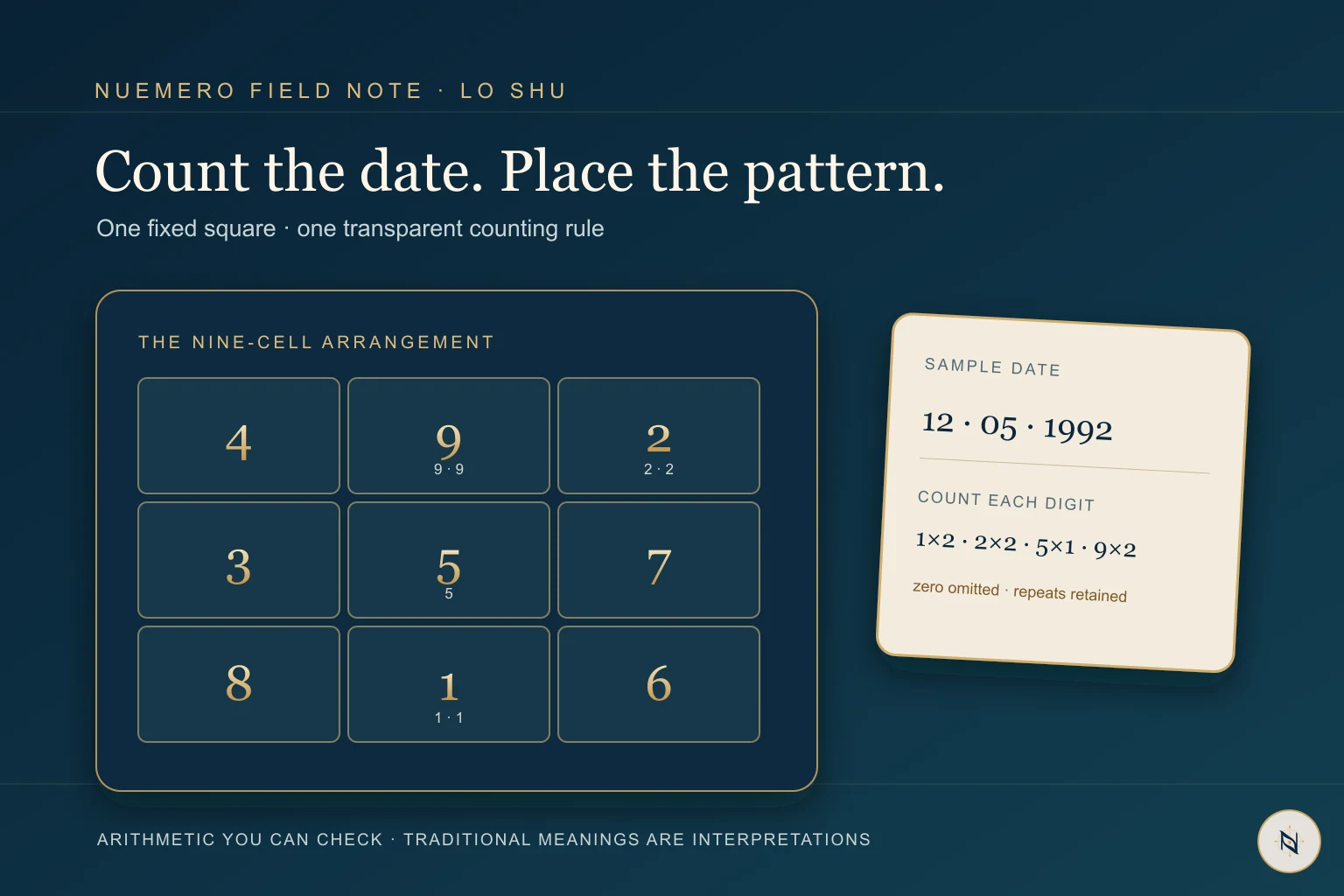
Lo Shu numerology·6 min
Lo Shu Grid Calculator: Build a Grid From Your Birth Date
Build a Lo Shu grid from a sample birth date. See the fixed 4–9–2 / 3–5–7 / 8–1–6 layout, repeated digits, zero rule, and every step of the count.
Read the guide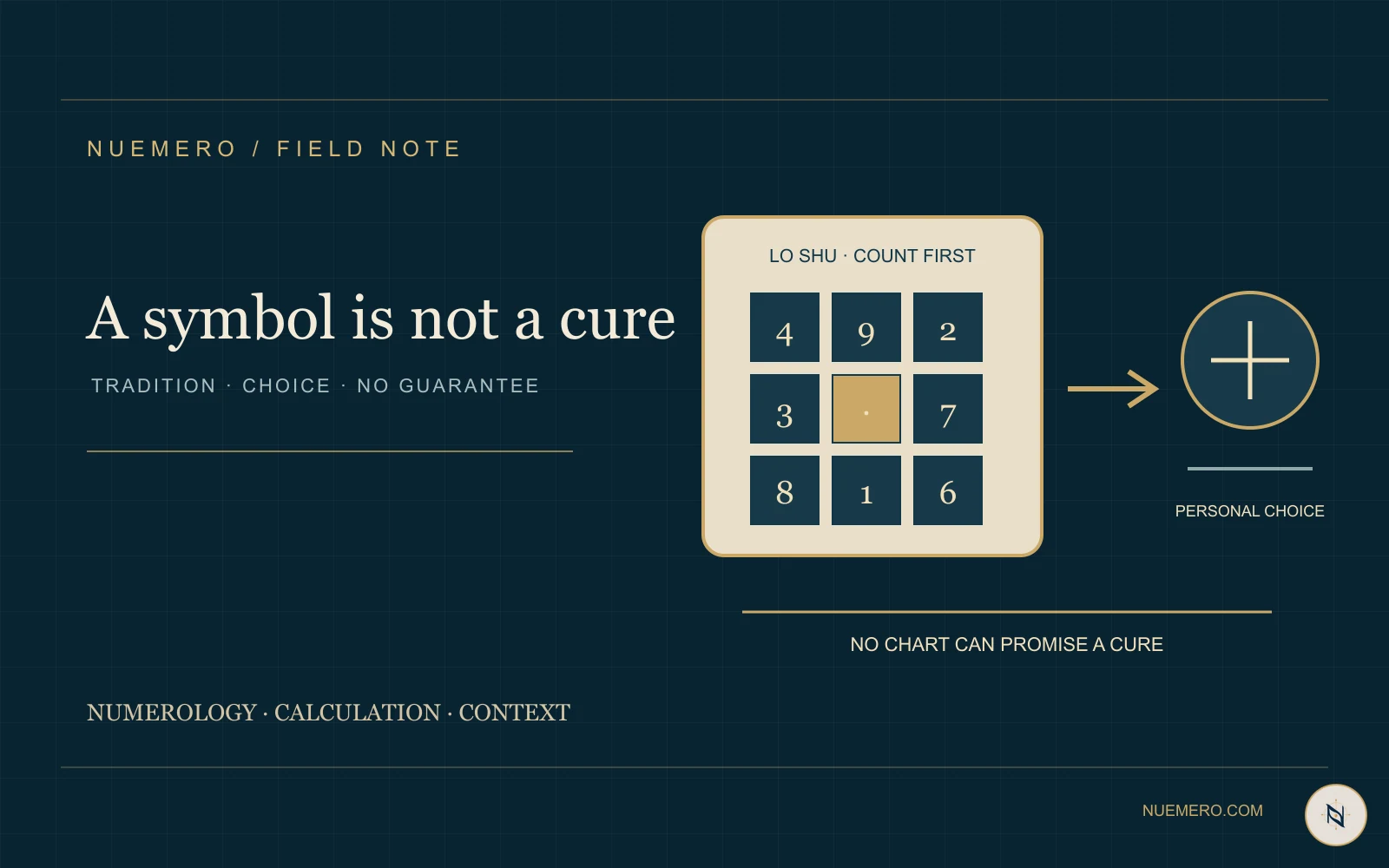
Lo Shu numerology·8 min
Lo Shu Remedies: Tradition, Personal Choice, and Claims to Question
Some practitioners suggest colours, objects, or habits for an empty Lo Shu cell. Learn to separate optional symbolism from evidence, safety, and sales pressure.
Read the guide