
Relationships & compatibilityNumerology guide
Mulank Compatibility: What Two Birth Numbers Actually Compare
Learn how a Mulank comparison starts with two birth days, why traditions disagree about pairing rules, and how to keep a number reading from becoming a relationship verdict.
The short answer
Start here
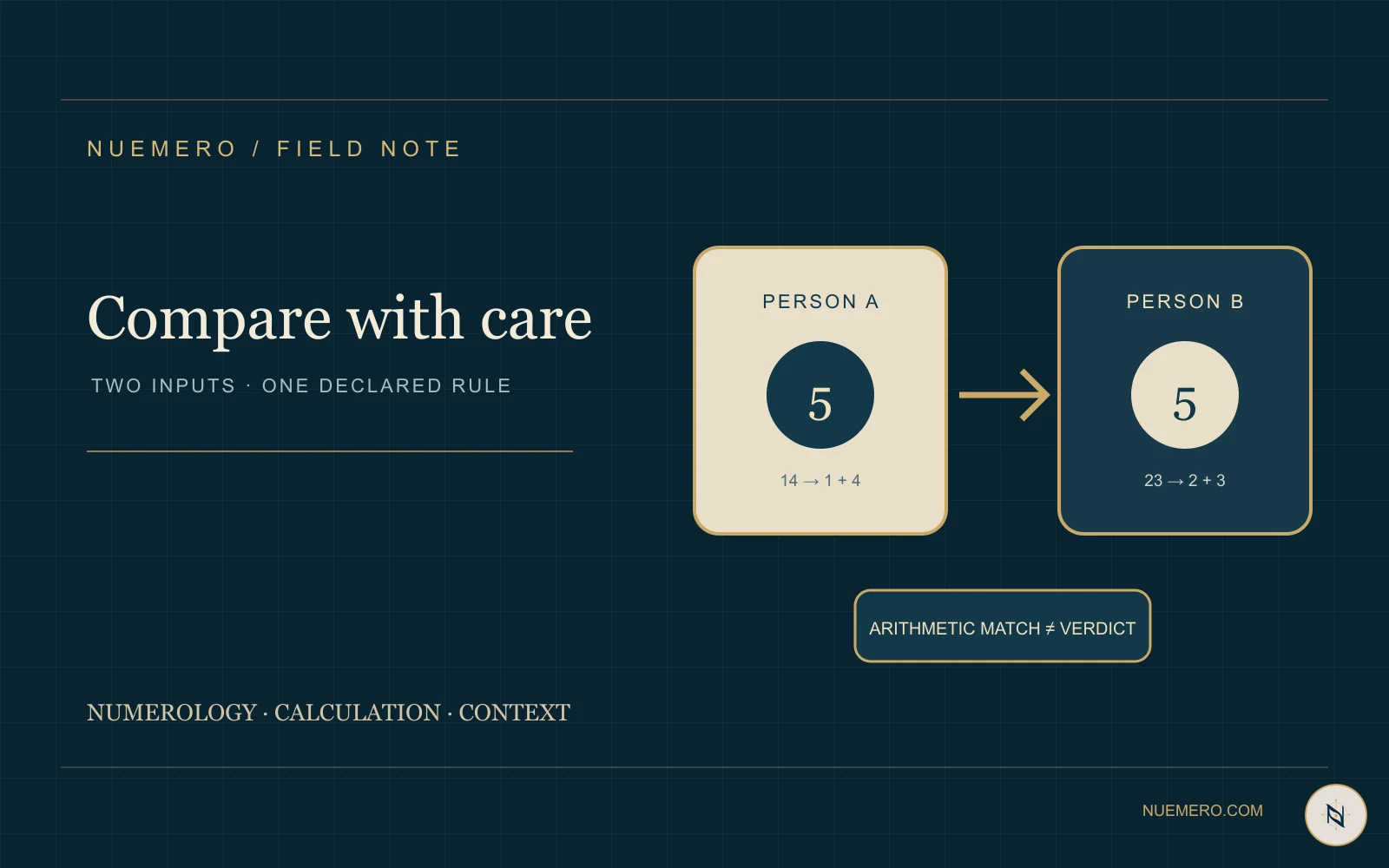
Mulank usually starts with the day of the month, reduced to a digit from 1 to 9, but compatibility sources do not share one universally accepted matrix or weighting. For example, 14 gives 1 + 4 = 5 and 23 gives 2 + 3 = 5, so both dates yield Mulank 5 under this reduction rule. That shared result describes arithmetic, not relationship quality. Some practitioners compare Mulank with Mulank; others also use Bhagyank, names, or planetary friendship. Ask for the exact method and never use a score to accept, reject, or pressure a partner.
Key takeaways
Mulank is commonly derived from the day of the month, but state the exact reduction rule.
Compatibility traditions differ on whether to include Bhagyank, names, or planetary associations.
A number pairing is not a validated measure of care, safety, or long-term fit.
Use the comparison as a conversation prompt; prioritize respect, consent, and lived behavior.
On this page
Start with what Mulank means in this comparison
A common Indian numerology usage derives Mulank (also called Moolank or birth number) from the day of the month. A day such as 14 is reduced as 1 + 4 = 5. Practices can differ in naming and downstream interpretation, so define the arithmetic before interpreting a pairing.
“Compatibility” may refer to a symbolic comparison in a practitioner's school. It does not mean the two people have been tested for communication, values, reliability, shared goals, safety, or relationship satisfaction.
Worked arithmetic: dates 14 and 23
Use only the day-of-month rule for this illustration. Person A's day 14 becomes 1 + 4 = 5. Person B's day 23 becomes 2 + 3 = 5. The two people therefore have the same single-digit Mulank under this convention. A different school may preserve compound values or add other numbers; label those as separate lenses rather than quietly changing the rule.
Fictional example · birth-day reduction only
14 → 1 + 4 = 523 → 2 + 3 = 55 and 5 · arithmetic match onlyWhy compatibility charts disagree
One source may compare the two Mulank values; another may add each person's Bhagyank, name number, or a planet-friendship table. A percentage score also requires choices about which pairs count and how heavily to weight them. Those are features of a source's method, not a universal mathematical consequence of the dates.
Before trusting a compatibility chart, look for its input list, reduction formula, interpretation source, and explanation of any score. If these are missing, the displayed verdict cannot be reproduced or fairly compared with another tool.
Keep the relationship bigger than the number
If a symbolic pairing starts a useful conversation, ask what support, boundaries, communication, and shared plans each person wants. Judge compatibility through how people treat one another and whether both feel safe and respected—not through a digit match.
Never use a number to pressure a person into dating, marriage, separation, or staying in an unsafe relationship. For safety concerns, seek trusted support. A compatibility reading is optional entertainment or reflection, not a consent or decision tool.
Method and limits
This guide describes the conventions stated above and the way Nuemero’s current calculator works. Numerology interpretations are traditional beliefs, not scientific predictions. Check a source’s method before applying its meanings.
Read Nuemero’s full methodQuick answers
Frequently asked questions
How is Mulank calculated for compatibility?
A common convention reduces the day of the month to one digit. For example, 14 becomes 1 + 4 = 5. State if your source uses another rule.
Is there one accepted Mulank compatibility table?
Sources vary in pairings and may add Bhagyank, name values, or planetary associations. Identify the tradition and source rather than presenting one chart as universal.
Can a Mulank match tell me whether to marry someone?
No. It is not a validated measure of relationship quality, consent, safety, or future outcomes. Base decisions on the people, their behavior, values, and direct conversations.
Why do two compatibility calculators give different scores?
They may compare different numbers or assign different weights. Compare both inputs, formulas, source traditions, and score construction before comparing the result.
Read further
Sources and method notes
- Cheiro, The Book of Numbers · edition recordA practitioner source for one historical numerology tradition; it does not establish relationship prediction.
- Nuemero compatibility calculatorReview its stated inputs, comparison lenses, and limitations.
Sources document calculation conventions and claims made within their traditions. They are not evidence that numerology predicts real-world outcomes.
Relationships & compatibility·7 min
Name-Number Compatibility: Compare Two Names Fairly
See how name-number compatibility calculators turn two names into numbers, why scores vary by method, and how to keep a symbolic comparison from becoming a relationship verdict.
Read the guide
Relationships & compatibility·8 min
How to Compare Numerology Compatibility Without Reducing Love to a Score
See what compatibility charts compare, how to check their methods, and how to use number themes as conversation prompts while keeping respect, safety, and real behavior central.
Read the guide