
Indian numerologyNumerology guide
Mulank vs Bhagyank: Meaning, Calculation, and Difference
Learn what Mulank and Bhagyank each calculate, work through a sample birth date, and see how to compare the two without treating either as destiny.

The short answer
Start here
Mulank is calculated from the day of the month you were born; Bhagyank is calculated from the complete date of birth. For 14 March 1992, Mulank is 1 + 4 = 5, while the full-date total is 29 → 11. Nuemero preserves 11 at the final step, so Bhagyank / Life Path is shown as 11/2. The two numbers use different inputs and should not be confused.
Key takeaways
Mulank uses only the birth day; Bhagyank uses the full date.
A person can have matching or different values—one does not replace the other.
Nuemero reduces Mulank fully to 1–9 and calculates Bhagyank from the full-date digit sum, preserving a final 11, 22, or 33.
Interpretations are tradition-based reflections; they do not determine someone’s character or future.
On this page
Two numbers, two inputs
Mulank and Bhagyank are common terms in contemporary Indian numerology. The calculation convention used here is straightforward: Mulank starts with the day of birth, while Bhagyank uses every digit in the full birth date. These terms belong to modern numerology practice and should not be presented as a universal rule from every classical Jyotish text.
Nuemero displays Bhagyank alongside Life Path because both names refer to its shared full-date calculation. It does not calculate them as separate numbers or quietly merge their arithmetic with Mulank.
Calculate both from one example
Use the fictional date 14 March 1992. The day number is calculated first on its own. Then calculate the full-date number from every digit in the date. Keep the two traces separate so the inputs stay clear.
Example: 14 March 1992
Birth day 14 → 1 + 4 = 51 + 4 + 0 + 3 + 1 + 9 + 9 + 2 = 29 → 2 + 9 = 11Mulank 5 · Bhagyank / Life Path 11/2How practitioners interpret the difference
Many practitioners use Mulank as a lens for immediate preferences or day-to-day style, and Bhagyank as a broader full-date theme. The specific meanings attached to each number vary between authors. Treat these as interpretive conventions rather than facts that can be read directly from a date.
A practical way to use the pair is to compare the questions they raise. What feels instinctive to you? What longer-term direction are you choosing? Where might those priorities support one another, and where do you need a concrete plan? Your experience and circumstances matter more than a label.
Can Mulank and Bhagyank be the same?
Yes. Since the numbers use different inputs, they may match by coincidence or differ. Matching values do not prove a stronger destiny, and different values do not mean a person is conflicted. They are simply outputs from two calculations.
If two calculators disagree, check whether both used the same date format, whether one preserved master numbers, and whether the Bhagyank tool sums the whole date. Some products also use different labels or calculation conventions, so read the formula rather than relying on the heading alone.
Use the numbers as reflection, not a verdict
Numerology does not establish whether someone will succeed, marry, become wealthy, or be suited to a particular job. For choices that affect money, health, work, or relationships, use relevant evidence and advice from qualified people.
If the framework is meaningful to you, turn a number into a small, testable reflection: name one strength you have actually observed, one habit you want to practise, and one action you can try this week. Keep the action useful even if you set the numerology aside.
Method and limits
This guide describes the conventions stated above and the way Nuemero’s current calculator works. Numerology interpretations are traditional beliefs, not scientific predictions. Check a source’s method before applying its meanings.
Read Nuemero’s full methodQuick answers
Frequently asked questions
What is the main difference between Mulank and Bhagyank?
Mulank uses the day of the month you were born. Bhagyank uses the complete birth date. The inputs and arithmetic are different.
How do I calculate Mulank for a date like the 29th?
Under Nuemero’s convention, add the day digits and reduce fully: 2 + 9 = 11, then 1 + 1 = 2. Mulank is reduced to 1–9 even when the day sum reaches a master number.
How do I calculate Bhagyank?
Add every digit in the full Gregorian birth date and reduce the total. Nuemero preserves 11, 22, or 33 only if reached at the final reduction, and shows the compound total in the trace.
Which one is more important?
There is no universal ranking across all numerology schools. They use different inputs and are interpreted as different lenses. Neither should be treated as a decisive measure of a person or their future.
Is Mulank and Bhagyank part of classical Vedic astrology?
They are widely used terms in modern Indian numerology practice. Avoid assuming that every classical Jyotish text uses the same framework or definitions; check the source and tradition being discussed.
Read further
Sources and method notes
- Nuemero calculation methodologyProduct-specific birth-date and master-number rules.
- Kaala Panchang: Mulank calculator and method noteA contemporary Indian numerology source distinguishing birth-day and full-date inputs and noting the modern-practice context.
- Nuemero numerology learning libraryHow Nuemero separates its modern Indian and Western calculation profiles.
Sources document calculation conventions and claims made within their traditions. They are not evidence that numerology predicts real-world outcomes.
Core numbers & calculations·6 min
Mulank, Moolank, and Birth Number: What the Terms Mean
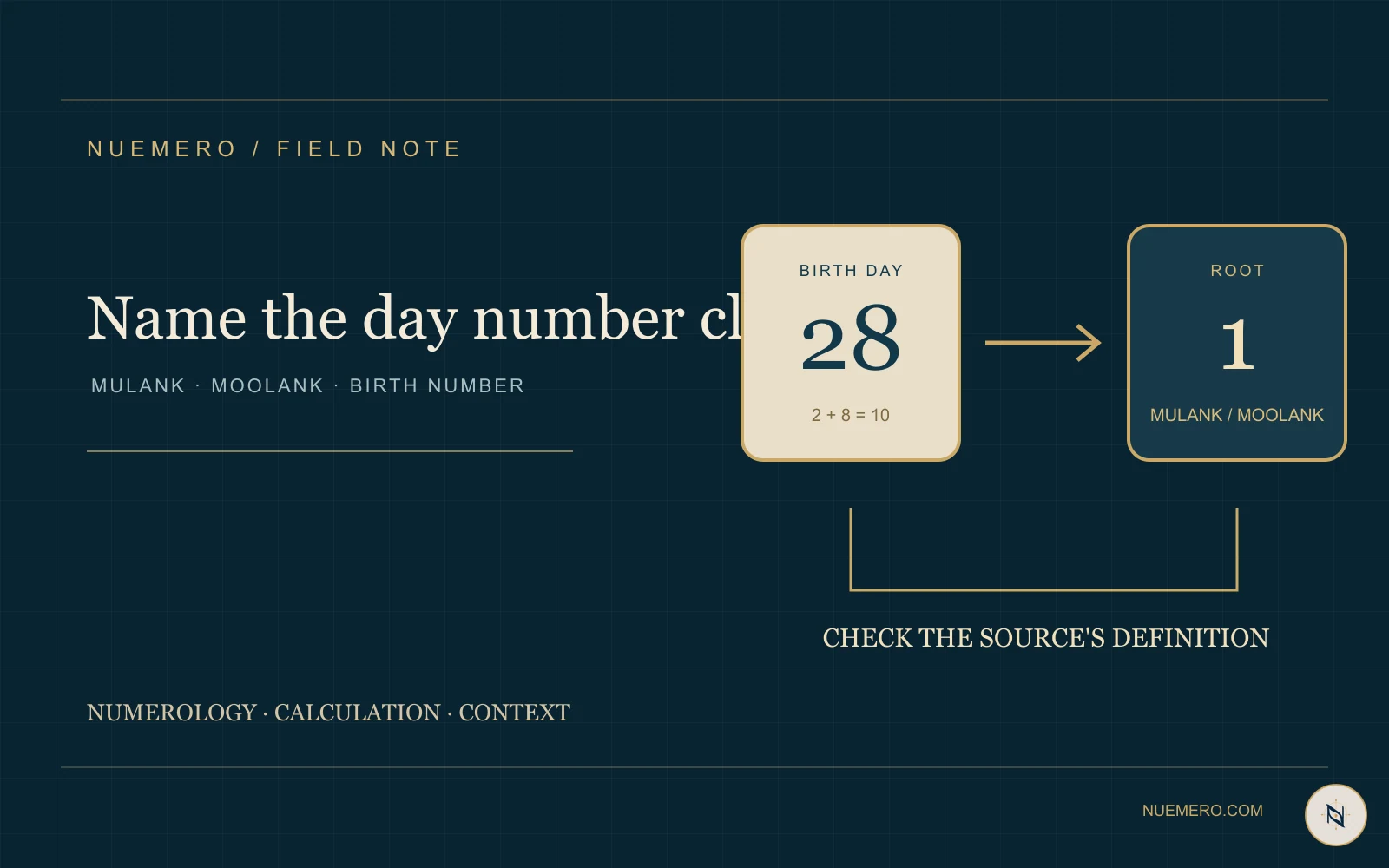
Learn when Mulank, Moolank, and Birth Number are used for the birth-day root, how a source may define them differently, and how to distinguish them from Bhagyank.
Read the guide
Work, business & daily life·7 min
Career Numerology by Date of Birth: A Reflection Guide, Not a Job Test
Use numerology themes as prompts for career reflection, then test ideas against skills, working conditions, and real-world evidence—not a deterministic job prediction.
Read the guide