
Core numbers & calculationsNumerology guide
Mulank, Moolank, and Birth Number: What the Terms Mean
Learn when Mulank, Moolank, and Birth Number are used for the birth-day root, how a source may define them differently, and how to distinguish them from Bhagyank.
The short answer
Start here
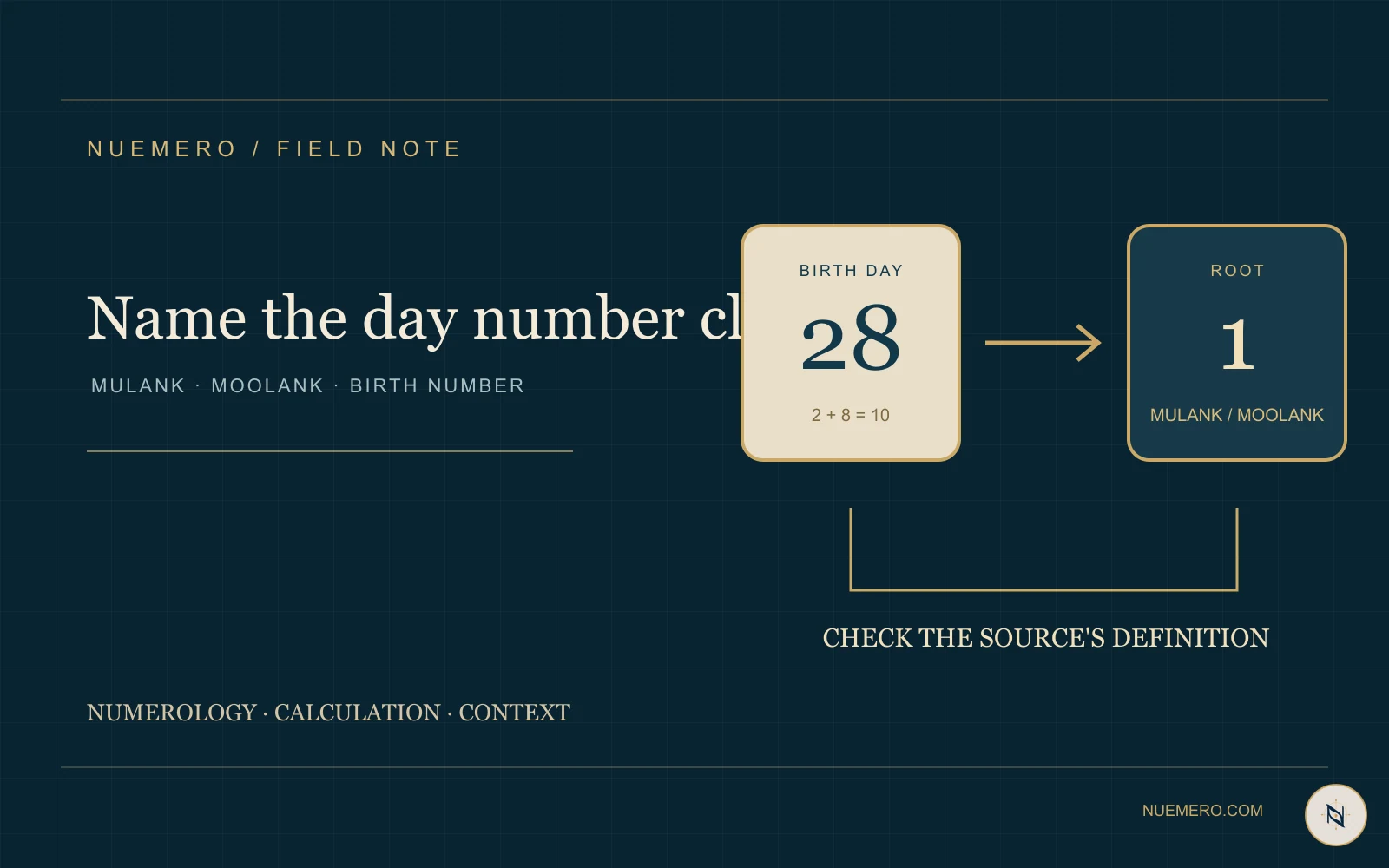
Mulank and Moolank are spelling variants commonly used for the root number derived from the calendar day of birth; some Indian numerology articles call this the Birth Number. A common rule reduces 28 to 2 + 8 = 10, then 1 + 0 = 1. Bhagyank is usually derived from the complete birth date. Terminology is not fully standardized across practitioners, so check the author's definition and calculation instead of assuming the label tells you the formula. These are traditional numerology categories, not scientifically validated personality measures.
Key takeaways
Mulank and Moolank are commonly spelling variants, but always check how a specific source defines the term.
The birth-day root uses the day; Bhagyank usually uses the full date.
Keep the original day, each reduction, and the chosen convention visible.
On this page
A term usually tied to the birth day
A number of Indian numerology explainers use Mulank or Moolank for the single-digit root of the day in the month. For example, a person born on the 28th gets 2 + 8 = 10, then 1 + 0 = 1 under a full reduction rule. The month and year are not part of that particular input.
Some schools also retain the compound birth day beside its root, such as 28/1. That display choice does not change the addition; it tells you that the source wants both the calendar day and reduced root recorded. Avoid saying every practitioner treats the compound day identically.
Keep the full-date number separate
Bhagyank is commonly calculated from every digit of the complete date, then reduced under the method's stated rule. It answers a different arithmetic question from the birth-day root. A source may also call a whole-date number a Destiny Number, while Western systems may use Life Path; names overlap, so compare the formula rather than translating labels mechanically.
For a clean comparison, write the exact date once, calculate the day-only value in one column, and the full-date value in another. Include leading zeros only when the method says they matter; show the year in four digits if the formula uses all year digits.
Method and limits
This guide describes the conventions stated above and the way Nuemero’s current calculator works. Numerology interpretations are traditional beliefs, not scientific predictions. Check a source’s method before applying its meanings.
Read Nuemero’s full methodQuick answers
Frequently asked questions
Are Mulank and Moolank different numbers?
They are commonly spelling variants for the same birth-day-root idea. The source's exact definition still matters because terminology varies.
Is Mulank the same as Bhagyank?
Usually not: Mulank uses the calendar day, while Bhagyank commonly uses the complete birth date. Follow the named source's formula.
Does a Mulank label have one universal interpretation?
No. It is a tradition-specific label and reading. It should not be treated as a validated personality test or prediction.
Read further
Sources and method notes
- Free Press Journal: Mulank and Birth NumberUses Mulank/Moolank for the birth-day root and distinguishes it from a whole-date number.
- Nuemero core profile calculatorSee the product's explicitly named date-based calculations and their arithmetic.
Sources document calculation conventions and claims made within their traditions. They are not evidence that numerology predicts real-world outcomes.

Core numbers & calculations·6 min
Mulank vs Bhagyank: Meaning, Calculation, and Difference
Learn what Mulank and Bhagyank each calculate, work through a sample birth date, and see how to compare the two without treating either as destiny.
Read the guide
Core numbers & calculations·7 min
Attitude Number: Add Birth Month and Day, Then Reduce
Calculate the Decoz Attitude Number from birth month and day, see how its arithmetic matches the First Pinnacle input, and keep their chart interpretations distinct.
Read the guide