
Core numbers & calculationsNumerology guide
Attitude Number: Add Birth Month and Day, Then Reduce
Calculate the Decoz Attitude Number from birth month and day, see how its arithmetic matches the First Pinnacle input, and keep their chart interpretations distinct.
The short answer
Start here
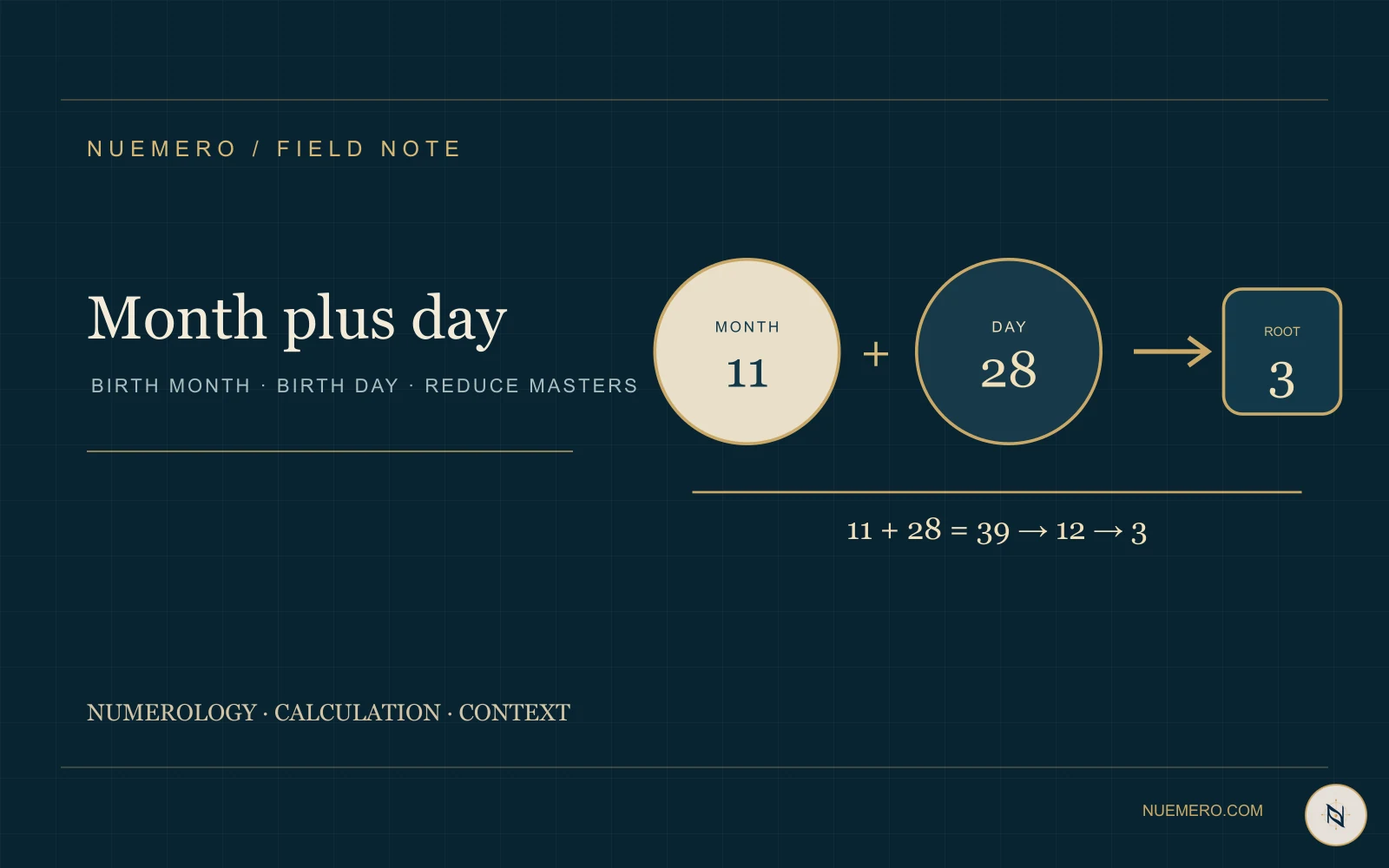
In Hans Decoz’s convention, add the numeric birth month and day, then reduce all totals, including Master Numbers, until one digit remains. November 28 gives 11 + 28 = 39 → 12 → 3. The same month-and-day arithmetic is used for the First Pinnacle, but a Pinnacle is a long-term cycle with separate timing and interpretation. Some numerologists preserve Master Numbers for an Attitude Number; this article follows the cited Decoz rule and identifies the alternative. Traditional meanings are not validated behavior forecasts.
Key takeaways
Only the numeric birth month and day enter this cited Attitude formula; the birth year does not.
Decoz reduces Master Numbers here; other practitioners may choose differently.
Matching arithmetic with First Pinnacle does not make their cycle meanings interchangeable.
On this page
The month-plus-day rule
The cited Hans Decoz method adds the calendar month number to the day of birth, then reduces the result repeatedly to one digit. For November, use 11 as the month input before addition; under this rule, even an intermediate 11, 22, or 33 is reduced rather than retained. The year of birth is not included.
Rules are not universal. The Decoz page notes disagreement over keeping Master Numbers for this value. State which convention you follow and do not present another site’s output as an arithmetic error until its rule is known.
Example: November 28 gives 3
Add month 11 and day 28: 39. Reduce 3 + 9 = 12, then 1 + 2 = 3. In Decoz’s material, the same starting arithmetic also appears for the First Pinnacle; however, a Pinnacle is interpreted as a cycle and has a separate age-duration formula. One shared number can occupy distinct roles in a chart.
November 28 · fictional worked date
11 + 28 = 393 + 9 = 121 + 2 = 3Use the reading as a prompt, not a forecast
Decoz describes Attitude as an initial approach to a person or situation. That is a tradition-specific interpretation, not a validated personality measure or guarantee about how someone will react. When the stakes are real, pay attention to actual behavior, the situation, and the people involved.
If you enjoy the symbolism, use it to ask what helps you pause before reacting or gather information when something unexpected happens. That practical reflection is yours; the chart cannot establish that one number dictates it.
Method and limits
This guide describes the conventions stated above and the way Nuemero’s current calculator works. Numerology interpretations are traditional beliefs, not scientific predictions. Check a source’s method before applying its meanings.
Read Nuemero’s full methodQuick answers
Frequently asked questions
How do I calculate the Attitude Number?
Add the numeric birth month and day, then reduce to one digit under the cited Decoz method. November 28 becomes 11 + 28 = 39 → 12 → 3.
Is Attitude Number the same as First Pinnacle?
The same month-and-day arithmetic is used in the cited chart, but the First Pinnacle has a separate cycle role and timing calculation. Similar arithmetic does not mean identical interpretation.
Does this method keep 11 as a Master Number?
The cited Decoz page reduces Master Numbers for Attitude. It notes that some numerologists use a different rule, so identify your source.
Read further
Sources and method notes
- Hans Decoz: Your Attitude NumberPrimary practitioner source for month-plus-day formula, reduction of Master Numbers, and distinction from Personality.
- Hans Decoz: Calculate Every NumberShows where the same month/day sum is used as the First Pinnacle, a different chart role.
Sources document calculation conventions and claims made within their traditions. They are not evidence that numerology predicts real-world outcomes.
Core numbers & calculations·6 min
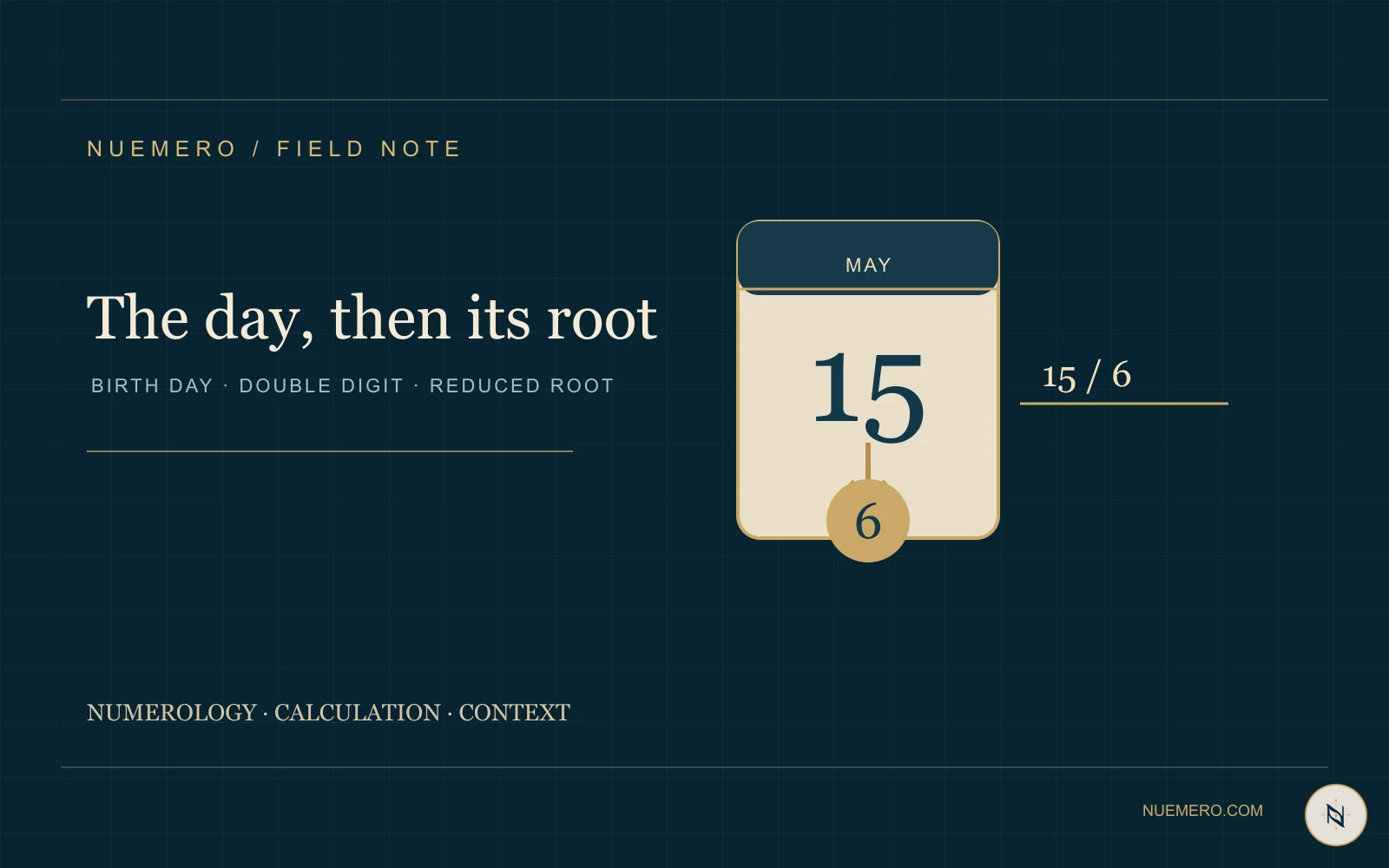
Birthday Number in Numerology: Keep the Day and Its Root
Calculate a Birthday Number from the day of birth, preserve its double-digit form beside the reduced digit, and see how one practitioner convention distinguishes it from Life Path.
Read the guide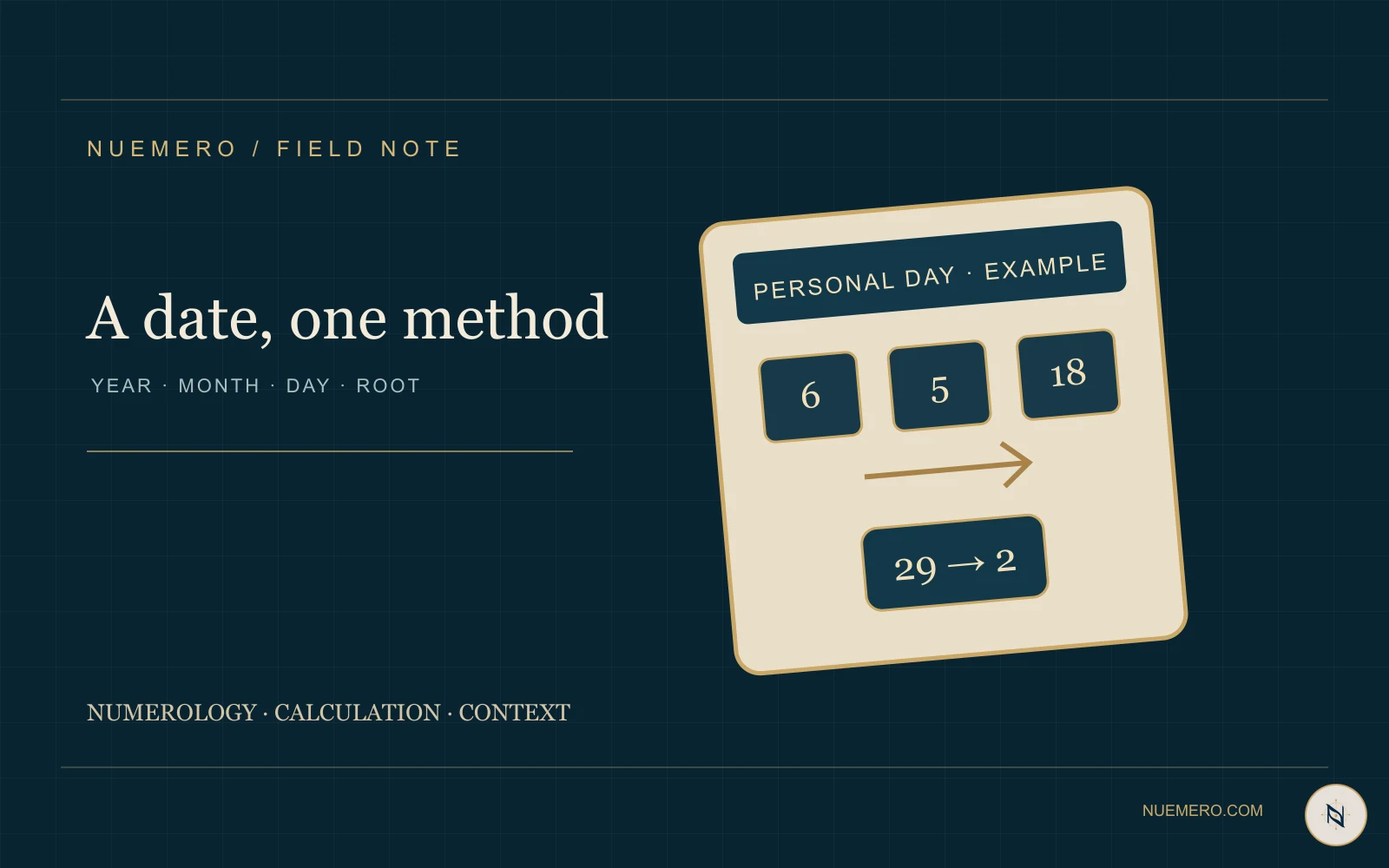
Core numbers & calculations·7 min
Personal Day Number: A Calculation You Can Check
Follow one clearly stated numerology convention for a Personal Day number, compare common calculation choices, and use the result as an optional reflection prompt rather than a forecast.
Read the guide