
Core numbers & calculationsNumerology guide
Personal Day Number: A Calculation You Can Check
Follow one clearly stated numerology convention for a Personal Day number, compare common calculation choices, and use the result as an optional reflection prompt rather than a forecast.
The short answer
Start here
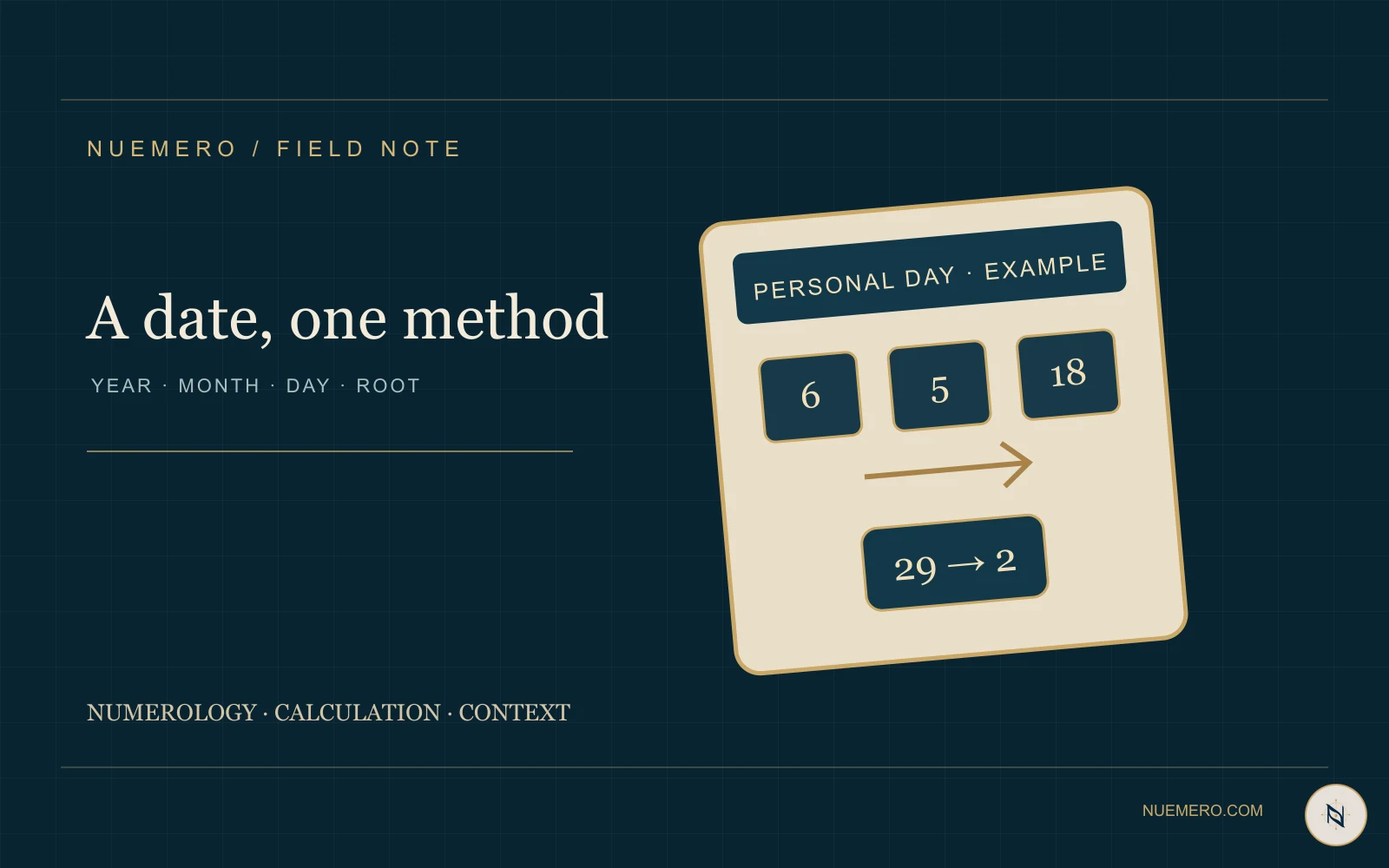
“Personal Day” is a modern numerology label, and authors vary on how they combine it with Personal Month and Personal Year. This guide names one reproducible convention: calculate the Personal Year, add the calendar month and day, then reduce to one digit. For 18 May in a Personal Year 6, 6 + 5 + 18 = 29 → 11 → 2 if master numbers are not retained here. The arithmetic is checkable; the interpretation is traditional, not a reliable forecast.
Key takeaways
There is no single Personal Day formula shared by every numerology school.
This example adds Personal Year + calendar month + day, then reduces the result.
Write the date, year boundary, and master-number rule beside the answer.
Use a number as a journaling prompt, not as the reason for a consequential choice.
On this page
What a Personal Day label describes
Some modern numerology readers assign a daily number by combining a person's longer cycle with a calendar date. The label and arithmetic are not standardized across every author. Before comparing two calendars, find out whether they use a Personal Month, a Personal Year, the universal calendar year, and which date marks a cycle change.
The guide below uses one convenient convention for demonstration. It is not presented as the one historically correct formula. If your teacher or calculator declares another convention, keep that method consistent and show its steps instead of mixing the totals.
Worked example: 18 May in Personal Year 6
Assume that a separately calculated Personal Year is 6. Use the calendar month as 5 and the day as 18. Add 6 + 5 + 18 = 29. Reduce 29 to 11, then to 2 under the single-digit convention used in this example. If a source preserves 11 at this stage, its display may instead be 11/2; record the choice.
One declared convention · illustrative date
65 + 186 + 5 + 18 = 2929 → 11 → 2 (or 11/2 if retained)Why daily calendars can disagree
A calendar may change the Personal Year on January 1 or on the birthday; it may calculate a Personal Month first and add a date number; it may also retain master numbers. Any of those choices changes the answer without making the arithmetic internally inconsistent. Compare the declared inputs and sequence before comparing meanings.
Keep the calendar year in view. A Personal Day page for a particular date should show the date and time zone if the reading depends on a local day boundary. Do not imply that a number changes what will happen or that it can identify a guaranteed lucky hour.
Turn a reading into a useful question
If you enjoy the symbolic framework, make the day's theme a low-stakes journaling prompt: What do I want to complete? Which conversation needs preparation? What evidence should I check before buying or committing? The answers come from your circumstances, not from the number.
For appointments, money, health, or relationship decisions, use relevant information and qualified advice. A numerology calendar is a cultural or reflective tool; it is not a substitute for a schedule, forecast, or professional assessment.
Method and limits
This guide describes the conventions stated above and the way Nuemero’s current calculator works. Numerology interpretations are traditional beliefs, not scientific predictions. Check a source’s method before applying its meanings.
Read Nuemero’s full methodQuick answers
Frequently asked questions
How do I calculate a Personal Day number?
There is no universal formula. In the convention shown here, add Personal Year + calendar month + day and reduce according to a stated master-number rule.
Does the Personal Day change at midnight?
A calendar usually follows a chosen local calendar day, but authors and time-zone settings can differ. State the date and time zone when precision matters.
Is a Personal Day number a prediction?
It is a numerology interpretation attached to a calculation convention, not a validated way to forecast an individual's events. Treat it as optional reflection.
Why does another website show a different number?
Check the Personal Year boundary, whether a Personal Month is included, the date and time zone, and the rule for retaining 11, 22, or 33.
Read further
Sources and method notes
- Nuemero personal-cycles calculatorCompare the product's stated cycle calculation and date inputs.
- Nuemero calculation methodologyReview the current rules before comparing two numerology outputs.
Sources document calculation conventions and claims made within their traditions. They are not evidence that numerology predicts real-world outcomes.
Core numbers & calculations·7 min
Personal Month Number: Formula, Example, and Calendar Boundaries
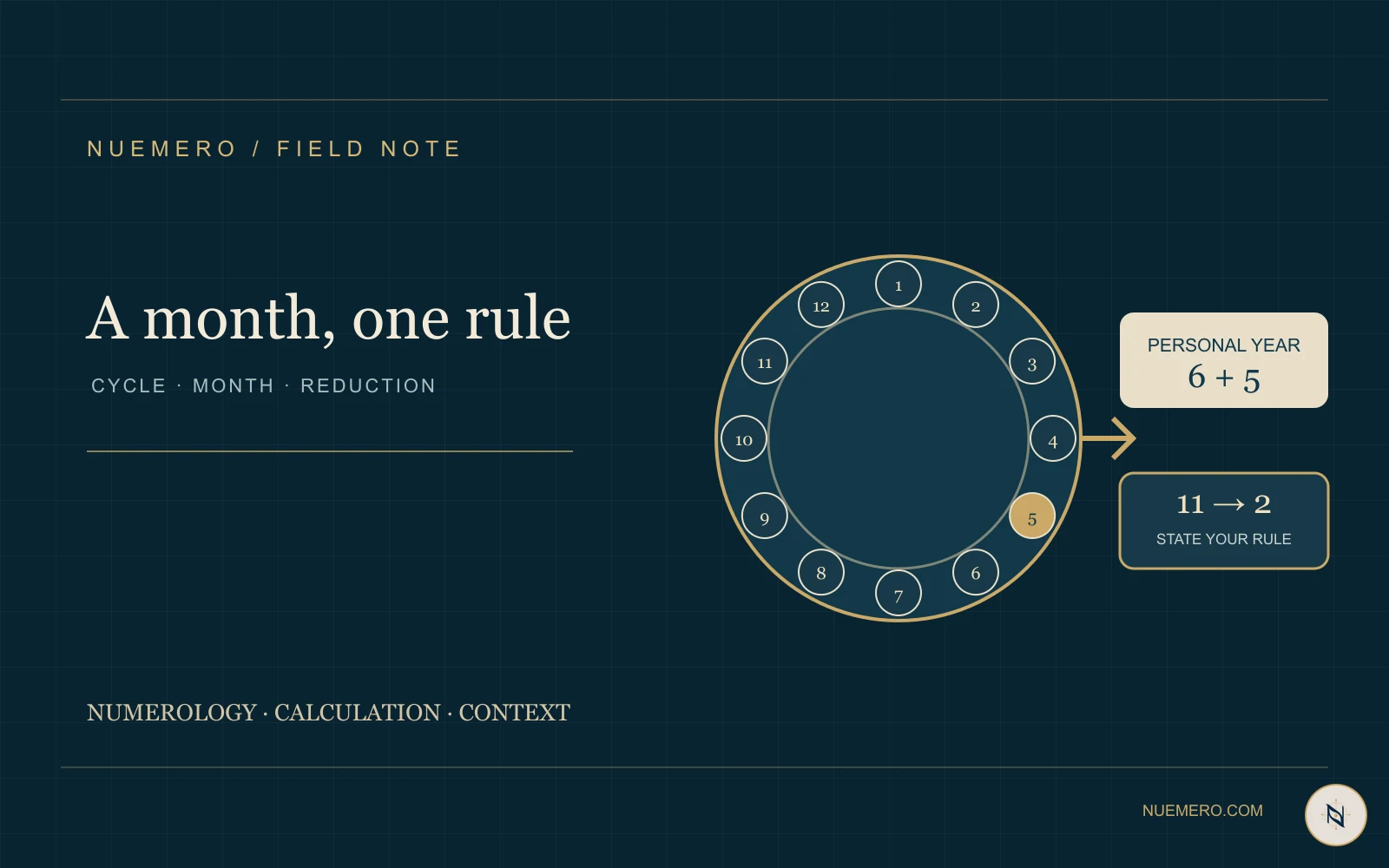
See one transparent Personal Month calculation, learn why calendar and master-number rules change the result, and turn the reading into a practical monthly reflection.
Read the guide
Core numbers & calculations·6 min
How to Calculate a Life Path Number (and Why Formulas Differ)
Calculate a Life Path number from a birth date, see every addition in a worked example, and learn how master-number conventions change the display.
Read the guide