
Core numbers & calculationsNumerology guide
Personal Month Number: Formula, Example, and Calendar Boundaries
See one transparent Personal Month calculation, learn why calendar and master-number rules change the result, and turn the reading into a practical monthly reflection.
The short answer
Start here
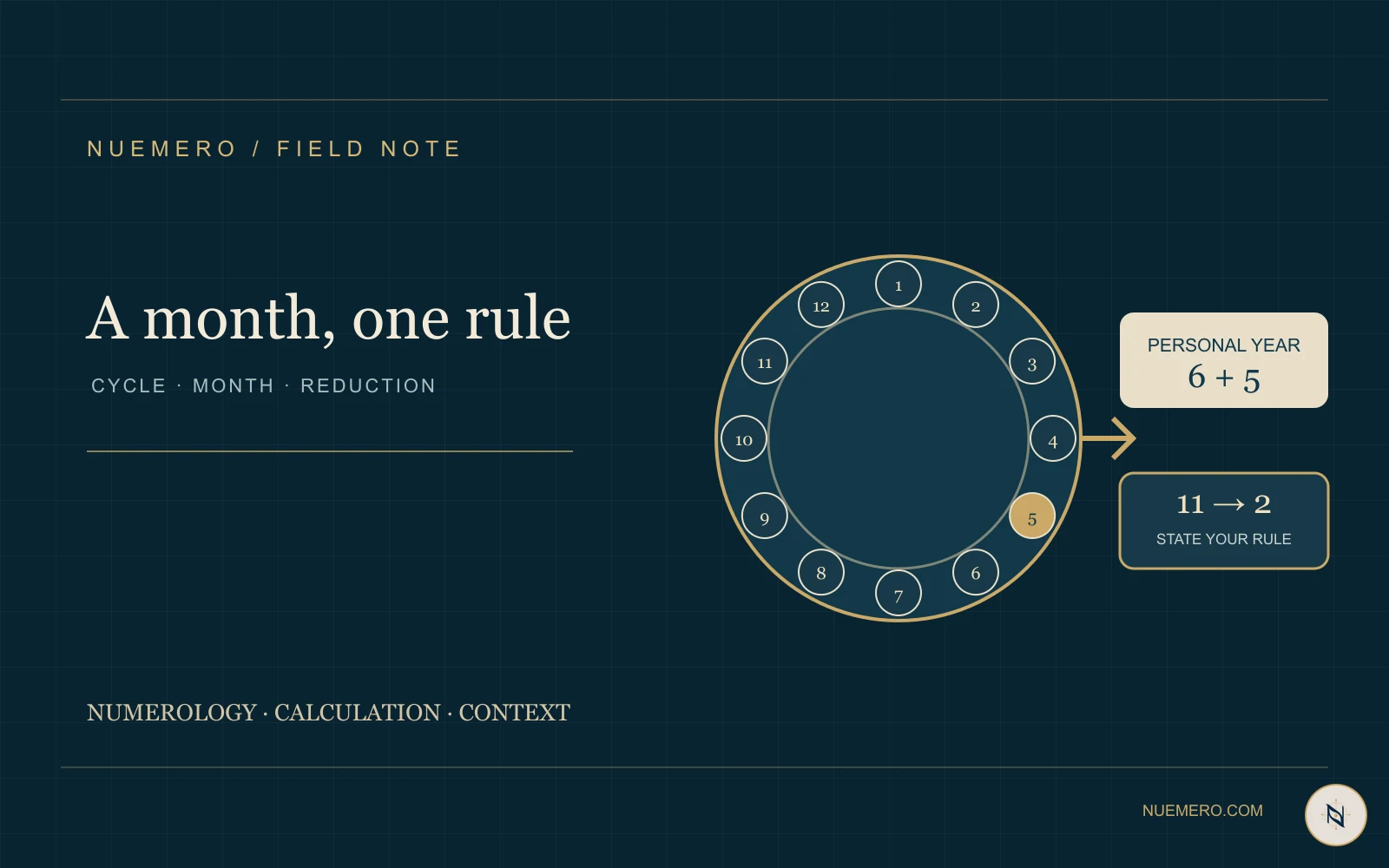
Personal Month is a modern numerology convention, and calendars do not all calculate it alike. In this worked example, take a Personal Year of 6 and calendar month 5: 6 + 5 = 11, then reduce to 2 when the chosen convention does not retain 11 at this stage. Other sources may preserve 11/2 or use a different cycle boundary. State the formula, year rule, and master-number policy; treat the interpretation as reflection, not a promise about the month.
Key takeaways
Personal Month formulas and cycle boundaries vary by source.
This example adds the Personal Year and calendar month: 6 + 5 = 11 → 2.
Show whether 11, 22, or 33 is retained at the intermediate step.
Use the theme for planning questions, not guaranteed timing or financial decisions.
On this page
What a Personal Month number represents
Some modern numerology approaches combine a Personal Year with the number of a calendar month to make a Personal Month. It is an interpretive cycle within those approaches, not a standardized calendar shared by every school. A site may start its cycle in January, on a birthday, or under another stated convention.
Because the label sounds precise, a reader may mistake it for a measured forecast. Keep the calculation visible and label meanings as traditional themes. The sum itself cannot establish what events a month will bring.
Worked example: a Personal Year 6 in May
For this demonstration, use the calendar month index and add it to an already calculated Personal Year. May is month 5. If the Personal Year is 6, the month total is 6 + 5 = 11. Under a rule that reduces this intermediate total, 1 + 1 = 2; a source that preserves 11 can show 11/2 instead. The inputs are illustrative, and the convention is declared rather than universal.
A declared month-index convention
656 + 5 = 1111 → 2 (or retain 11/2)Check the cycle boundary and reduction rule
A published calendar may label months by the civil calendar year, while another may connect the month to a Personal Year that turns on a birthday. It may also preserve a compound number at one step and reduce it at another. Read the author's rule before using a chart; do not copy a number from a different convention into it.
When comparing two results, write the month, year cycle, formula, and master-number treatment beside each one. This quick audit often explains a mismatch without assuming the arithmetic is wrong.
Use the theme as a planning prompt
If you read symbolic themes, use them to ask grounded questions: What is one priority for this month? Which task needs a smaller first step? What date, budget, and help do I need? Those answers should come from your commitments and available information, not a number label.
Do not postpone a medical appointment, investment, job application, or important conversation because a month number is called unfavorable. Use qualified advice and practical constraints for consequential decisions.
Method and limits
This guide describes the conventions stated above and the way Nuemero’s current calculator works. Numerology interpretations are traditional beliefs, not scientific predictions. Check a source’s method before applying its meanings.
Read Nuemero’s full methodQuick answers
Frequently asked questions
How do you calculate a Personal Month number?
One common modern convention adds the Personal Year and the calendar month index, then applies a declared reduction rule. Sources vary, so show the exact steps used.
Does Personal Month begin on the first or my birthday?
The cycle boundary depends on the method. Check whether the source follows calendar months or a birthday-based Personal Year cycle.
Why is my Personal Month 11 on one site and 2 on another?
One may retain 11/2 as a compound or master number while another reduces it to 2. Compare the intermediate-step rule.
Can a Personal Month number guarantee a good or bad month?
No. It is a traditional interpretation attached to a chosen formula, not a validated forecast. Treat it as an optional reflection prompt.
Read further
Sources and method notes
- Nuemero personal cycles calculatorInspect the date inputs and currently published cycle conventions.
- Nuemero calculation methodologyCompare a displayed total with the method that produced it.
Sources document calculation conventions and claims made within their traditions. They are not evidence that numerology predicts real-world outcomes.
Core numbers & calculations·7 min
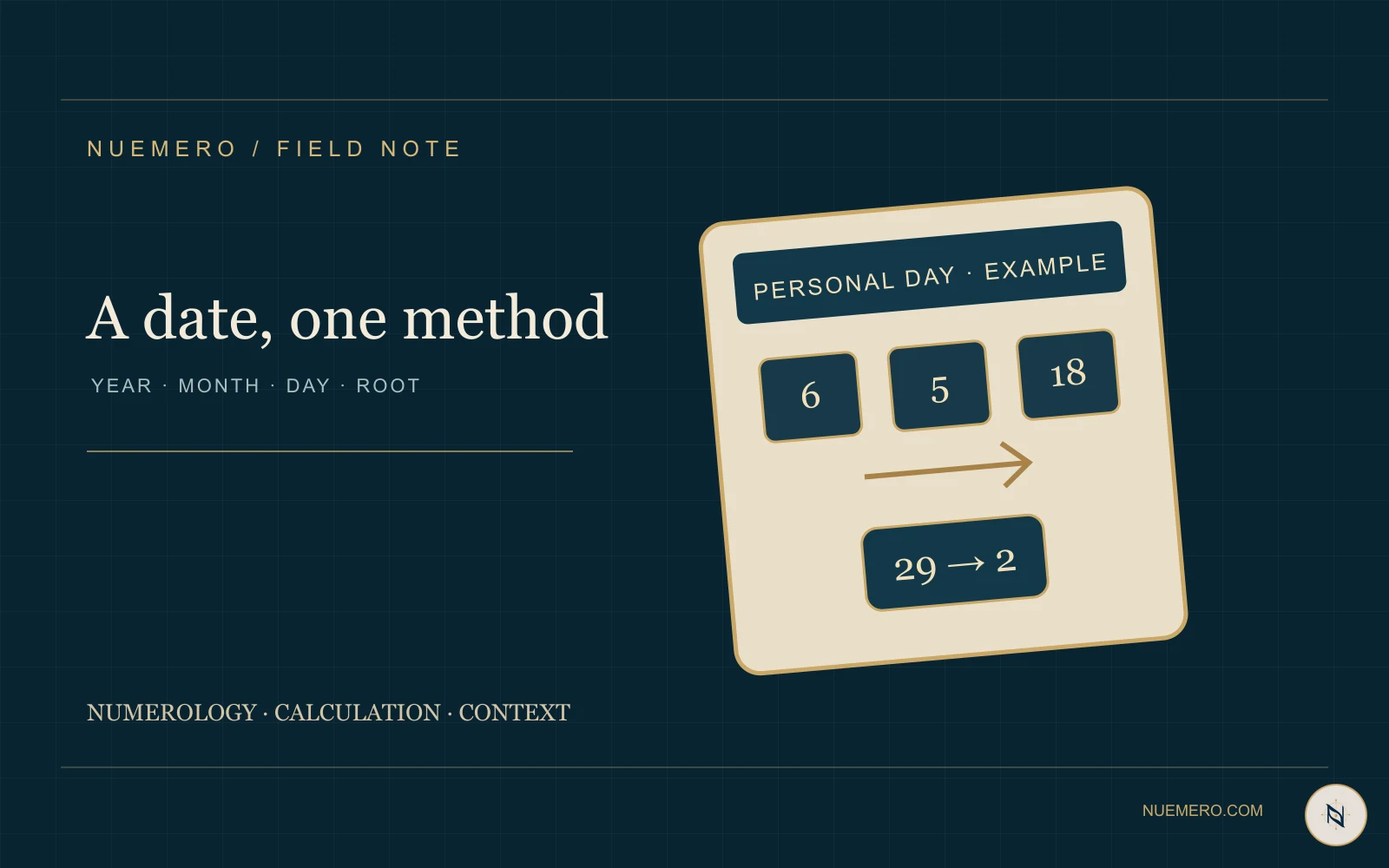
Personal Day Number: A Calculation You Can Check
Follow one clearly stated numerology convention for a Personal Day number, compare common calculation choices, and use the result as an optional reflection prompt rather than a forecast.
Read the guide
Core numbers & calculations·6 min
How to Calculate a Life Path Number (and Why Formulas Differ)
Calculate a Life Path number from a birth date, see every addition in a worked example, and learn how master-number conventions change the display.
Read the guide