
Core numbers & calculationsNumerology guide
Birthday Number in Numerology: Keep the Day and Its Root
Calculate a Birthday Number from the day of birth, preserve its double-digit form beside the reduced digit, and see how one practitioner convention distinguishes it from Life Path.
The short answer
Start here
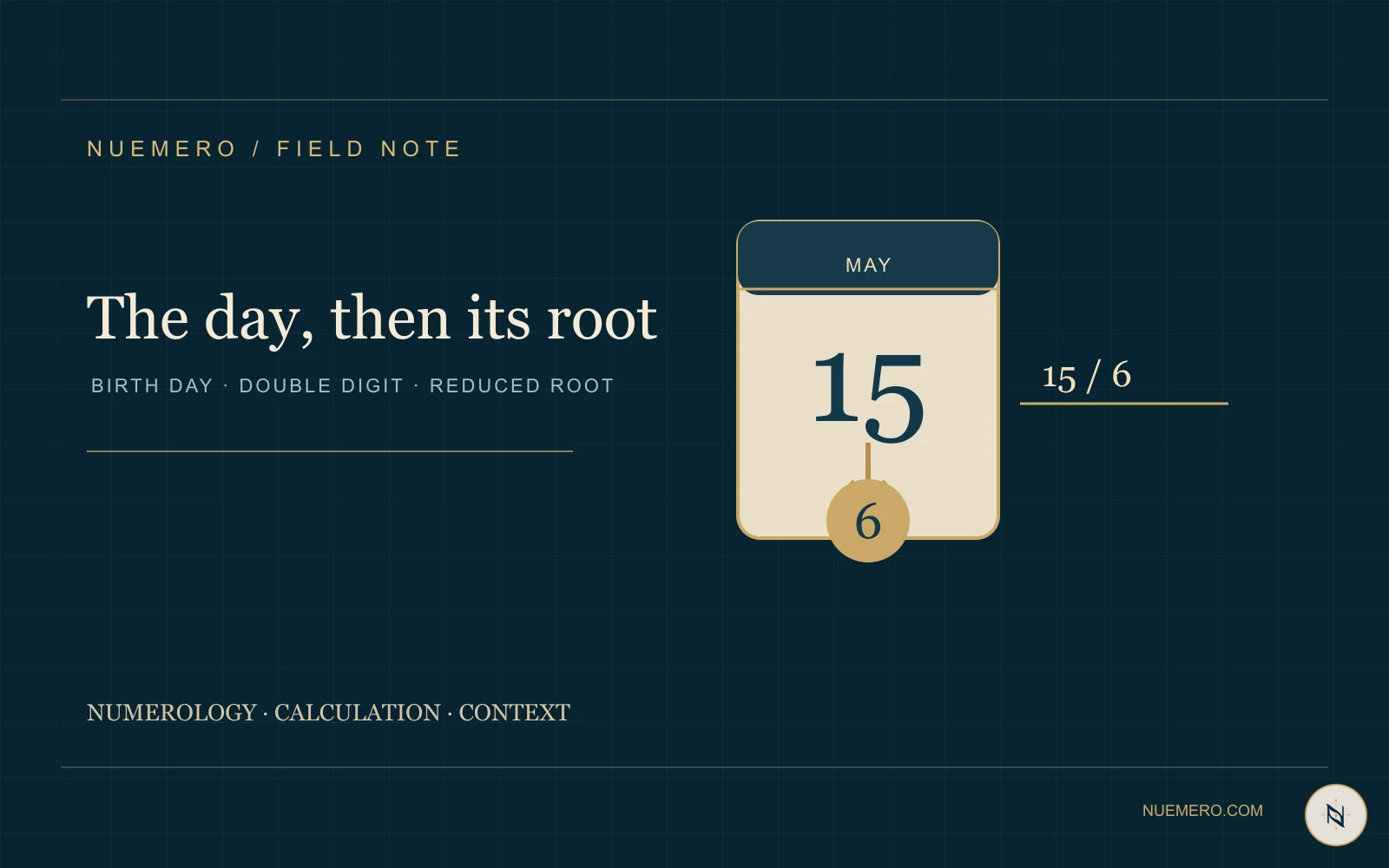
In Hans Decoz’s practitioner convention, the Birthday number is the calendar day of birth, read both as its original one- or two-digit number and, when applicable, its reduced root. A person born on the 15th therefore has a 15/6 Birthday number in this presentation. The Life Path uses the complete date and is a different calculation. Traditional associations are symbolic interpretations, not a verified measure of talent or a basis for hiring, health, or relationship decisions.
Key takeaways
Start with the day number itself; for the 15th, keep 15 visible before reducing to 6.
Birthday number and Life Path use different inputs.
A symbolic reading cannot establish a person’s actual skills or future.
On this page
Use the birth day, not the whole date
This article follows Hans Decoz’s published method: the Birthday number is simply the day of the month on which a person was born. The source examines both the double-digit day and its single-digit reduction. Other numerology writers may frame the number differently, so name the convention when comparing charts.
Do not replace a day such as 15 with 6 and throw away the original value if your selected source interprets both layers. Keeping 15/6 makes the arithmetic and the source’s two-part reading inspectable.
Worked example: day 15 becomes 15/6
For a fictional date of 15 May 1992, the Birthday input is 15. Add its digits: 1 + 5 = 6. Record the result as 15/6 under this convention. No month or birth year is added to calculate this number.
15 May 1992 · fictional example
151 + 5 = 615 / 6Birthday number is not Life Path
The Birthday number uses one component—the day. The Life Path uses the complete date under a specified reduction convention. Two people born on the same day in different months or years can share a Birthday number while having different Life Path calculations. Keep the two labels and inputs separate in any chart or calculator.
Practitioner texts may attach a talent theme to the Birthday number. Treat that as a tradition-specific prompt to reflect on skills you can actually observe and develop, not proof of a hidden ability or a reason to choose someone else’s career for them.
Method and limits
This guide describes the conventions stated above and the way Nuemero’s current calculator works. Numerology interpretations are traditional beliefs, not scientific predictions. Check a source’s method before applying its meanings.
Read Nuemero’s full methodQuick answers
Frequently asked questions
What is my Birthday number if I was born on the 15th?
In the cited Decoz convention, it is shown as 15/6: the birth day is 15 and 1 + 5 reduces to 6.
Is Birthday number the same as Life Path?
No. Birthday uses the calendar day; Life Path uses the whole date and a stated reduction rule.
Does the number prove I have a specific talent?
No. Talent meanings are traditional interpretations, not a validated skills assessment. Use experience, practice, and relevant evidence to understand your abilities.
Read further
Sources and method notes
- Hans Decoz: How to Do Your Own Numerology ReadingDefines the Birthday number as the day of birth and says to examine its single- and double-digit forms.
- Hans Decoz: Birthday NumbersPractitioner interpretation source; its claims are presented as tradition, not validated measurement.
Sources document calculation conventions and claims made within their traditions. They are not evidence that numerology predicts real-world outcomes.
Core numbers & calculations·7 min
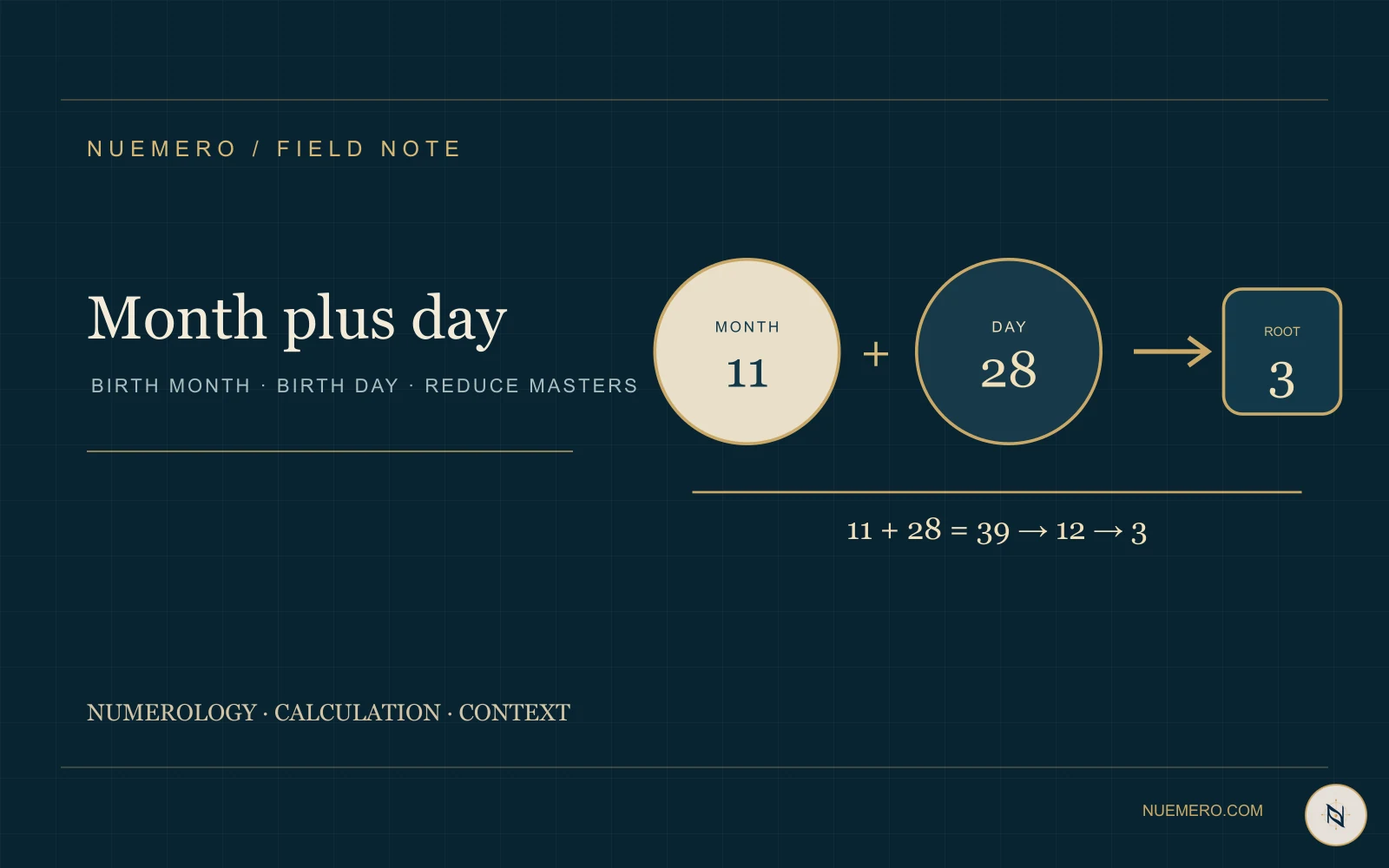
Attitude Number: Add Birth Month and Day, Then Reduce
Calculate the Decoz Attitude Number from birth month and day, see how its arithmetic matches the First Pinnacle input, and keep their chart interpretations distinct.
Read the guide
Core numbers & calculations·6 min
How to Calculate a Life Path Number (and Why Formulas Differ)
Calculate a Life Path number from a birth date, see every addition in a worked example, and learn how master-number conventions change the display.
Read the guide