
Cycles & timingNumerology guide
Numerology Cycles Compared: Personal Year, Pinnacle, Period, and Essence
Use a side-by-side guide to identify each cycle's inputs and timing, see how name-based and date-based methods differ, and avoid mixing unlike chart layers.
The short answer
Start here
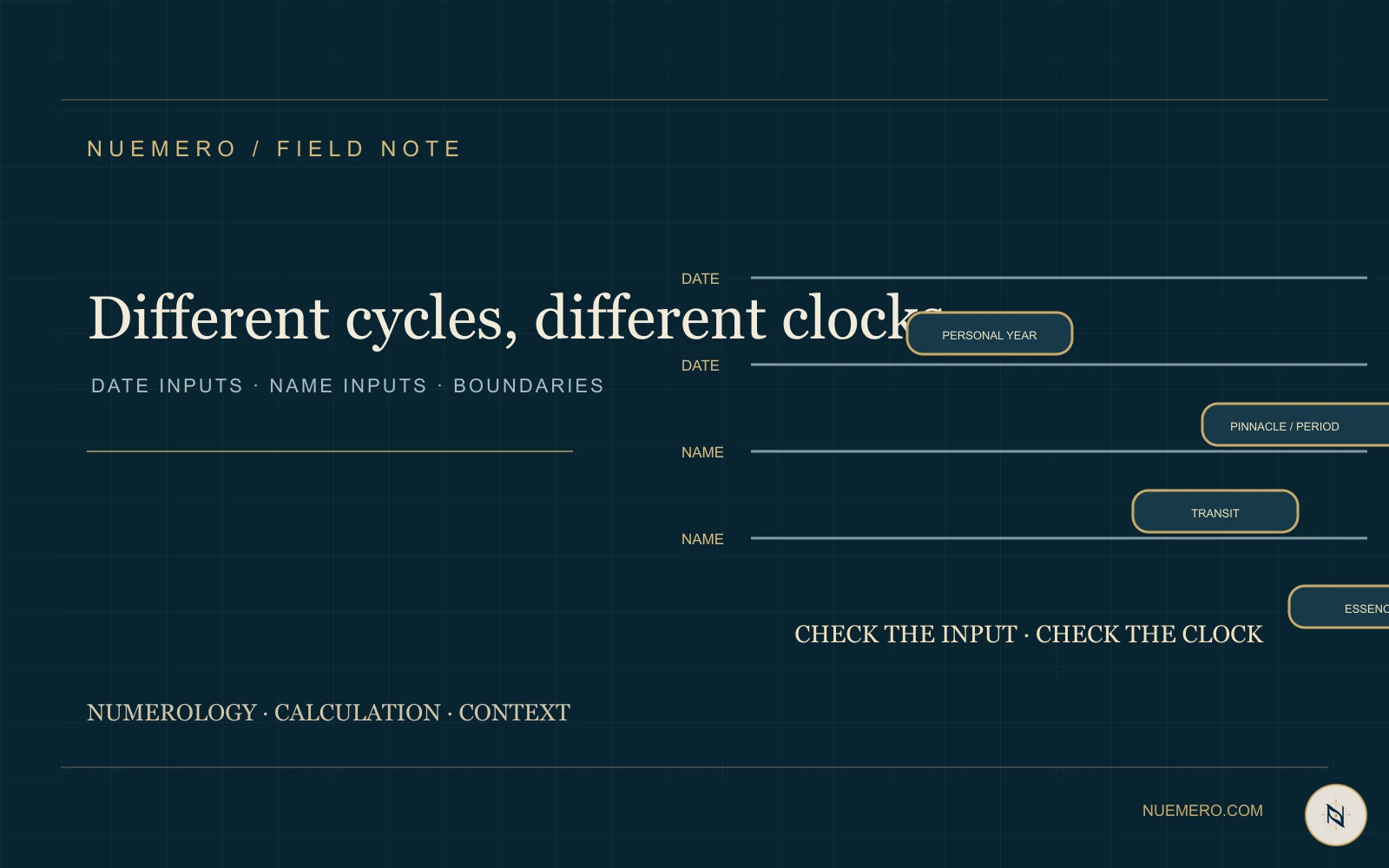
Numerology charts may show several cycles at once. In common modern Western systems, Personal Year uses birth-date numbers and usually follows a calendar-year convention; Pinnacles and Challenges combine birth-date components into longer phases; Period Cycles use month, day, and year in one practitioner method; Transits and Essence use name letters and may run birthday to birthday. The formulas and transition rules vary by source. Label each method and its time boundary before comparing results. A layered chart is an interpretive framework, not a proven event calendar.
Key takeaways
A cycle's name does not tell you its input; check the formula and source.
Name-derived and date-derived cycles may use different clocks and boundaries.
Compare like with like and treat interpretations as traditional reflection.
On this page
Cycles built from birth-date inputs
A Personal Year is a short-term cycle derived from date components under a stated reduction rule. Pinnacle and Challenge systems use combinations of month, day, and year to describe longer chart phases; their formulas and age boundaries must be attributed to a particular source. Period Cycles are another practitioner's three-part structure based separately on month, day, and year. These labels should not be treated as one interchangeable timeline.
Cycles built from name letters
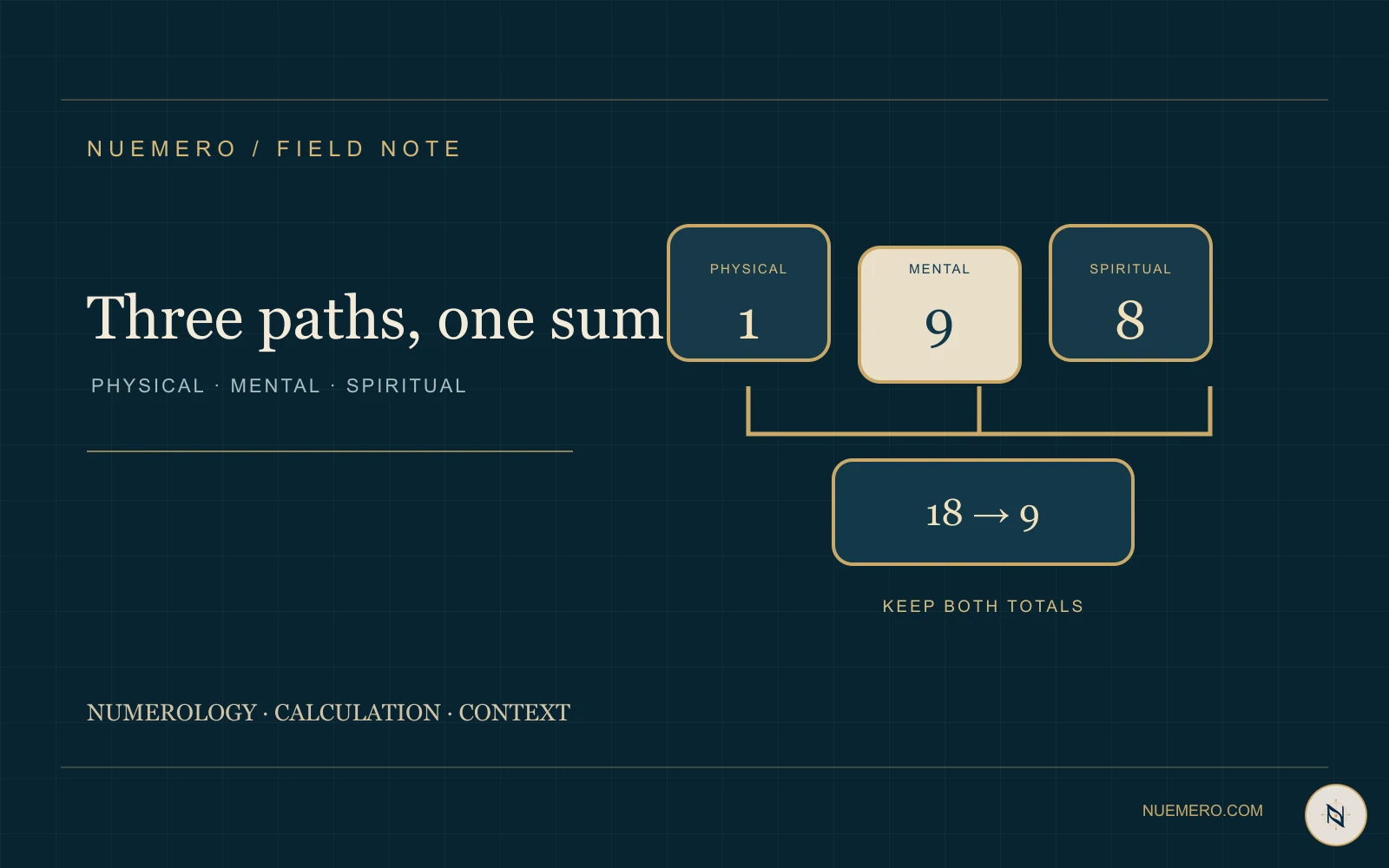
In Hans Decoz's chart framework, Transits are linked to individual name letters, and Essence adds active physical, mental, and spiritual Transit values. These cycles are described with birthday-to-birthday timing, unlike a Personal Year that the same source places on the calendar-year clock. Name spelling and transliteration therefore matter to those calculations.
A four-question check before reading a cycle
For each row in a chart, write: What input produced this number? Which author or school defines the formula? What date or age starts and ends the period? Is the displayed total reduced or compound? If any answer is missing, pause before combining that row with another cycle. Matching digits do not imply matching meanings.
Use a cycle as an optional reflection question, then plan with actual commitments, capacity, and evidence. Do not use it alone to time a medical decision, investment, wedding, move, or career change.
Method and limits
This guide describes the conventions stated above and the way Nuemero’s current calculator works. Numerology interpretations are traditional beliefs, not scientific predictions. Check a source’s method before applying its meanings.
Read Nuemero’s full methodQuick answers
Frequently asked questions
Are Personal Year and Essence cycles the same?
No. In the cited system, Personal Year is date-based and calendar-year timed; Essence is name-Transit based and birthday-to-birthday. Other schools may define timing differently.
Can I combine several cycles into one prediction?
You can compare them as traditional chart layers if each method is labeled, but their combined reading is still an interpretation—not verified evidence of an event.
Which cycle should I trust most?
For arithmetic, trust a clearly stated, reproducible rule. For important decisions, rely on relevant real-world evidence and qualified advice rather than ranking symbolic cycles.
Read further
Sources and method notes
- Hans Decoz: Personal Year and Essence CyclesPractitioner comparison of date-based Personal Year and name-based Essence timing.
- Nuemero: Pinnacle NumbersRead one cycle's date formula and age boundary in detail.
Sources document calculation conventions and claims made within their traditions. They are not evidence that numerology predicts real-world outcomes.
Cycles & timing·7 min
Essence Cycle in Numerology: Add the Name Transits
See how one practitioner method combines physical, mental, and spiritual name transits, keeps the compound total, and distinguishes this birthday-to-birthday cycle from a Personal Year.
Read the guide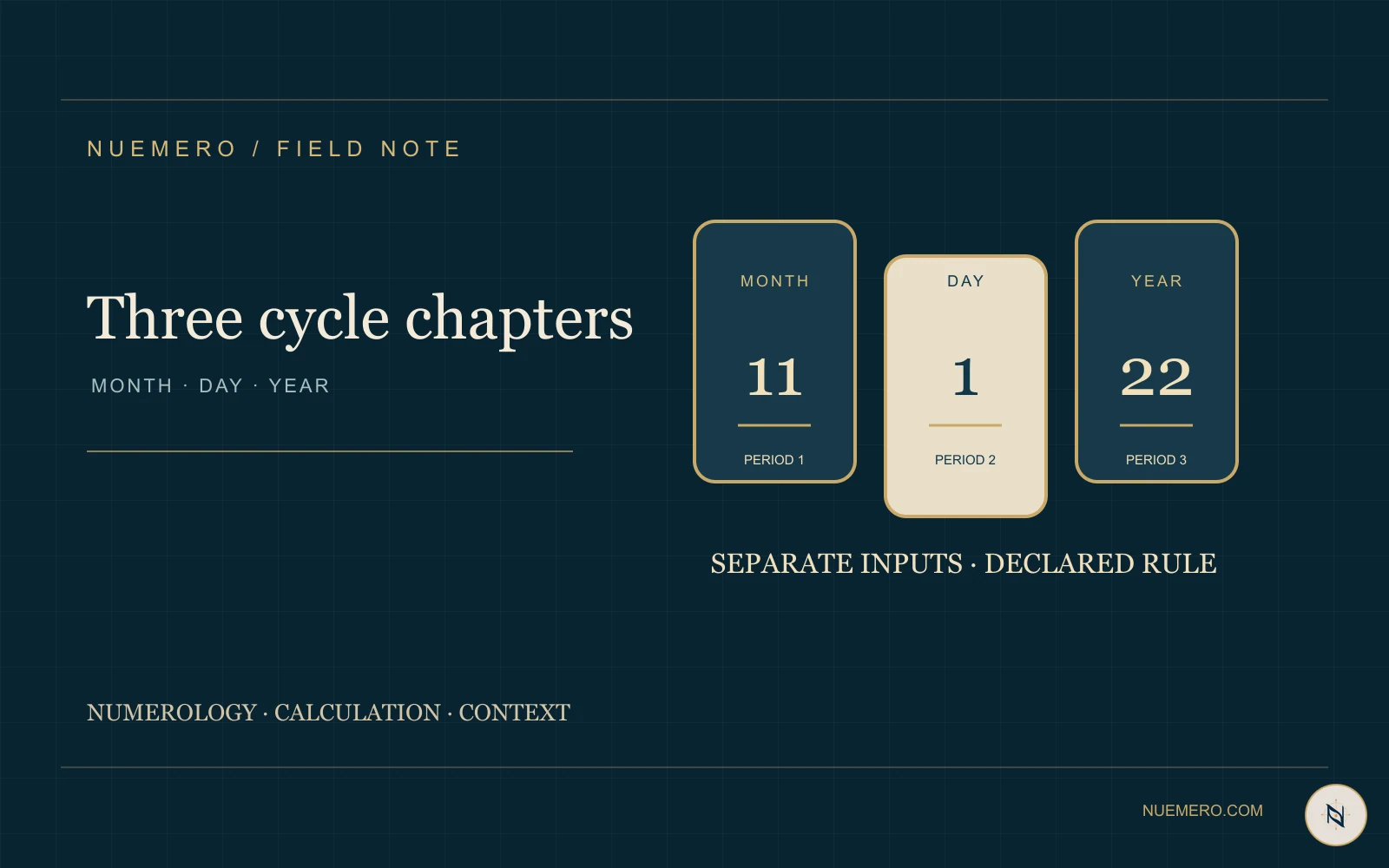
Cycles & timing·8 min
Period Cycles in Numerology: Calculate the Month, Day, and Year Numbers
Work through a three-part Period Cycle chart from birth month, day, and year, distinguish its inputs from Pinnacles, and check how one source defines the transition ages.
Read the guide