
Cycles & timingNumerology guide
Period Cycles in Numerology: Calculate the Month, Day, and Year Numbers
Work through a three-part Period Cycle chart from birth month, day, and year, distinguish its inputs from Pinnacles, and check how one source defines the transition ages.
The short answer
Start here
In the cited Hans Decoz method, the three Period Cycle numbers come separately from birth month, birth day, and birth year, each reduced to a single digit or retained Master Number under that source's convention. The source says the first period lasts until the first Personal Year 1 on or after age 27; the second lasts 27 years; the third continues thereafter. Its transition ages depend on Life Path. Do not confuse these with Pinnacles, which use different combinations and timing formulas. This is a tradition-specific framework, not an evidence-based life-stage assessment.
Key takeaways
First, second, and third Period Cycles use birth month, day, and year respectively in the cited method.
Keep Master Number handling and the Life Path timing rule explicit.
Period Cycles and Pinnacles are different chart calculations, even when both describe broad phases.
On this page
Three inputs, three cycle values
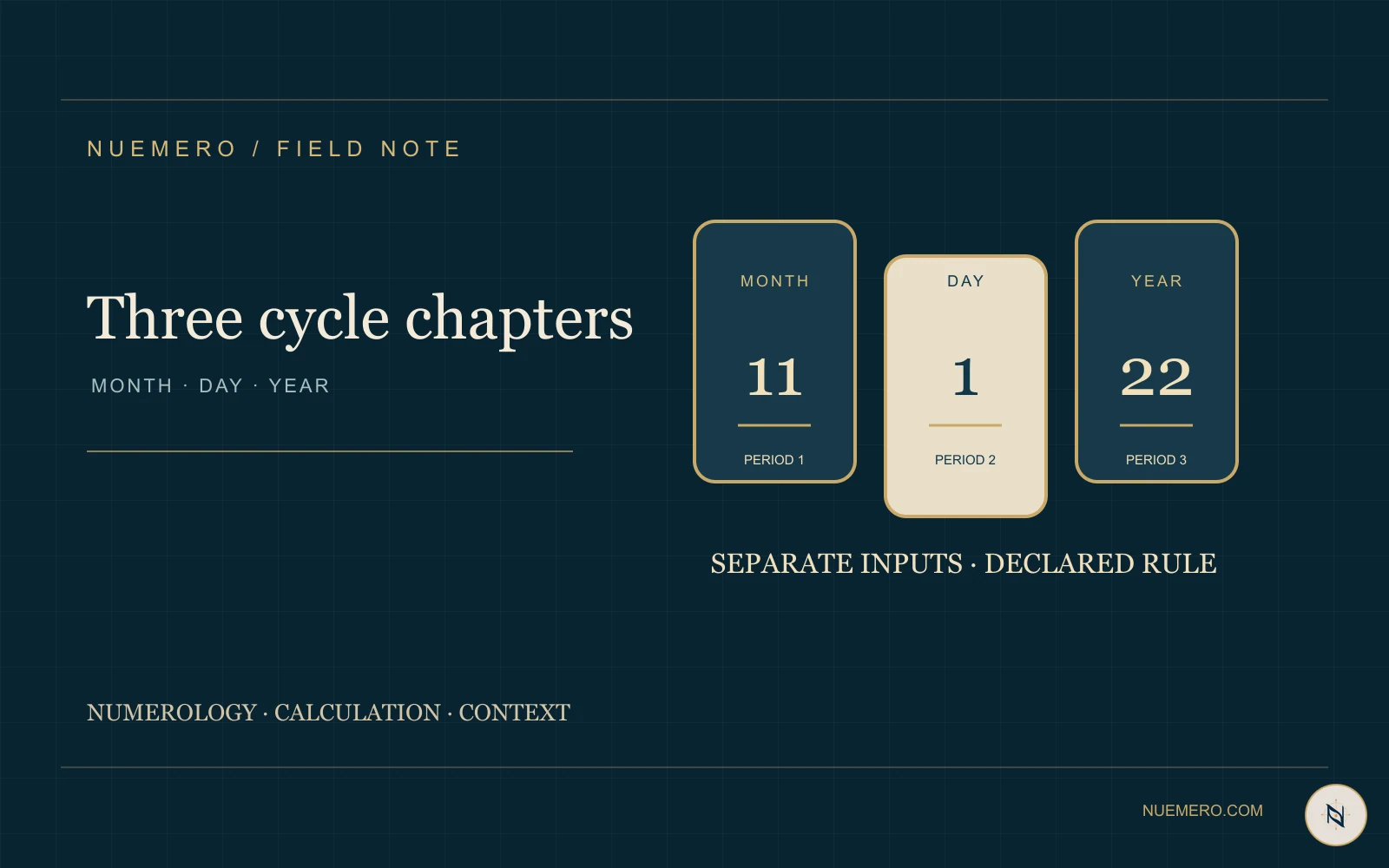
The cited source derives the first Period Cycle from birth month, the second from birth day, and the third from birth year. Reduce each under the source's stated rule, and preserve a Master Number only if that rule says to. Keep the raw input beside the reduced result so another reader can reproduce it.
For a fictional date of 28 November 1984, the month is 11, the day is 28, and the year digits total 22. Under a convention retaining 11 and 22 while reducing 28, the displayed values are 11, 1 (2 + 8), and 22. This example demonstrates input mapping only; disclose the selected convention because schools vary.
Fictional date · convention shown
November = 1128 → 2 + 8 = 10 → 11 + 9 + 8 + 4 = 22Timing is a separate calculation
The source describes the first period as lasting until the first Personal Year 1 on or after age 27, the second as exactly 27 years, and the third as the remaining later period. It says the transition ages depend on Life Path. Those boundaries come from that author's chart system, so do not infer them by simply dividing a lifespan into thirds.
Pinnacles also describe numbered periods in some numerology charts, but they are calculated using different date combinations and their own duration rule. Label each result so a reader can tell which cycle system is being shown.
Use the framework without making it a verdict
A period label may prompt a useful journal question—what skills, responsibilities, or relationships are present in your life right now? The answer should come from your actual circumstances. A numerology chart cannot verify a fixed life stage or determine what someone should do.
For education, career, financial, health, or relationship decisions, consider practical evidence and qualified help where needed. Keep numerology optional and clearly labeled as a traditional interpretation.
Method and limits
This guide describes the conventions stated above and the way Nuemero’s current calculator works. Numerology interpretations are traditional beliefs, not scientific predictions. Check a source’s method before applying its meanings.
Read Nuemero’s full methodQuick answers
Frequently asked questions
How do I calculate the three Period Cycles?
In the cited method, reduce the birth month, birth day, and birth year separately under the chosen Master Number rule. The source's timing formula is a separate step.
Are Period Cycles the same as Pinnacles?
No. They are separate chart calculations with different input combinations and timing rules. Name the system and convention for each result.
Do Period Cycles define what will happen in my life?
No reliable evidence establishes numerology cycles as predictors of life events. Treat the framework as optional reflection, not a decision rule.
Read further
Sources and method notes
- Hans Decoz: Numerology Period CyclesPractitioner source for month/day/year inputs, cycle sequence, and the source-specific duration boundaries.
- Hans Decoz: Calculate Every NumberShows the broader chart context and helps distinguish Period Cycle arithmetic from neighboring cycle calculations.
Sources document calculation conventions and claims made within their traditions. They are not evidence that numerology predicts real-world outcomes.
Cycles & timing·8 min
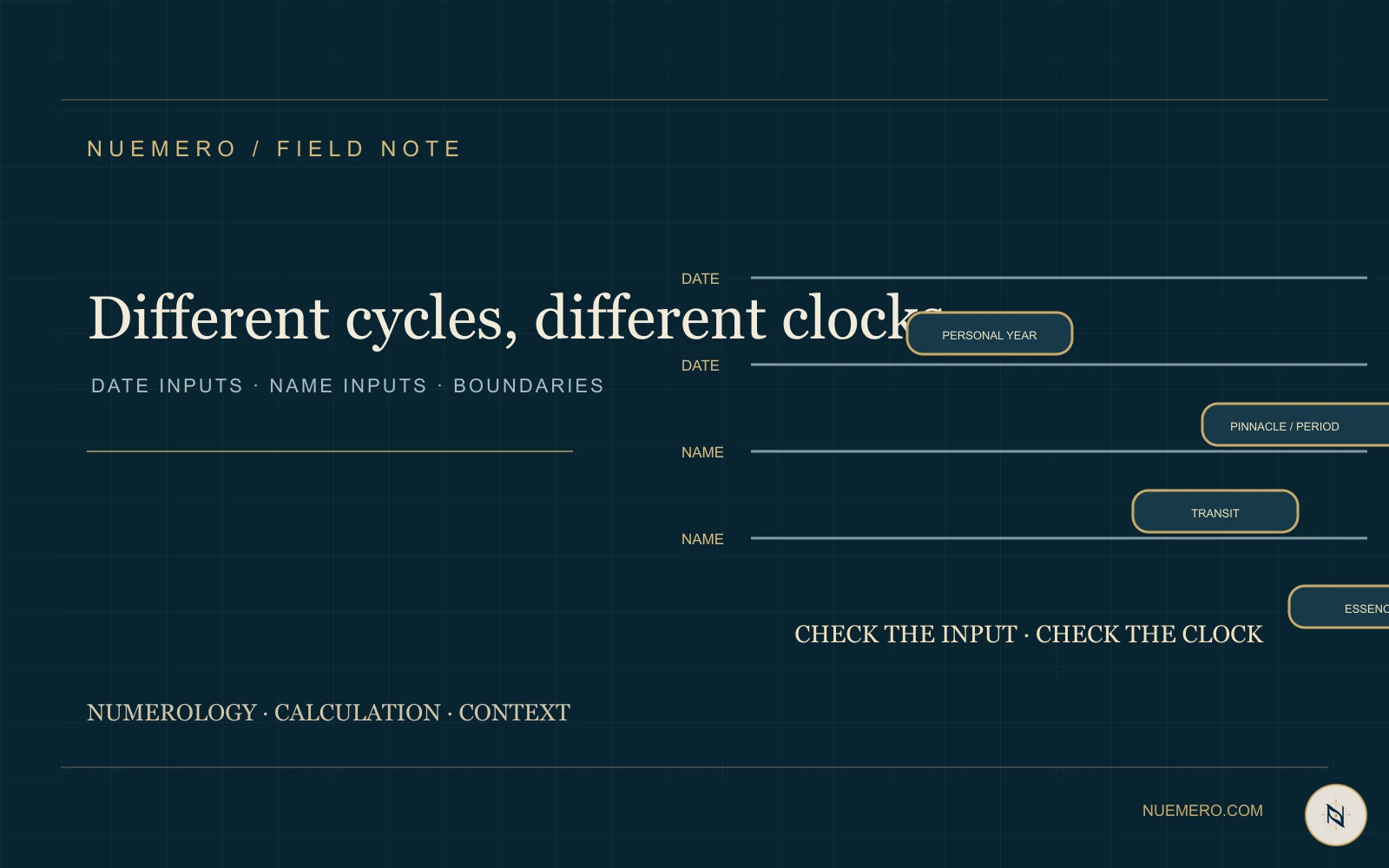
Numerology Cycles Compared: Personal Year, Pinnacle, Period, and Essence
Use a side-by-side guide to identify each cycle's inputs and timing, see how name-based and date-based methods differ, and avoid mixing unlike chart layers.
Read the guide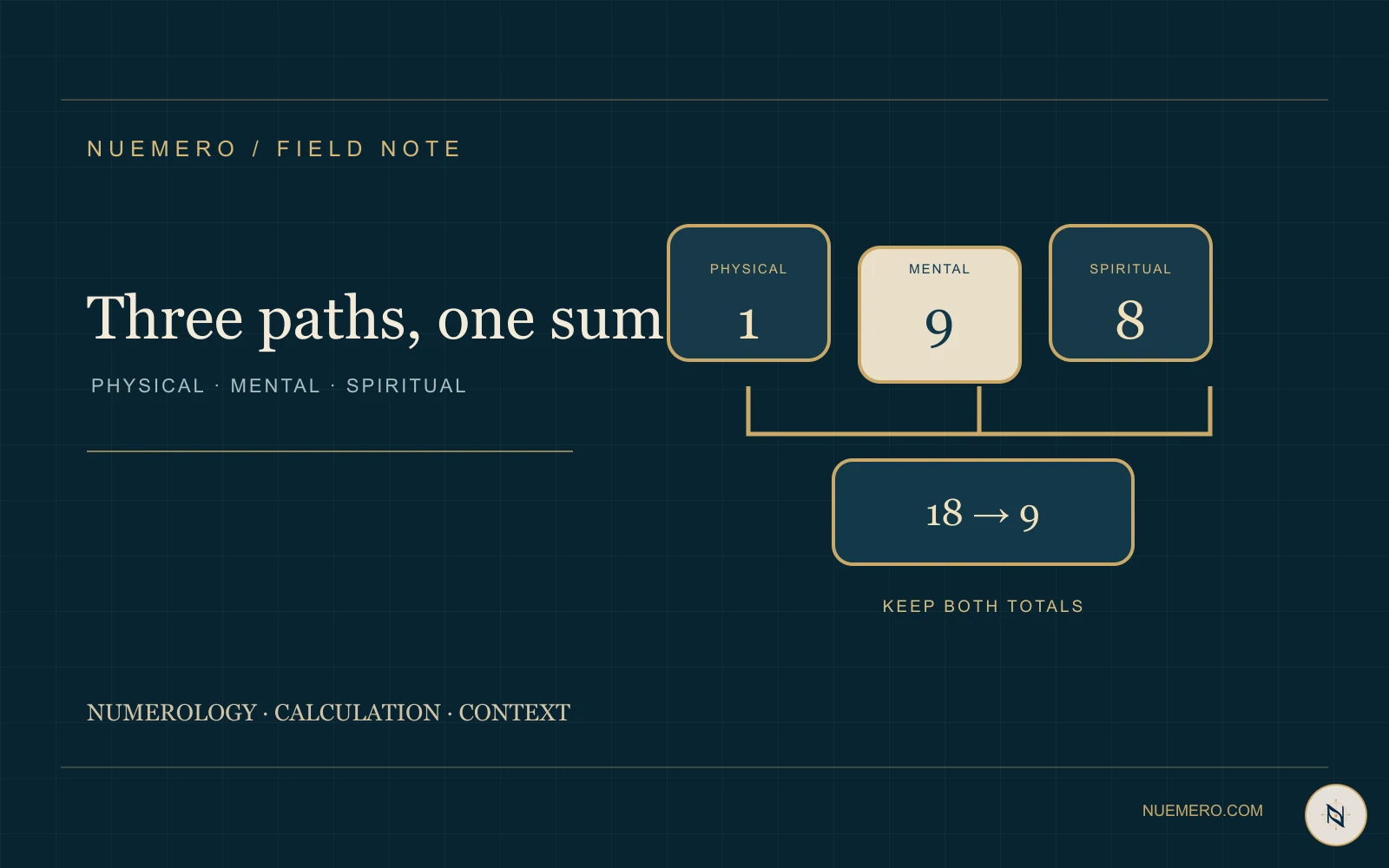
Cycles & timing·7 min
Essence Cycle in Numerology: Add the Name Transits
See how one practitioner method combines physical, mental, and spiritual name transits, keeps the compound total, and distinguishes this birthday-to-birthday cycle from a Personal Year.
Read the guide