
Research, evidence & responsible useNumerology guide
Numerology Testimonials: What a Success Story Can—and Cannot—Show
Learn why a moving personal story does not establish a prediction’s accuracy, how selected examples distort expectations, and what evidence to ask for.
The short answer
Start here
A testimonial can truthfully describe one person’s experience, but a collection of positive stories does not show how often a reading misses, how results compare with chance, or whether typical customers experience the same outcome. Selection, memory, expectation, and marketing can shape which stories are shared. Look for a defined claim, all outcomes, suitable comparison, transparent methods, and independent replication. For advertising claims, consumer-protection rules also require endorsements not to mislead about typical results.
Key takeaways
A sincere story is evidence of one person’s report, not a measured general success rate.
Ask how many readings did not fit and whether all outcomes were recorded.
Marketing testimonials should not imply that unusual outcomes are typical without substantiation.
Prefer specific methods and independently checkable results over a gallery of praise.
On this page
What a testimonial actually tells you
A reader’s account may tell you what they remember, how they interpreted a session, or whether the service felt welcoming. Those experiences matter to that person. But a claim such as “the reading predicted my promotion” needs more than a recollection to establish predictive accuracy: Was the statement recorded before the event? Was it specific? How many forecasts did not happen? Were alternative explanations considered?<br>
A page that shows only successful examples leaves the denominator hidden. Without knowing how many people were read, how cases were chosen, and how misses were handled, the examples cannot estimate how often a claimed result occurs.
Check the story and the marketing around it
Ask whether the endorser received payment, a free reading, a referral benefit, or another incentive. Find out whether the testimonial is typical or an exceptional case and what evidence supports that claim. The U.S. Federal Trade Commission’s endorsement guidance says advertising endorsements must not mislead and that exceptional outcomes require appropriate context or support.
A testimonial cannot establish a general claim just by being heartfelt or repeated. Genuine reviews can still be unrepresentative, and the presence of a famous or confident endorser does not replace a transparent test.
What evidence would answer the question better?
For a predictive claim, look for a precise preregistered prediction, a comparison group, blind scoring, all enrolled participants, defined success criteria, and results from an independent replication. For arithmetic, ask for the actual input, rule, intermediate sums, and a repeatable calculation. Different claims need different evidence.
Keep a personal story as a story: it can suggest a question or explain why a service mattered to someone. Do not use it as a substitute for the calculation, method, or representative evidence.
Method and limits
This guide describes the conventions stated above and the way Nuemero’s current calculator works. Numerology interpretations are traditional beliefs, not scientific predictions. Check a source’s method before applying its meanings.
Read Nuemero’s full methodQuick answers
Frequently asked questions
Do numerology testimonials prove the readings work?
No. They report individual experiences, but do not by themselves establish typical accuracy, comparison with chance, or causation. Ask for defined methods and complete results.
Can a successful story still be genuine?
Yes. A person may sincerely describe what happened to them. The separate question is whether that one account supports a claim about what most people can expect.
What should a numerology service disclose with testimonials?
For advertising, disclose material connections and do not imply exceptional results are typical without adequate support or clear context. Also explain what the reading can and cannot establish.
Read further
Sources and method notes
- FTC: Endorsements and testimonialsOfficial U.S. consumer-protection guidance on truthful endorsements, material connections, and claims about typical results in advertising.
- Nuemero: Test numerology claims fairlyShows how to replace a testimonial with a preregistered, measurable research question.
Sources document calculation conventions and claims made within their traditions. They are not evidence that numerology predicts real-world outcomes.
Research, evidence & responsible use·8 min
Can Numerology Predict Money, Health, Marriage, or Fertility?
A candid guide to the evidence and limits of numerology predictions, with safer ways to handle health, financial, relationship, and fertility decisions.
Read the guide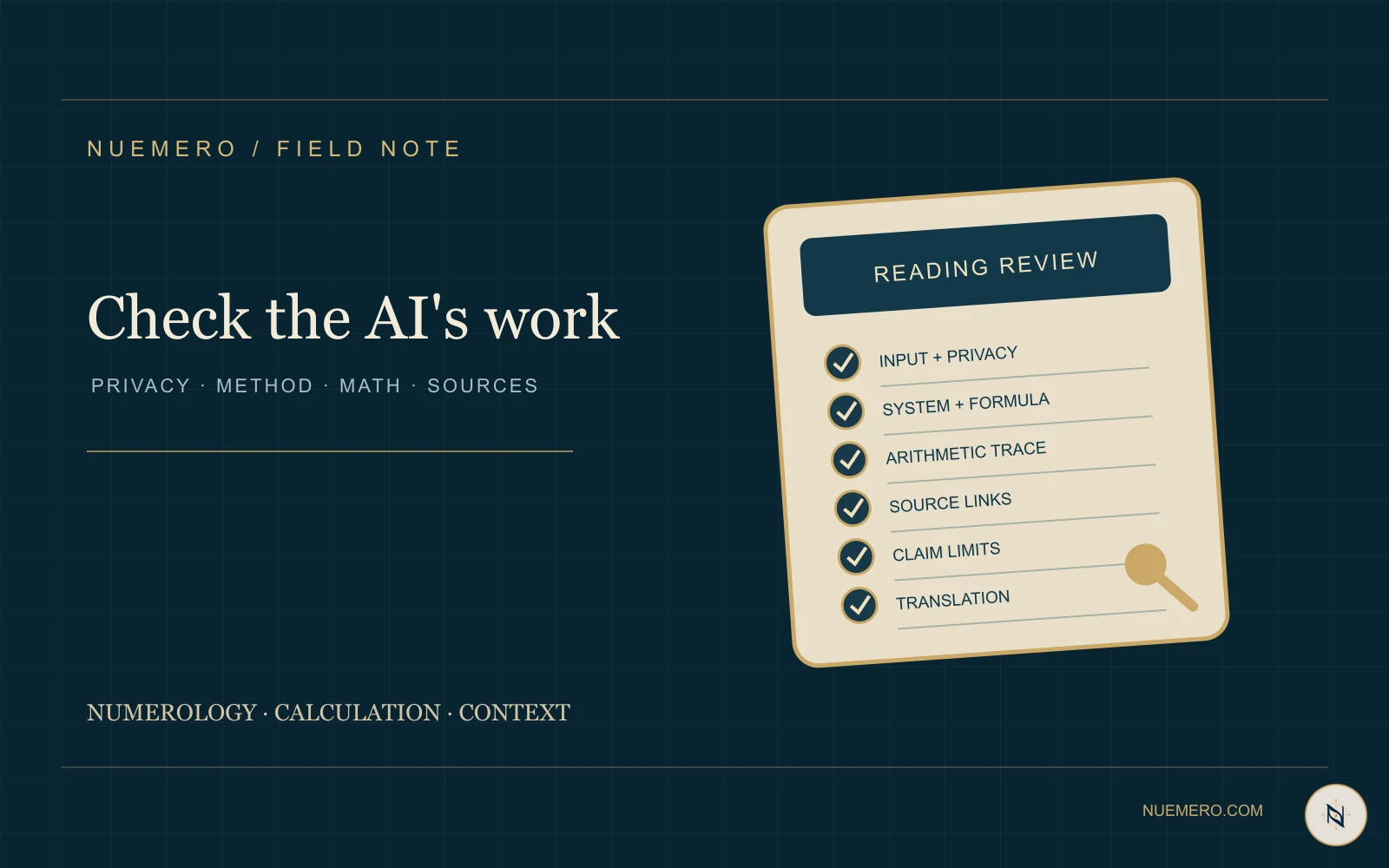
Research, evidence & responsible use·7 min
How to Check an AI Numerology Reading: A 6-Step Review
Audit an AI numerology answer for input privacy, system choice, arithmetic, source quality, unsupported certainty, and language accuracy before acting on it.
Read the guide