
Research, evidence & responsible useNumerology guide
How to Test a Numerology Claim Fairly: A Simple Research Checklist
Turn a broad prediction into a specific, preregistered question with blinded scoring, comparison conditions, clear outcomes, and an independent replication plan.
The short answer
Start here
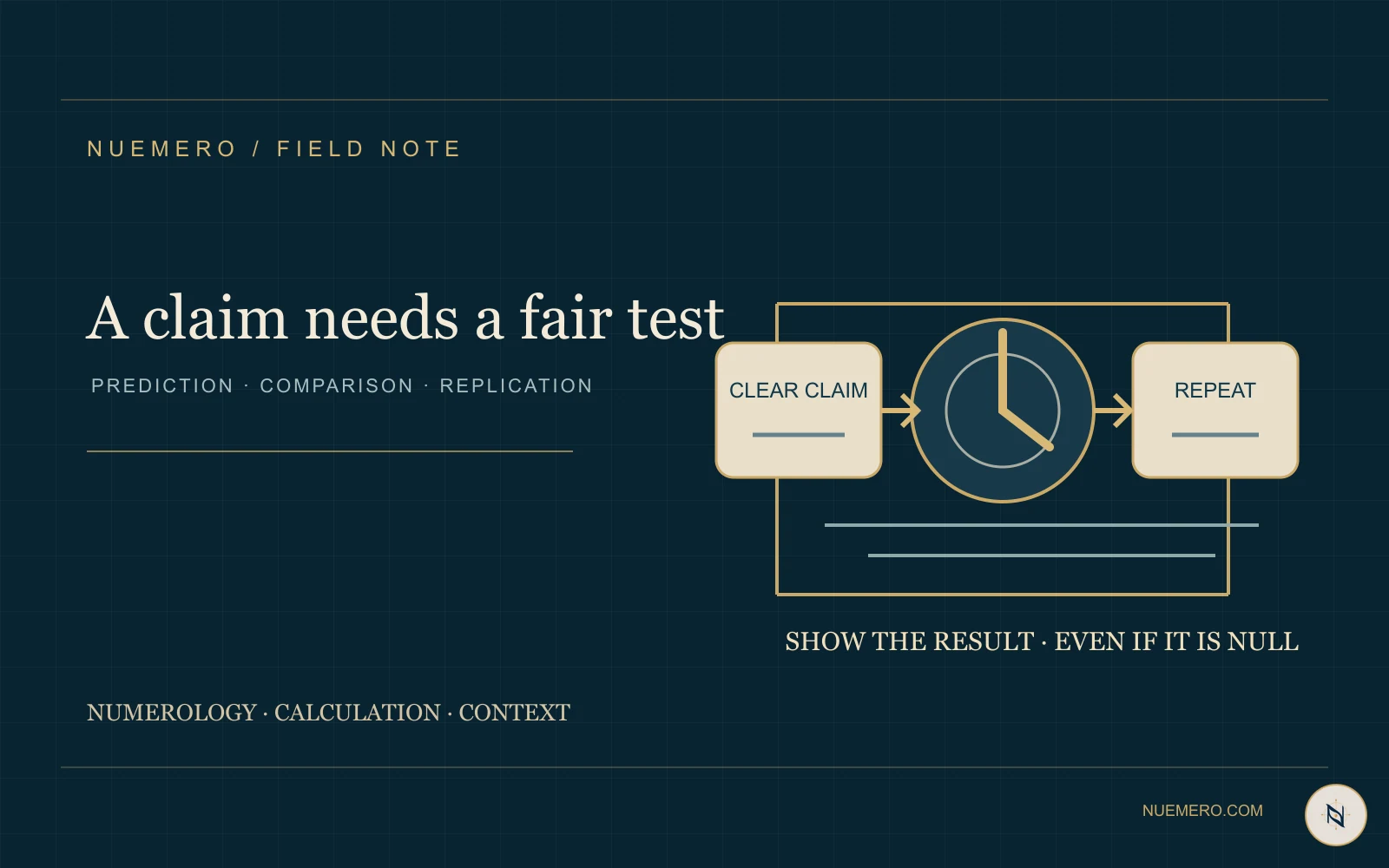
A fair test begins with one precise claim and a result that could prove it wrong. Define the numerology rule before seeing outcomes, use a suitable comparison group, blind readers and scorers where possible, predefine scoring, and report every result—including null findings. Record the protocol before collecting data and invite independent teams to repeat it. A personal story or one striking match can inspire a test, but it cannot substitute for one.
Key takeaways
State a specific, falsifiable claim before collecting or examining outcomes.
Name the system, input, calculation rule, outcome measure, and comparison condition in advance.
Use blinding and preregistration to reduce flexible scoring and hindsight changes.
Publish null results and independent replications, not only successful examples.
On this page
Turn the claim into a testable question
Replace “the chart reveals your true personality” with a narrower prediction: “In a blinded matching task, can a reader match a preregistered chart interpretation to the person’s own profile more often than to decoys, under a scoring rule fixed in advance?” The test should state what result would count against the claim, not only what would support it.
Name the specific tradition, birth-date or name inputs, letter table, reduction convention, and interpretation text. If these choices change after the results appear, label the later analysis exploratory rather than presenting it as the original test.
Design before seeing the outcome
Decide who participates, how profiles are selected, how many readings and decoys each person sees, how outcomes are scored, and which statistical analysis answers the question. Randomize presentation order and hide names, chart labels, and answer keys from scorers. Protect personal birth data and obtain appropriate informed consent before collecting it.
The American Psychological Association notes that preregistration can strengthen theoretical claims by recording hypotheses and analysis plans before research is conducted. A public, time-stamped plan helps readers distinguish a planned test from patterns noticed after the fact.
Report the result that happened
Report recruitment, exclusions, missing data, scoring decisions, uncertainty, and every preregistered outcome. Include results that do not support the prediction. State whether the work was exploratory or confirmatory, share materials or code where ethical and lawful, and distinguish the arithmetic result from the interpretation attached to it.
A single study is not the final word. Invite independent researchers to repeat the same protocol, then compare results across teams and settings. If the outcomes do not replicate, publish that information instead of changing the rule until a favorable answer appears.
Method and limits
This guide describes the conventions stated above and the way Nuemero’s current calculator works. Numerology interpretations are traditional beliefs, not scientific predictions. Check a source’s method before applying its meanings.
Read Nuemero’s full methodQuick answers
Frequently asked questions
What makes a numerology claim falsifiable?
It makes a specific prediction and names an observable result that would count against it. A statement that can be reinterpreted to fit any outcome is difficult to test fairly.
Should researchers preregister a numerology study?
Preregistration is useful when researchers want to distinguish planned hypotheses and analyses from exploratory patterns noticed after data collection. It does not guarantee a good design, but makes the plan easier to inspect.
Is one successful matching example proof?
No. A fair evaluation needs predefined criteria, suitable comparisons, all outcomes, and ideally independent replication. One memorable example can motivate a test but cannot establish general predictive accuracy.
Read further
Sources and method notes
- APA: Preregistration guidanceAPA journal guidance explains how preregistered hypotheses and analysis plans distinguish confirmatory from exploratory research.
- Nuemero: Is numerology scientific?Separates repeatable arithmetic from claims about personality or prediction.
Sources document calculation conventions and claims made within their traditions. They are not evidence that numerology predicts real-world outcomes.
Research, evidence & responsible use·7 min
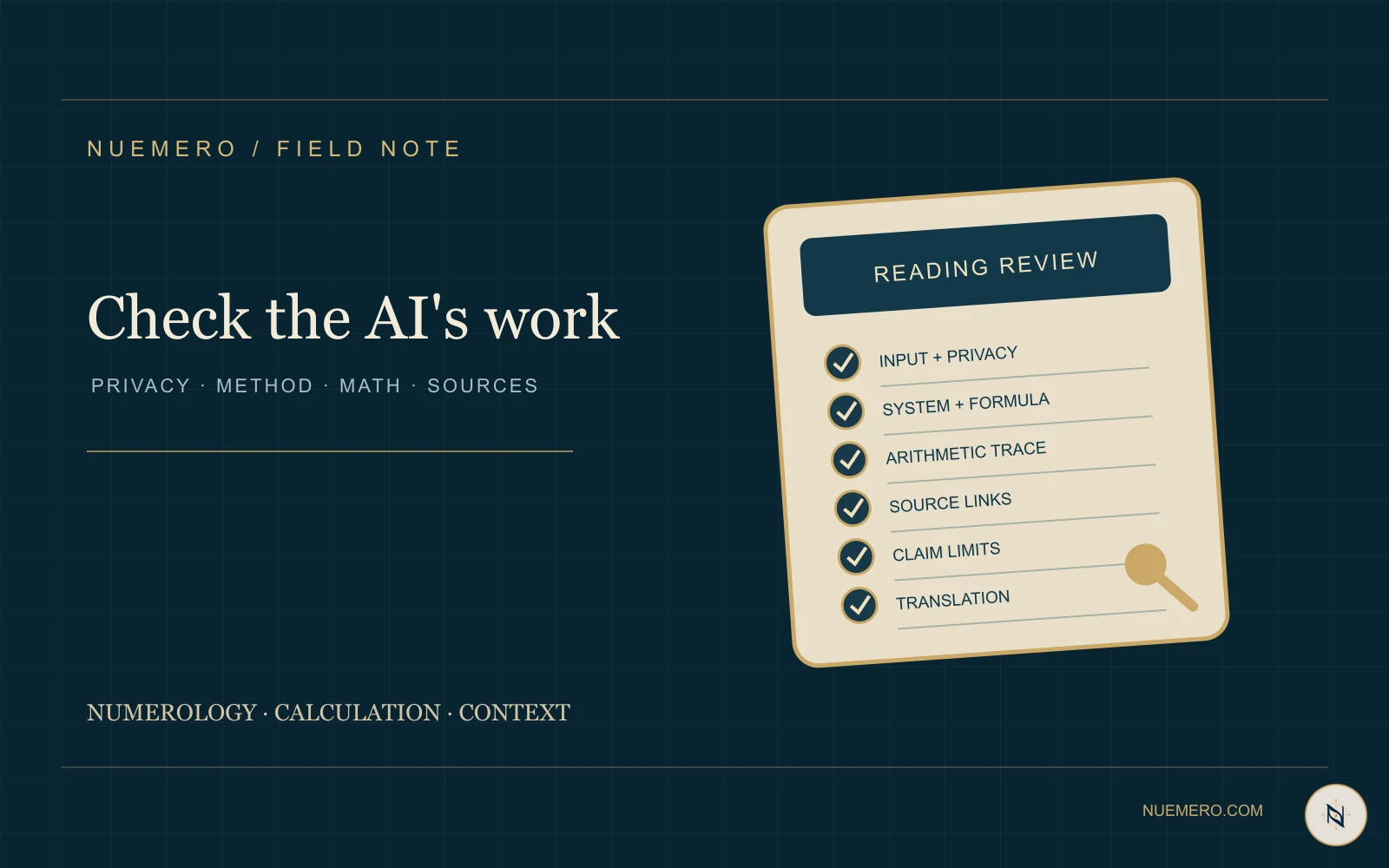
How to Check an AI Numerology Reading: A 6-Step Review
Audit an AI numerology answer for input privacy, system choice, arithmetic, source quality, unsupported certainty, and language accuracy before acting on it.
Read the guide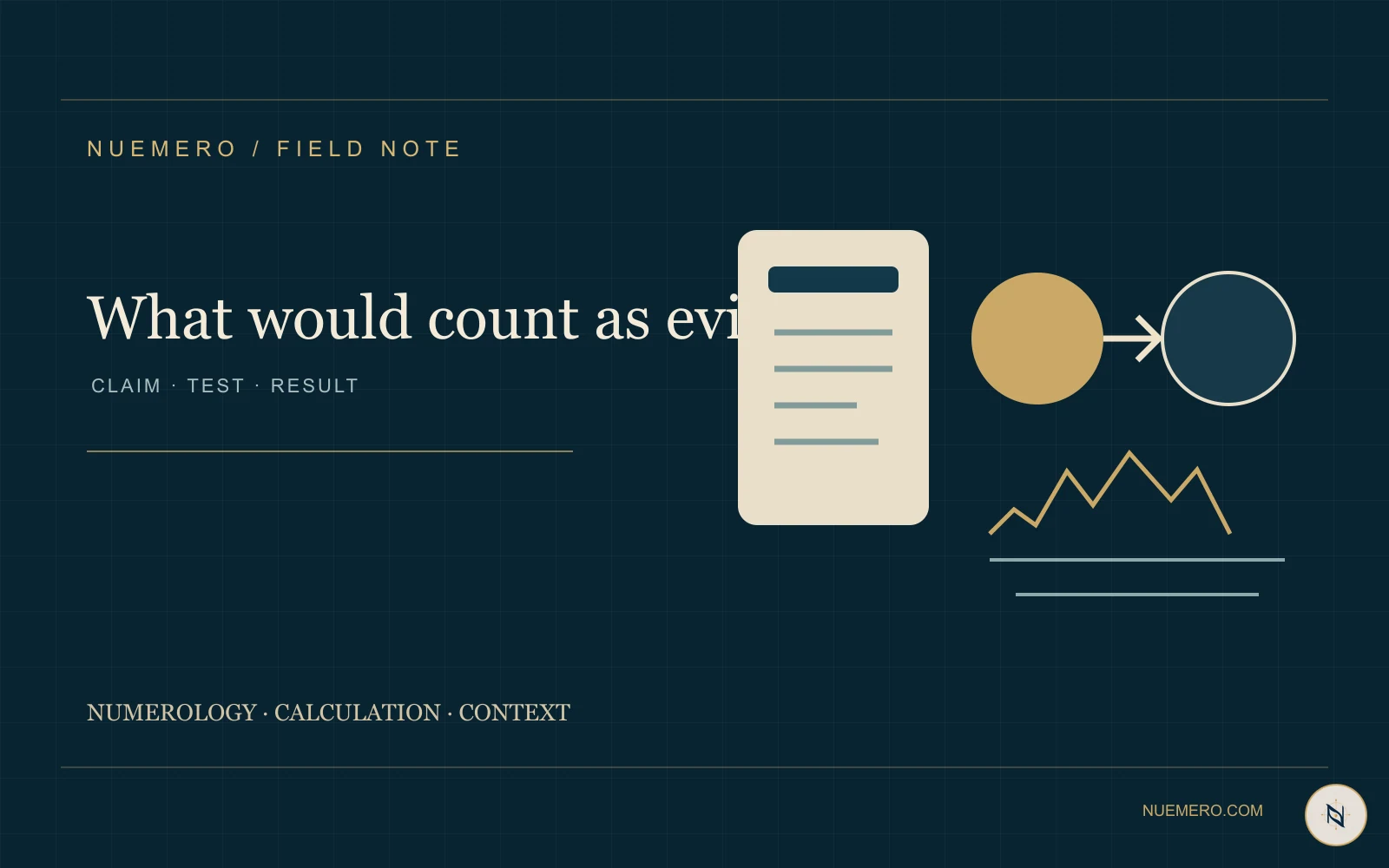
Research, evidence & responsible use·9 min
How to Grade Evidence in Numerology Articles: Math, History, Symbolism, Prediction
Use a four-lane reader checklist to separate reproducible calculations, historical documentation, tradition-specific symbolism, and testable prediction claims.
Read the guide