
Cycles & timingNumerology guide
Numerology Transit Cycles: How Name Letters Mark the Sequence
Follow a source-specific Transit sequence from name letters, understand how letter values set cycle duration, and compare this birthday-based method with date-based timing.
The short answer
Start here
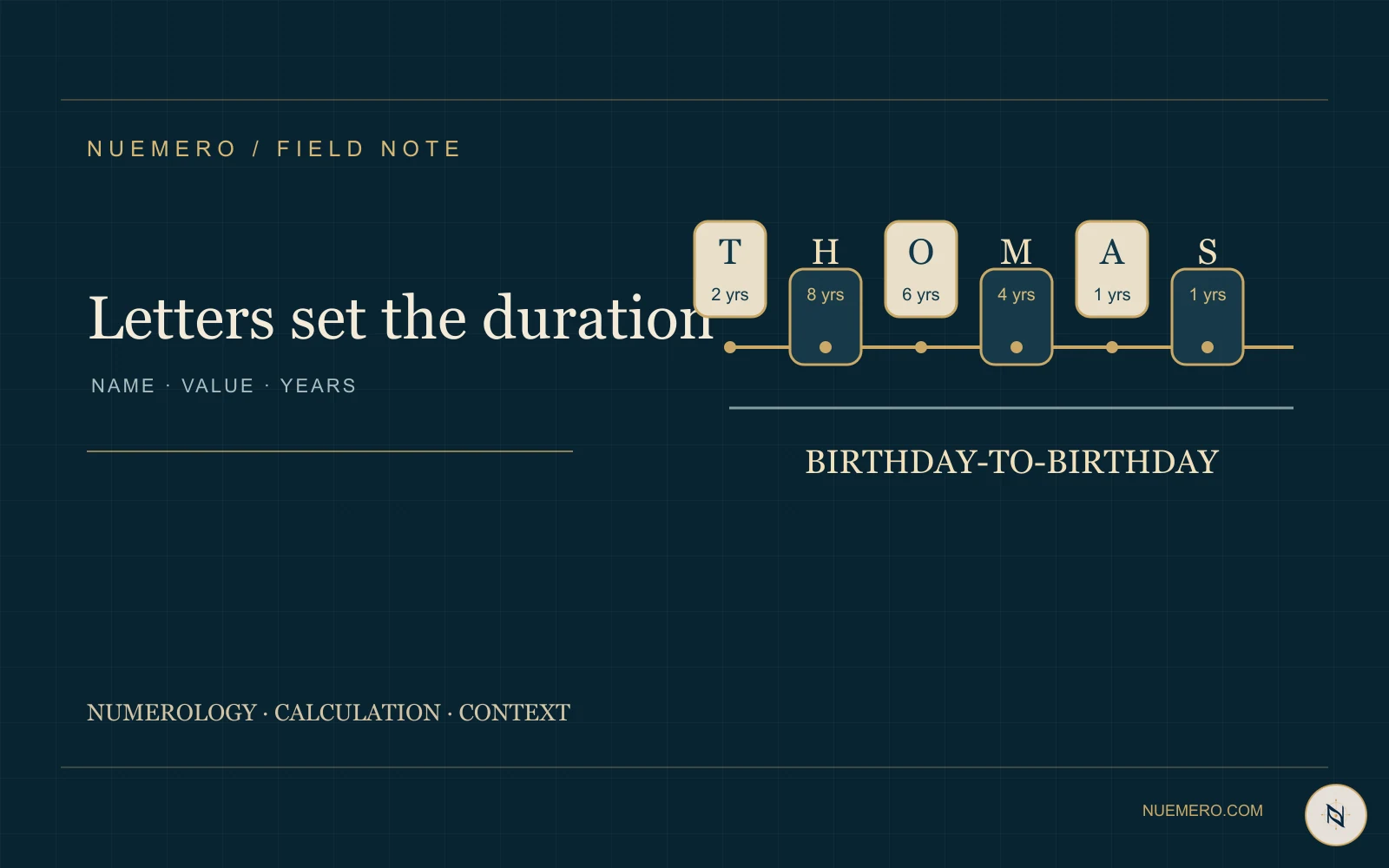
In Hans Decoz’s Transit framework, name letters supply values and each Transit lasts for a period matching its value; the sequence is read with age and birthday boundaries. The source derives physical, mental, and spiritual tracks from first, middle, and last names. For example, a letter valued 3 represents a three-year segment in that convention. This illustrates a practitioner system, not an empirically established life-cycle forecast. Record the transliteration and exact letter chart because spelling and school can change the sequence.
Key takeaways
The cited method derives Transit tracks from the first, middle, and last names.
Each letter's stated value corresponds to its segment length in this convention.
Treat the sequence as traditional reflection, and preserve exact spelling and timing assumptions.
On this page
What a Transit represents in this chart
The cited source describes Transits as a sequence based on individual letters in a person's name. It assigns three tracks: first name for physical, middle name for mental, and last name for spiritual. These labels belong to that author's framework; they are not clinical categories.
A name written in Devanagari must be transliterated before a Latin-letter table can be used. Different reasonable spellings can produce different letters and values, so record the chosen spelling and do not present one transliteration as uniquely correct.
How letter values set a segment length
Under the cited rule, each Transit lasts for the numerology value of its letter. A value of 3 therefore marks a three-year segment, followed by the next letter according to the chart's sequence and birthday timing. This is a method-specific illustration; use the source's full chart and start-age rule for an actual calculation.
Illustrative segment
33 years, before the sequence advancesKeep timing assumptions visible
Transit and Essence cycles in this source are name-based and birthday-to-birthday; Personal Year cycles use birth-date numbers and calendar-year timing. Avoid combining a Transit boundary with a calendar-year boundary without explaining the convention. If the result affects a practical choice, use real constraints and evidence first.
A useful reflection is to note what has actually changed in your routines, energy, or priorities, then decide what action fits your own circumstances. The chart cannot establish that a letter caused those changes.
Method and limits
This guide describes the conventions stated above and the way Nuemero’s current calculator works. Numerology interpretations are traditional beliefs, not scientific predictions. Check a source’s method before applying its meanings.
Read Nuemero’s full methodQuick answers
Frequently asked questions
What are Transit cycles in numerology?
In the cited Decoz framework, they are age-timed sequences derived from name letters, arranged into physical, mental, and spiritual tracks.
How long does one Transit last?
The source says a Transit lasts for the numerology value of its letter. State which chart assigns that value and how the age boundary is counted.
Do Transits predict events?
They are part of a numerology tradition, not a validated forecasting method. Use them only as optional reflection and base decisions on real-world information.
Read further
Sources and method notes
- Hans Decoz: TransitsSource for the name-letter inputs, three tracks, and duration rule described here.
- Hans Decoz: The Power of Your Essence CyclesPlaces Transits beside Essence and Personal Year cycles, with their distinct timing.
Sources document calculation conventions and claims made within their traditions. They are not evidence that numerology predicts real-world outcomes.
Cycles & timing·7 min
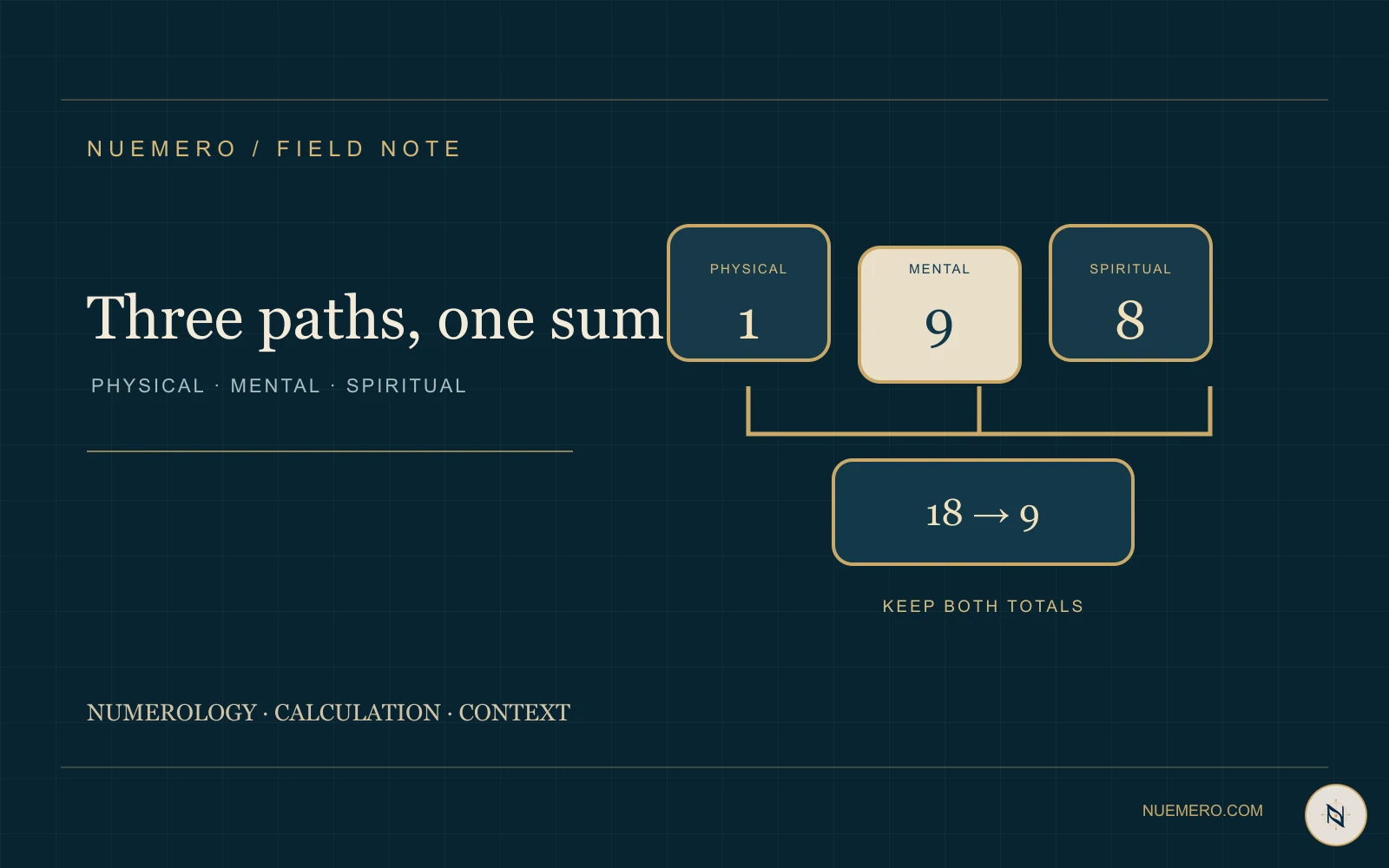
Essence Cycle in Numerology: Add the Name Transits
See how one practitioner method combines physical, mental, and spiritual name transits, keeps the compound total, and distinguishes this birthday-to-birthday cycle from a Personal Year.
Read the guide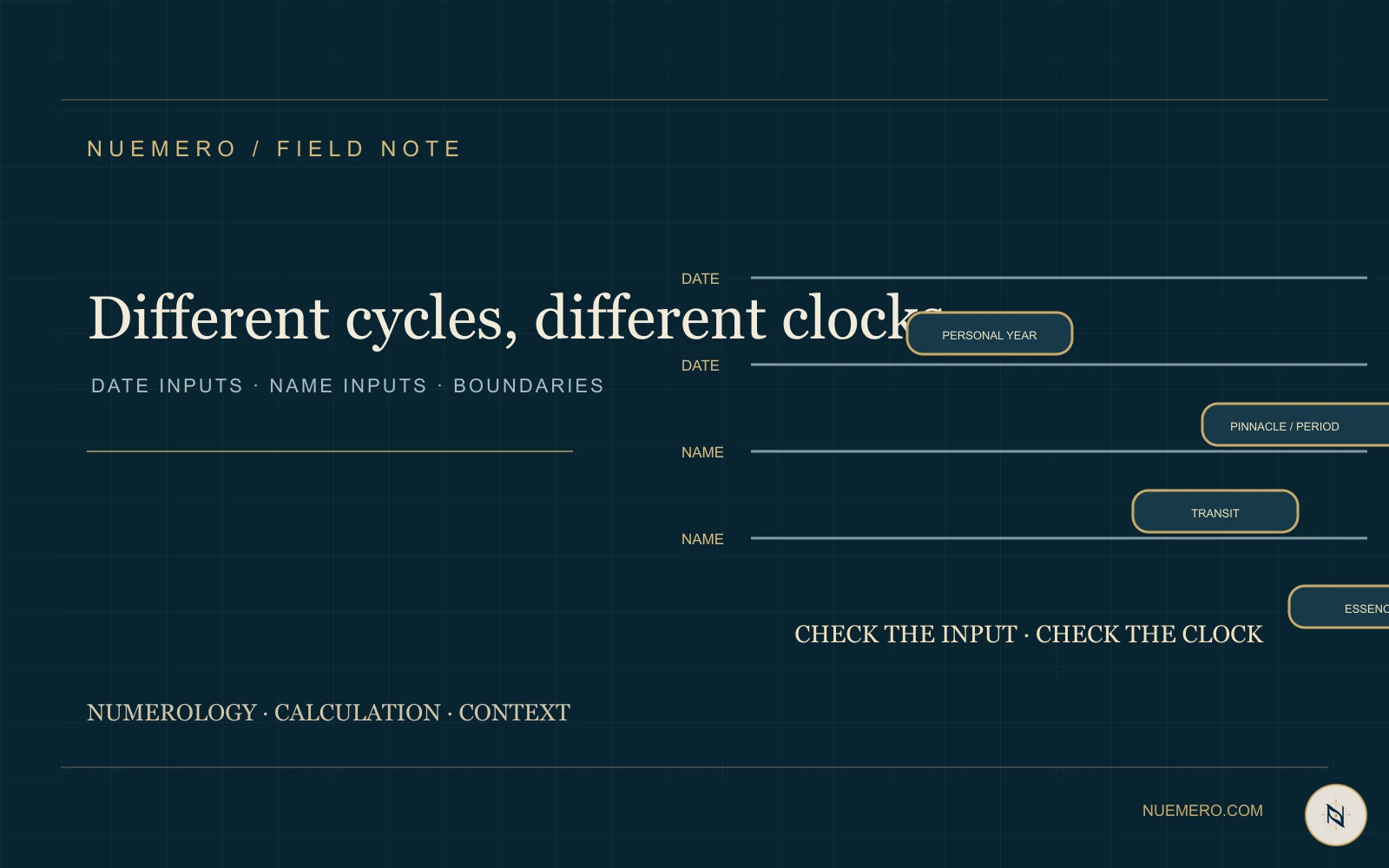
Cycles & timing·8 min
Numerology Cycles Compared: Personal Year, Pinnacle, Period, and Essence
Use a side-by-side guide to identify each cycle's inputs and timing, see how name-based and date-based methods differ, and avoid mixing unlike chart layers.
Read the guide