
Cycles & timingNumerology guide
Personal Year Numbers 1–9: Traditional Themes and a Practical Planning Guide
Explore common Personal Year themes from 1 to 9, check the calculation convention, and turn a symbolic cycle into grounded planning prompts.
The short answer
Start here
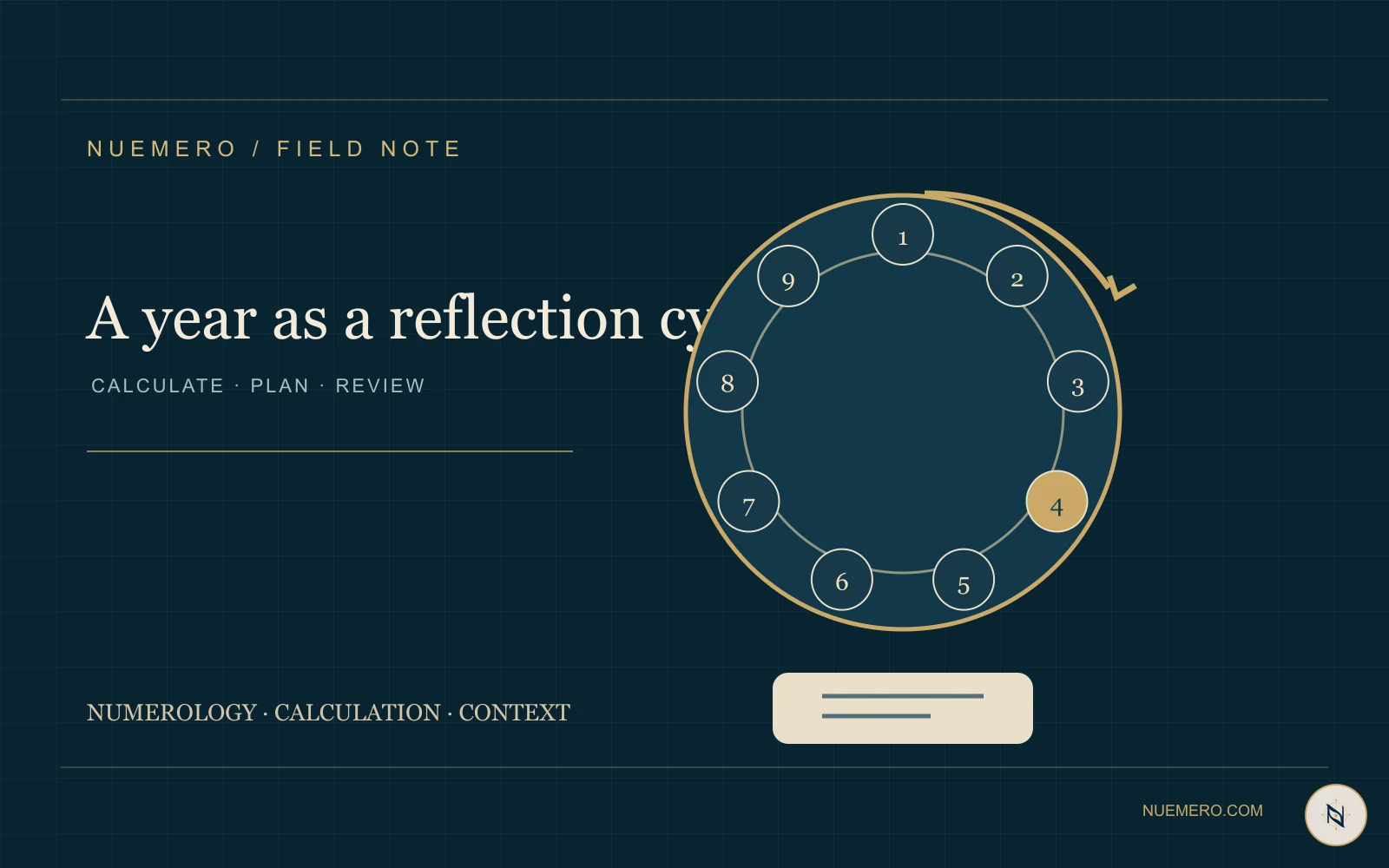
In one common numerology convention, a Personal Year is calculated from birth month, birth day, and the selected calendar year, then reduced by a stated rule. Authors attach themes to 1–9, but labels do not predict events. Use a number to choose a reflection question; make plans from your actual goals, resources, and responsibilities.
Key takeaways
A Personal Year is a calculation convention, not a guaranteed forecast.
Calendar-year and birthday-to-birthday approaches can differ.
A 1–9 theme can prompt reflection but cannot rank a year as objectively good or bad.
Make decisions from evidence, budget, health needs, and consent—not a cycle label.
On this page
First confirm how the year is calculated
A common calendar-year method adds birth month, birth day, and the digits of the target year, then reduces to 1–9; some schools preserve selected master numbers. Other readers use a birthday-to-birthday cycle or a different reduction sequence. Record the formula and date range before comparing readings.
For a fictional 14 June birth date and calendar year 2027: 6 + 14 + 2 + 0 + 2 + 7 = 31, then 3 + 1 = 4. This demonstrates one formula only. It does not mean every source uses the same year boundary or that the theme causes events.
Common symbolic themes for 1–9
Practitioner writing often frames 1 as initiative, 2 as cooperation, 3 as expression, 4 as structure, 5 as change, 6 as care, 7 as inquiry, 8 as responsibility or organization, and 9 as completion or broad perspective. This is a compact map of common modern themes, not a universal canon; writers disagree and traditions use different language.
Instead of asking what must happen in a ‘4 year,’ ask what structure would support a goal you chose. In a ‘5 year,’ review which changes are feasible. That keeps a reading useful without pretending the number controls opportunity, relationships, or health.
Turn a theme into a grounded plan
Choose one real goal, identify a small action, set a review date, and name the resources or support needed. Keep a separate record of what actually happened. If a reading conflicts with medical advice, safety, finances, or another person’s consent, follow the relevant evidence and boundaries.
Method and limits
This guide describes the conventions stated above and the way Nuemero’s current calculator works. Numerology interpretations are traditional beliefs, not scientific predictions. Check a source’s method before applying its meanings.
Read Nuemero’s full methodQuick answers
Frequently asked questions
Does a Personal Year run from January or my birthday?
Different schools use different boundaries. Many calculators use a calendar year; some readers describe birthday-to-birthday cycles. Check the source and use one convention consistently.
Is Personal Year 9 always a year of endings?
‘Completion’ is a traditional theme, not a promise that a relationship, job, or life stage will end. Use it as an optional prompt to review what you want to finish.
Can I use the cycle to choose a medical date or purchase?
Keep timing symbolism optional. For care, use clinical guidance; for purchases, compare need, cost, and terms; for appointments, prioritize availability and consent.
Read further
Sources and method notes
- Nuemero personal-cycle method noteReview the displayed inputs and reduction rule; annual themes are traditional interpretations, not tested event forecasts.
Sources document calculation conventions and claims made within their traditions. They are not evidence that numerology predicts real-world outcomes.
Cycles & timing·7 min
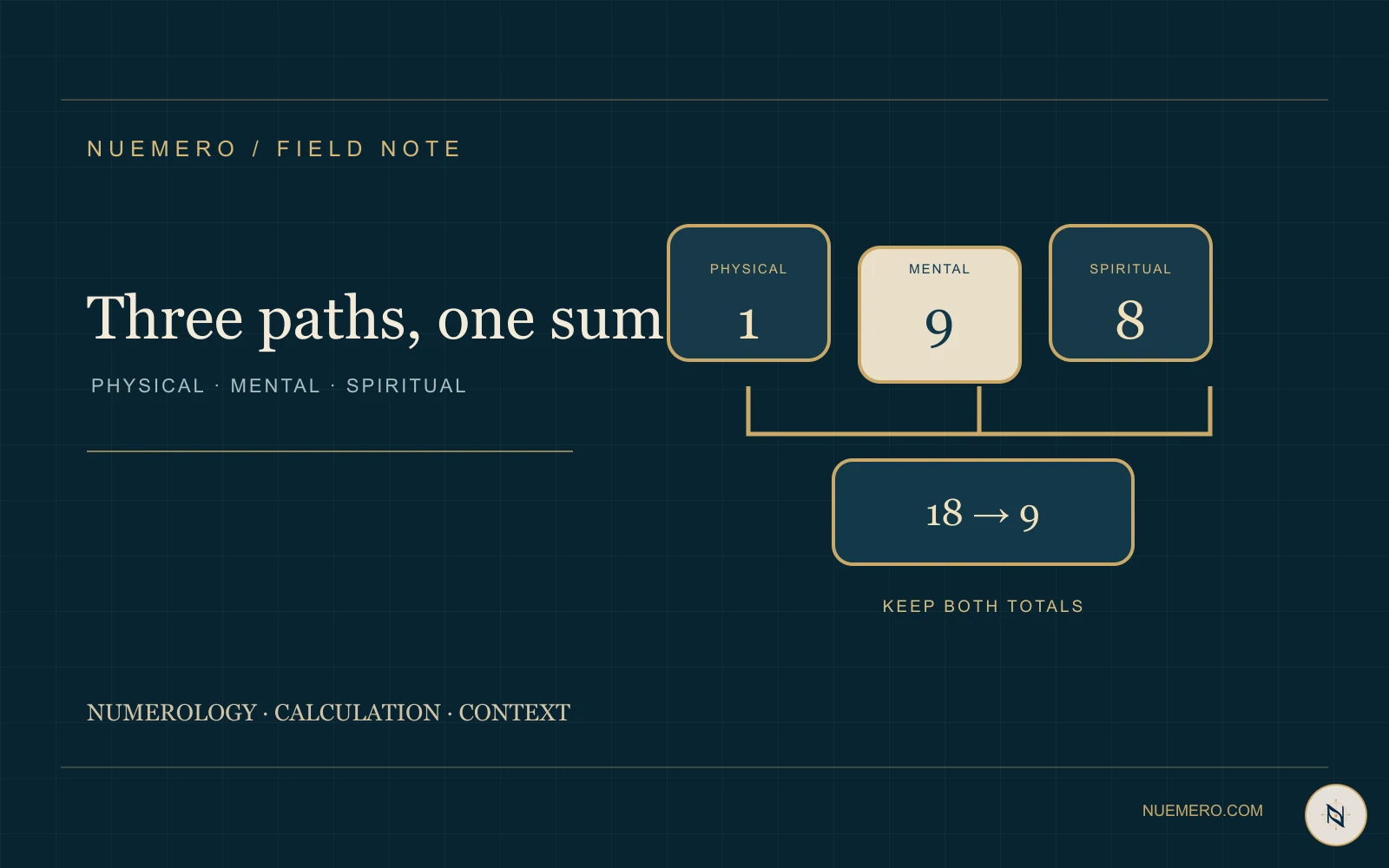
Essence Cycle in Numerology: Add the Name Transits
See how one practitioner method combines physical, mental, and spiritual name transits, keeps the compound total, and distinguishes this birthday-to-birthday cycle from a Personal Year.
Read the guide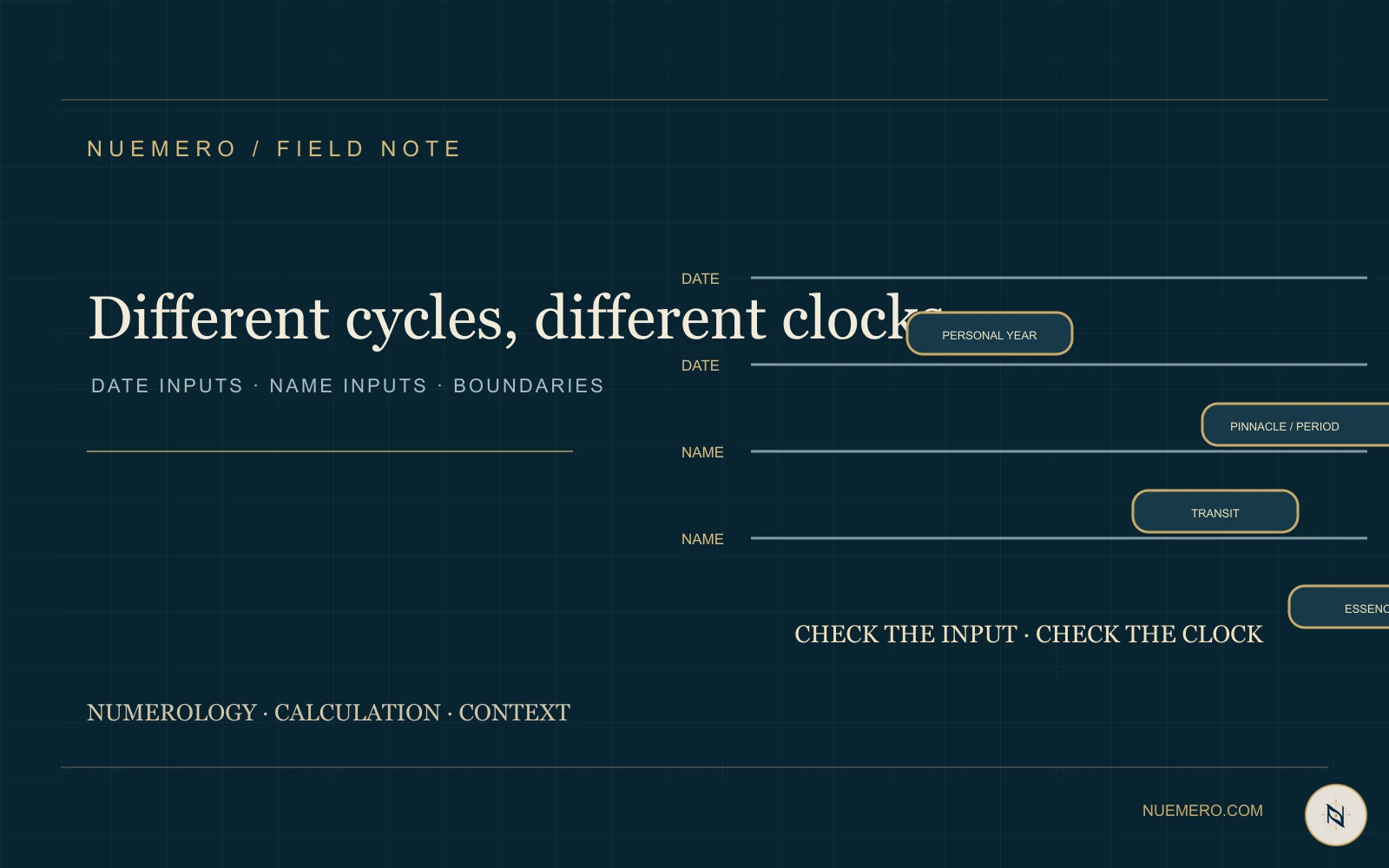
Cycles & timing·8 min
Numerology Cycles Compared: Personal Year, Pinnacle, Period, and Essence
Use a side-by-side guide to identify each cycle's inputs and timing, see how name-based and date-based methods differ, and avoid mixing unlike chart layers.
Read the guide