
Methods & calculationsNumerology guide
Why Do Numerology Calculators Give Different Answers?
A clear guide to why numerology results change across systems, letter charts, date formulas, and master-number rules—with worked examples you can check.

The short answer
Start here
Two calculators can both add correctly and still show different numerology results. The difference usually comes from the system or rule each one uses: a different letter table, a different date-reduction step, or a different policy for keeping master numbers. Check the method label and the arithmetic before comparing interpretations.
Key takeaways
Numerology has multiple traditions; a result is meaningful only alongside its stated method and input.
The same name can total 4 in Pythagorean numerology and 7 in a Chaldean table because the letter values differ.
Date methods can share a digital root but display a master number differently, depending on when it is preserved.
Compare the raw inputs and calculation trace before deciding that a calculator is wrong.
On this page
Same input, different rules
A numerology calculator is a rule-based tool. It takes an input—often a name or birth date—maps or adds it according to a chosen tradition, then reduces or interprets the result. There is no single formula shared by every numerology school.
That means a mismatch is a prompt to inspect the method, not proof that one calculator has made an arithmetic mistake. A reliable result should tell you what it counted, which mapping it used, and where it stopped reducing.
Name calculators may use different letter tables
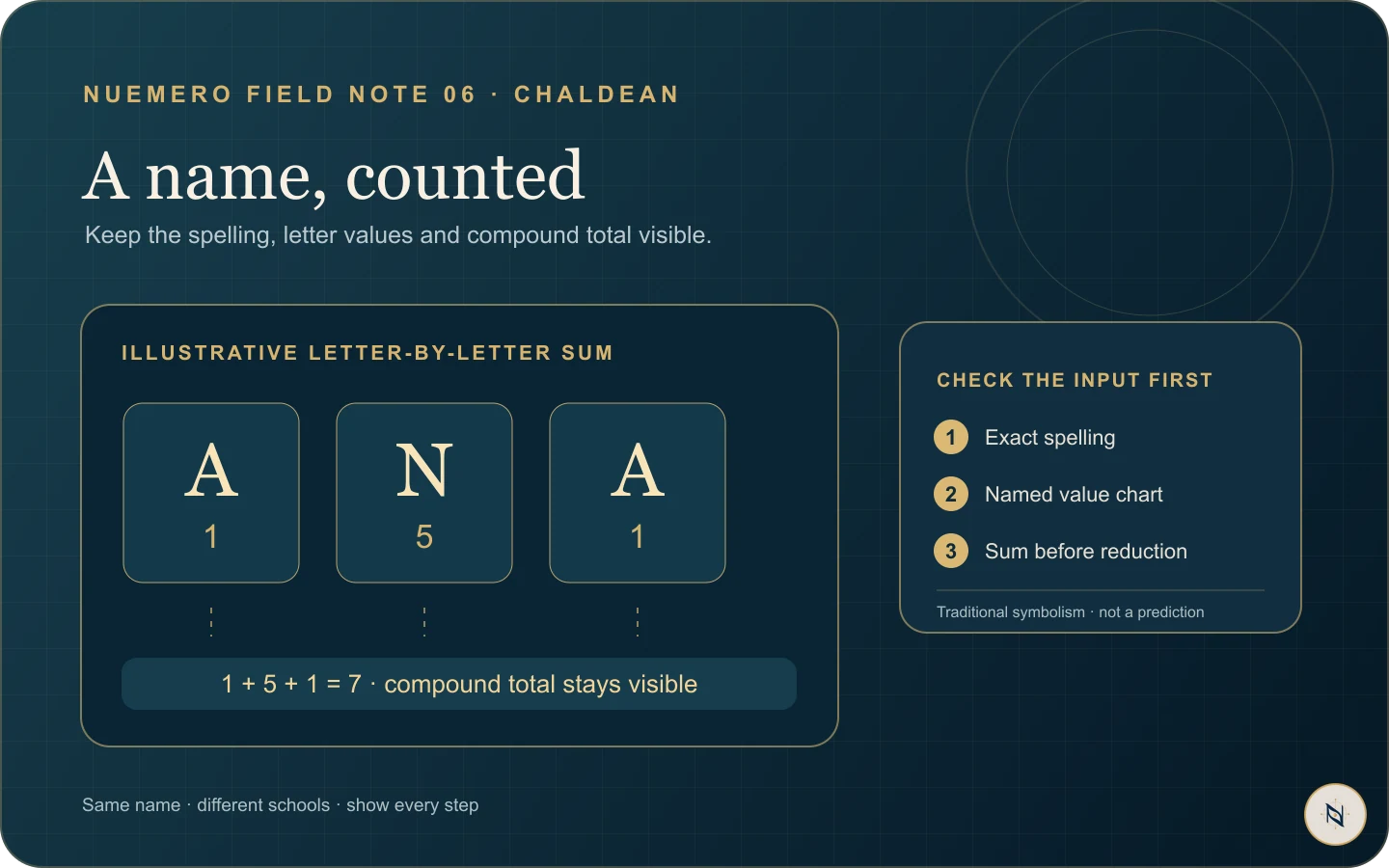
Modern Western Pythagorean numerology commonly assigns A through Z in a repeating 1–9 sequence. The Cheiro-derived Chaldean table assigns letters values from 1 to 8 and gives special attention to the unreduced compound total. These are separate tables, so the same spelling does not have to produce the same sum.
For example, using the two tables used in Nuemero’s comparison tool, MAYA is 4 + 1 + 7 + 1 = 13, then 1 + 3 = 4 in the Pythagorean calculation. In the Chaldean table it is 4 + 1 + 1 + 1 = 7. Each result follows its own mapping; neither should be silently substituted for the other.
One spelling, two declared tables
M(4) + A(1) + Y(7) + A(1) = 13 → 4M(4) + A(1) + Y(1) + A(1) = 7Date calculators may reduce at different stages
Life Path and Bhagyank calculations use the full birth date, but calculators do not always show the same intermediate steps. One method adds every date digit and reduces the total. Another common presentation reduces the month, day, and year separately before combining them. If a master number appears at an intermediate step, a calculator may preserve it there or reduce it further.
For 29 January 1988, adding every digit gives 2 + 9 + 0 + 1 + 1 + 9 + 8 + 8 = 38, then 3 + 8 = 11. A calculator that preserves 11 at the final step displays 11/2. If the same date is reduced by components first, the day can be shown as 11, the month as 1, and the year as 8; adding those gives 20 → 2. The arithmetic is visible in both cases, while the convention changes whether the final display retains 11.
Nuemero’s current full-date calculation sums the date digits and preserves 11, 22, or 33 when one appears at the final reduction. Its calculation trace shows the compound sum and each reduction. Other tools may use a different convention, so compare like with like.
Example: 29 January 1988
2 + 9 + 0 + 1 + 1 + 9 + 8 + 8 = 383 + 8 = 11 → display 11/2 when master numbers are preservedDay 29 → 11; month 1; year 1988 → 8; 11 + 1 + 8 = 20 → 2A four-step check for any result
Before comparing two readings, write down the details below. This turns a confusing mismatch into a checkable calculation.
- Input: confirm the exact spelling or date format. Transliteration, initials, and a changed surname alter the name input.
- System: record whether the calculator says Pythagorean, Chaldean, Lo Shu, or another named method.
- Rule: check the letter table, zero handling, reduction order, and master-number policy.
- Trace: repeat the addition yourself and compare the compound total as well as the displayed root.
Separate calculation from interpretation
Arithmetic can be checked exactly. The meaning assigned to a number belongs to a numerology tradition and may differ between authors or schools. A calculator can be transparent about its formula without proving that numerology predicts personality or events.
Use a reading as a prompt for reflection if that is useful to you. Avoid treating a number as a diagnosis, a guarantee, or the sole basis for a medical, financial, career, or relationship decision.
Method and limits
This guide describes the conventions stated above and the way Nuemero’s current calculator works. Numerology interpretations are traditional beliefs, not scientific predictions. Check a source’s method before applying its meanings.
Read Nuemero’s full methodQuick answers
Frequently asked questions
Which numerology calculator is correct?
A calculator is arithmetically correct when it applies its stated input and rules consistently. First identify the method and reduction policy, then verify its calculation trace. Different traditions can produce different valid outputs for the same input.
Why is my Life Path number 11 on one site and 2 on another?
Some methods preserve 11 as a master number at the final reduction; others reduce it to 2 or reach 2 by reducing date components separately. Check the displayed steps and the site’s master-number rule.
Why do Pythagorean and Chaldean name numbers differ?
The systems use different letter-to-number mappings. A name can therefore have different sums even when spelling and addition are correct in both systems.
Should I use my birth name or current name?
There is no one rule accepted by every school. Choose the name convention stated by the calculator or author, use the same spelling when comparing results, and note that a different spelling changes the input.
Read further
Sources and method notes
- Cheiro, The Book of Numbers (1926)A primary practitioner text for the Cheiro-derived letter and compound-number conventions; it documents the tradition’s claims, not scientific validation.
- Nuemero calculation methodologyCurrent product rules for date inputs, letter mappings, reductions, and visible calculation traces.
- Nuemero numerology learning libraryOverview of the four calculation traditions represented in the product.
Sources document calculation conventions and claims made within their traditions. They are not evidence that numerology predicts real-world outcomes.
Name numerology·6 min
Chaldean Name Numerology: Letter Chart, Compound Total, and Calculation
Follow a Chaldean name calculation letter by letter, keep the compound total visible, and see why spelling and historical sources can change a reading.
Read the guide
Name numerology·7 min
Business Name Numerology: Compare Spellings Without Skipping Due Diligence
See why a brand name can produce different totals across letter tables, then use a practical checklist for law, customers, language, and clarity.
Read the guide