
Lo Shu numerologyNumerology guide
Chinese Numerology and the Lo Shu Grid: Related Ideas, Different Claims
Separate the historical 3×3 magic square from modern birth-date Lo Shu numerology, and avoid treating all Chinese number symbolism as one system.
The short answer
Start here
“Lo Shu” can refer to a traditional Chinese story and the 3×3 arrangement whose rows, columns, and diagonals total 15. Modern numerology also uses a Lo Shu-style grid to place birth-date digits. The shared square connects these ideas, but modern personal-chart rules should not automatically be projected back into ancient history. Chinese number symbolism is diverse and context-dependent.
Key takeaways
The classic square is a mathematical arrangement; a birth-date grid adds later interpretive rules.
Every row, column, and diagonal totals 15 in the familiar 3×3 square.
Modern birth-date rules vary on zero, repeats, and extra numbers.
Do not describe all Chinese number practices as one unified system.
On this page
The 3×3 square and its arithmetic
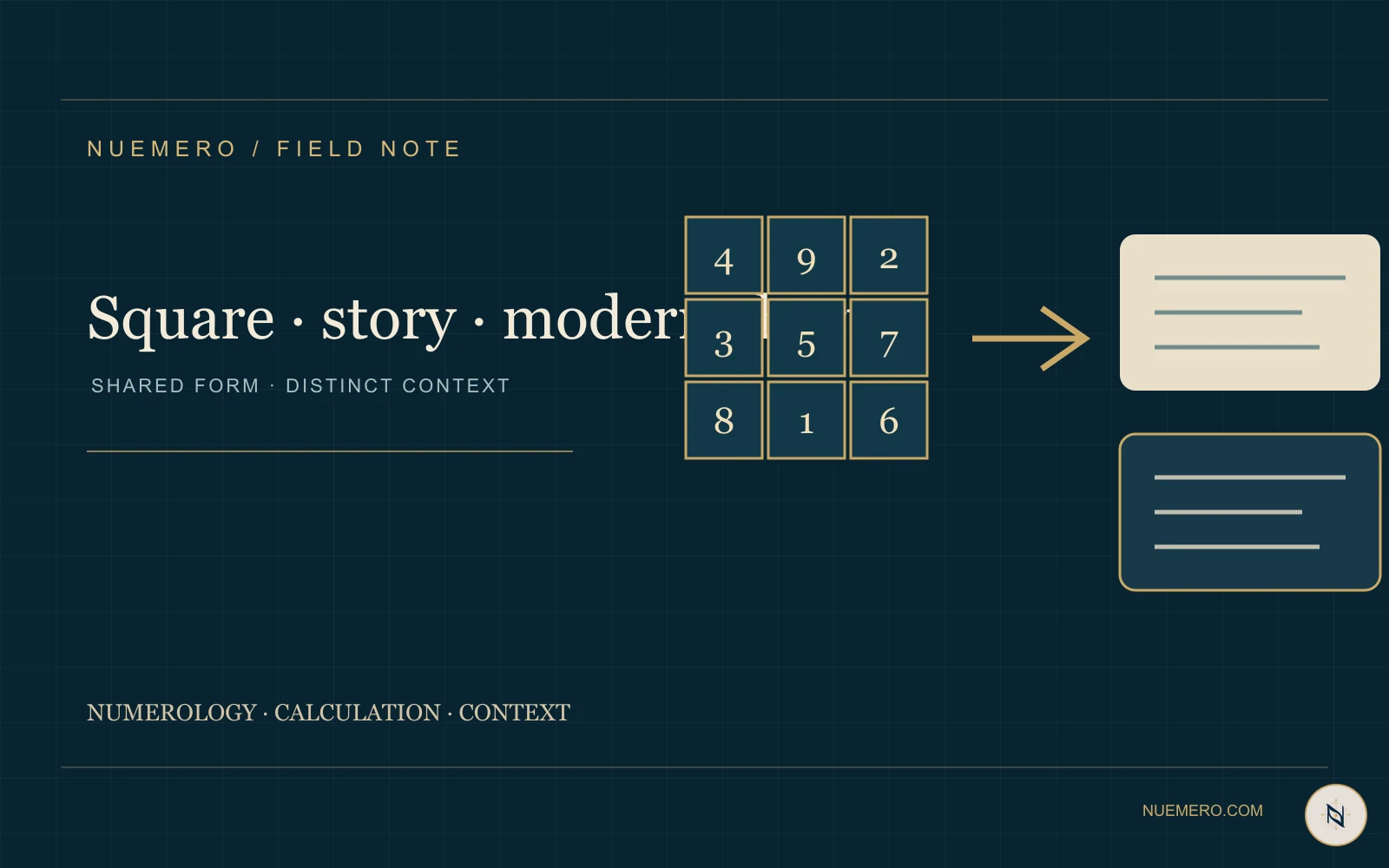
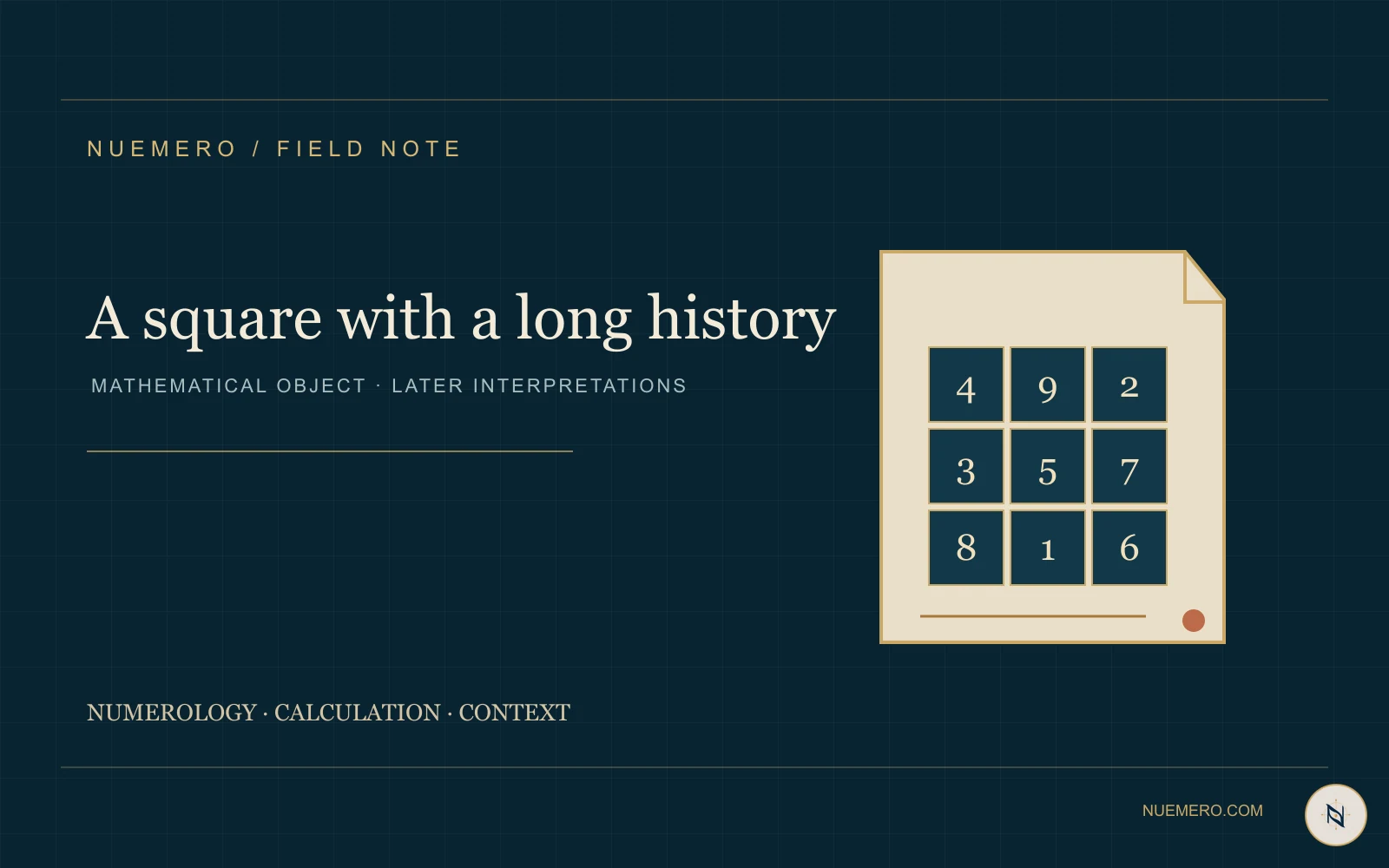
The familiar Lo Shu arrangement is 4–9–2 / 3–5–7 / 8–1–6. Every row, column, and long diagonal sums to 15. This is a verifiable mathematical property of the arrangement. Its origin story is a cultural tradition; describe it as a legend or traditional account unless historical evidence is cited.
Historical records about magic squares show that people knew or used the mathematical arrangement. They do not establish that every modern personal reading or birth-date chart existed in the same form at that time.
The modern birth-date grid adds another layer
In a modern Lo Shu-style chart, a practitioner counts selected birth-date digits and writes them in corresponding 1–9 cells. Authors differ on whether zero is omitted, repeated digits are retained, or extra derived values are added. Those are construction choices; disclose them before interpreting an empty cell or line.
A personal chart is therefore not identical to the classic square: one is an arrangement, the other adds date inputs and symbolic meanings. Both can be studied without claiming that every modern interpretation is ancient or scientifically predictive.
Describe the connection precisely
When comparing sources, identify the object: the 3×3 square, a cultural origin narrative, a modern birth-date chart, or a broader practice of number symbolism. Cite the specific author or historical source, and avoid using “Chinese numerology” as if it were one unchanging formula.
Method and limits
This guide describes the conventions stated above and the way Nuemero’s current calculator works. Numerology interpretations are traditional beliefs, not scientific predictions. Check a source’s method before applying its meanings.
Read Nuemero’s full methodQuick answers
Frequently asked questions
Is the modern Lo Shu birth grid historically the same as the magic square?
They share a 3×3 arrangement, but the personal chart adds counting rules and interpretations. Do not assume they are historically identical.
Why does every Lo Shu line add to 15?
The classic 1–9 magic square is arranged so each row, column, and main diagonal sums to 15. That mathematical property is separate from personal readings.
Is all Chinese number symbolism part of Lo Shu?
No. Number symbolism appears across diverse historical, linguistic, religious, and contemporary settings. One square does not represent all of them.
Read further
Sources and method notes
- Mathematical Association of America · Magic squares before MoschopoulosHistorical and mathematical context for magic squares; distinguish this from evidence for later personal numerology interpretations.
Sources document calculation conventions and claims made within their traditions. They are not evidence that numerology predicts real-world outcomes.
Lo Shu numerology·8 min
Where Lo Shu History Ends and Modern Birth-Date Grid Practice Begins
Separate the historic 3×3 magic square and its later cultural uses from modern numerology birth-date grids, legends, and interpretations.
Read the guide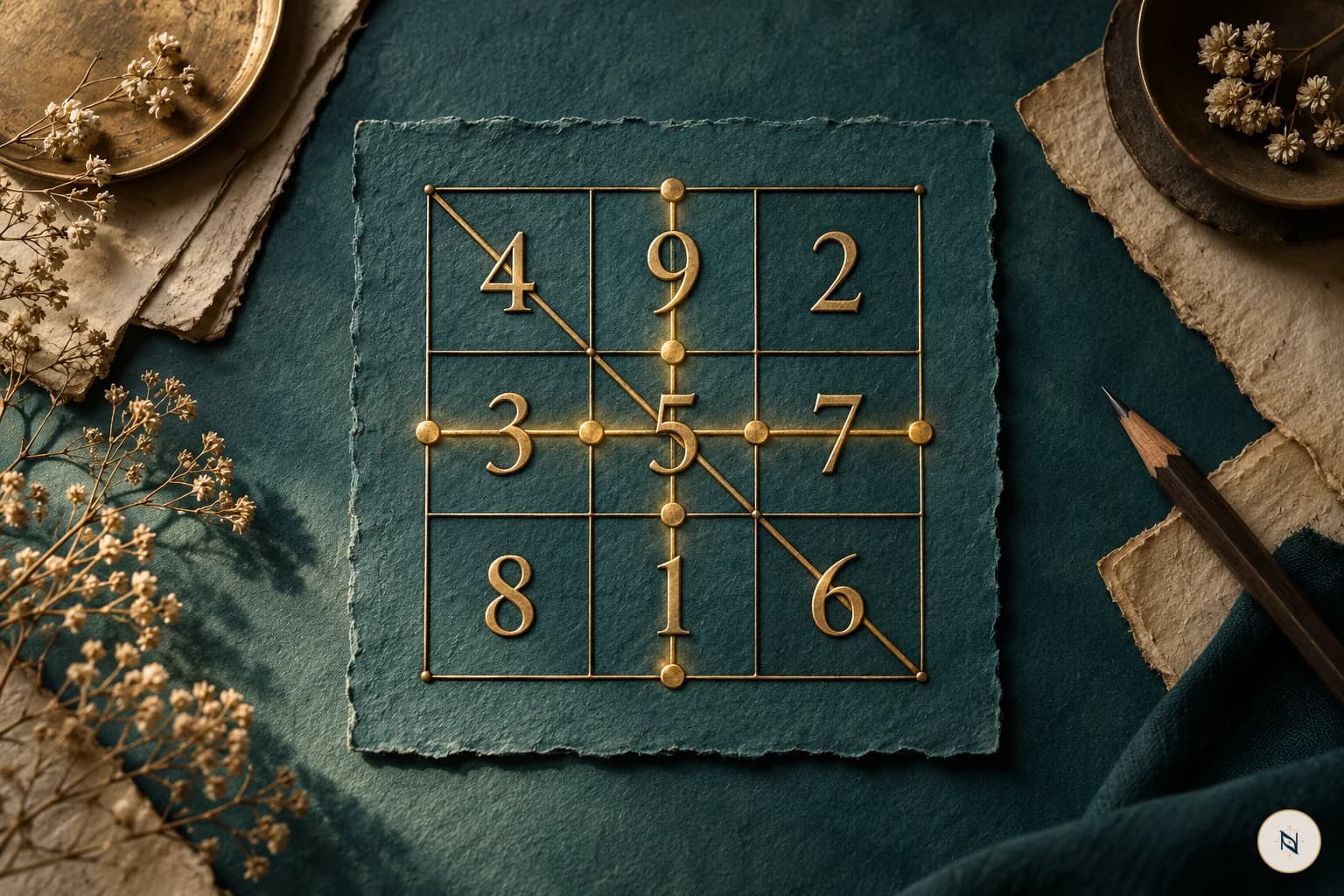
Lo Shu numerology·7 min
Lo Shu Arrows and Planes: Read the Lines Without Treating Them as a Diagnosis
See how a fixed Lo Shu layout creates rows, columns, and diagonals, why arrow labels vary, and what to verify before using a traditional interpretation.
Read the guide