
Lo Shu numerologyNumerology guide
Where Lo Shu History Ends and Modern Birth-Date Grid Practice Begins
Separate the historic 3×3 magic square and its later cultural uses from modern numerology birth-date grids, legends, and interpretations.
The short answer
Start here
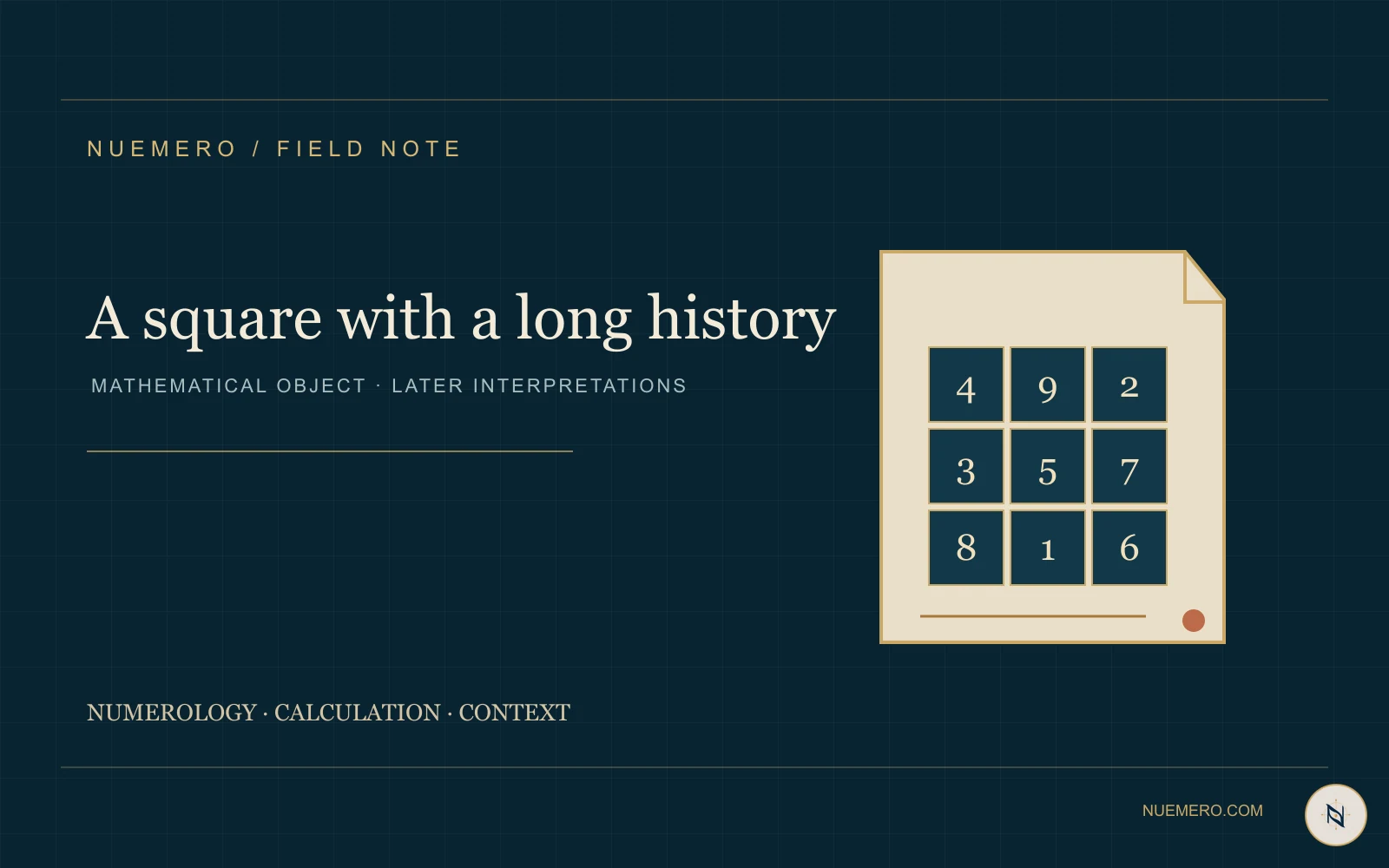
The Lo Shu is known as a 3×3 magic square whose rows, columns, and diagonals total 15. Historical writing discusses the square in Chinese traditions, while a famous tortoise-and-river origin story belongs to legend and should be labeled as such. Contemporary numerology may place birth-date digits into this arrangement and attach interpretations; those modern instructions and meanings should not be projected backward as if every historical source used today's system. Keep the mathematical object, historical evidence, legend, and current practice in separate lanes.
Key takeaways
The classic Lo Shu arrangement is a mathematical 3×3 magic square with line total 15.
Origin stories should be identified as legend, not dated documentary evidence.
Modern birth-date grid rules are not automatically the same as historical uses.
Attribute interpretations to a specific modern source or school.
On this page
The mathematical square
First describe the object without a prediction: arrange 1 through 9 so each of the three rows, columns, and two main diagonals sums to 15. The fixed layout is mathematical. A historical source may document the square's circulation or use, but that does not automatically document today's numerology rule for placing someone's birth-date digits into cells.
History, evidence, and legend
Popular accounts often tell of a patterned shell on a tortoise from the Luo River. Treat that narrative as a traditional legend unless a source establishes a specific historical record. Scholarship on magic squares traces different written witnesses and periods; cite the source and its date rather than compressing complex history into “four thousand years old” certainty.
Modern birth-date grid rules
Birth-date Lo Shu grids are contemporary interpretive practices with differing rules for zero, repeated digits, and missing cells. Document the exact version you use and show the count. A source about the square's history supports historical context; it does not validate a personality or future claim attached to a modern grid.
- Inspect the fixed 3×3 layout in the Lo Shu calculator.
- Read a historical source separately from modern interpretation guides.
- Ask which birth-date-grid convention an author is using.
Method and limits
This guide describes the conventions stated above and the way Nuemero’s current calculator works. Numerology interpretations are traditional beliefs, not scientific predictions. Check a source’s method before applying its meanings.
Read Nuemero’s full methodQuick answers
Frequently asked questions
Is the tortoise story a verified date for the Lo Shu square?
The story is a traditional origin legend; use a dated historical source when making a documentary claim.
Is today's birth-date grid exactly the historical Lo Shu use?
Not automatically. Modern digit-placement and interpretation rules should be attributed to their particular source or school.
Read further
Sources and method notes
- Mathematical Association of America · History of magic squaresHistorical discussion of the 3×3 square and written sources; it does not document or validate every modern numerology birth-grid interpretation.
Sources document calculation conventions and claims made within their traditions. They are not evidence that numerology predicts real-world outcomes.
Lo Shu numerology·8 min
Chinese Numerology and the Lo Shu Grid: Related Ideas, Different Claims
Separate the historical 3×3 magic square from modern birth-date Lo Shu numerology, and avoid treating all Chinese number symbolism as one system.
Read the guide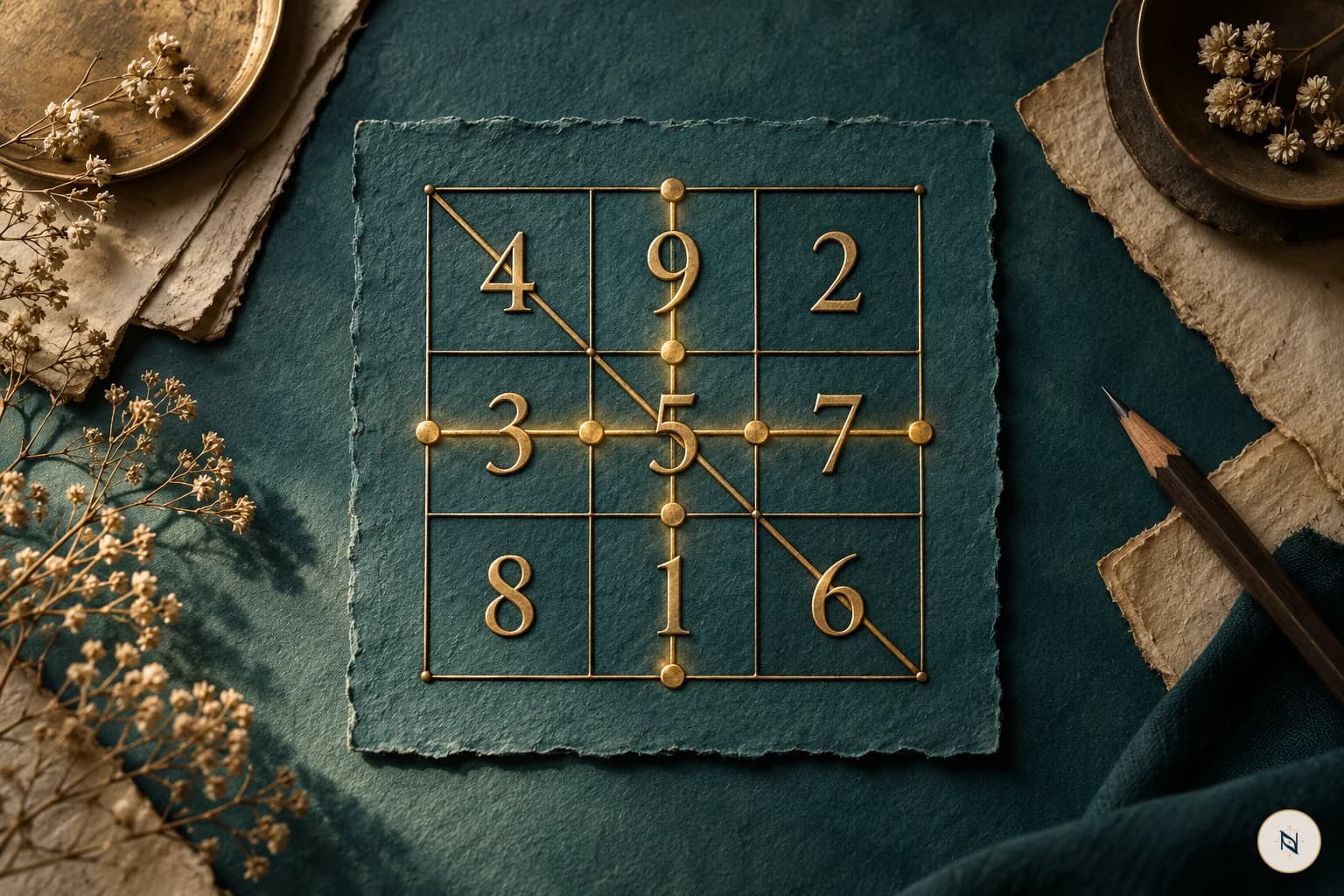
Lo Shu numerology·7 min
Lo Shu Arrows and Planes: Read the Lines Without Treating Them as a Diagnosis
See how a fixed Lo Shu layout creates rows, columns, and diagonals, why arrow labels vary, and what to verify before using a traditional interpretation.
Read the guide