
Systems, methods & foundationsNumerology guide
Lo Shu, Indian, and Western Numerology: Compare the Chart Inputs
Compare what a Lo Shu birth-date grid, common Indian birth numbers, and Western name numbers calculate before trying to combine their interpretations.
The short answer
Start here
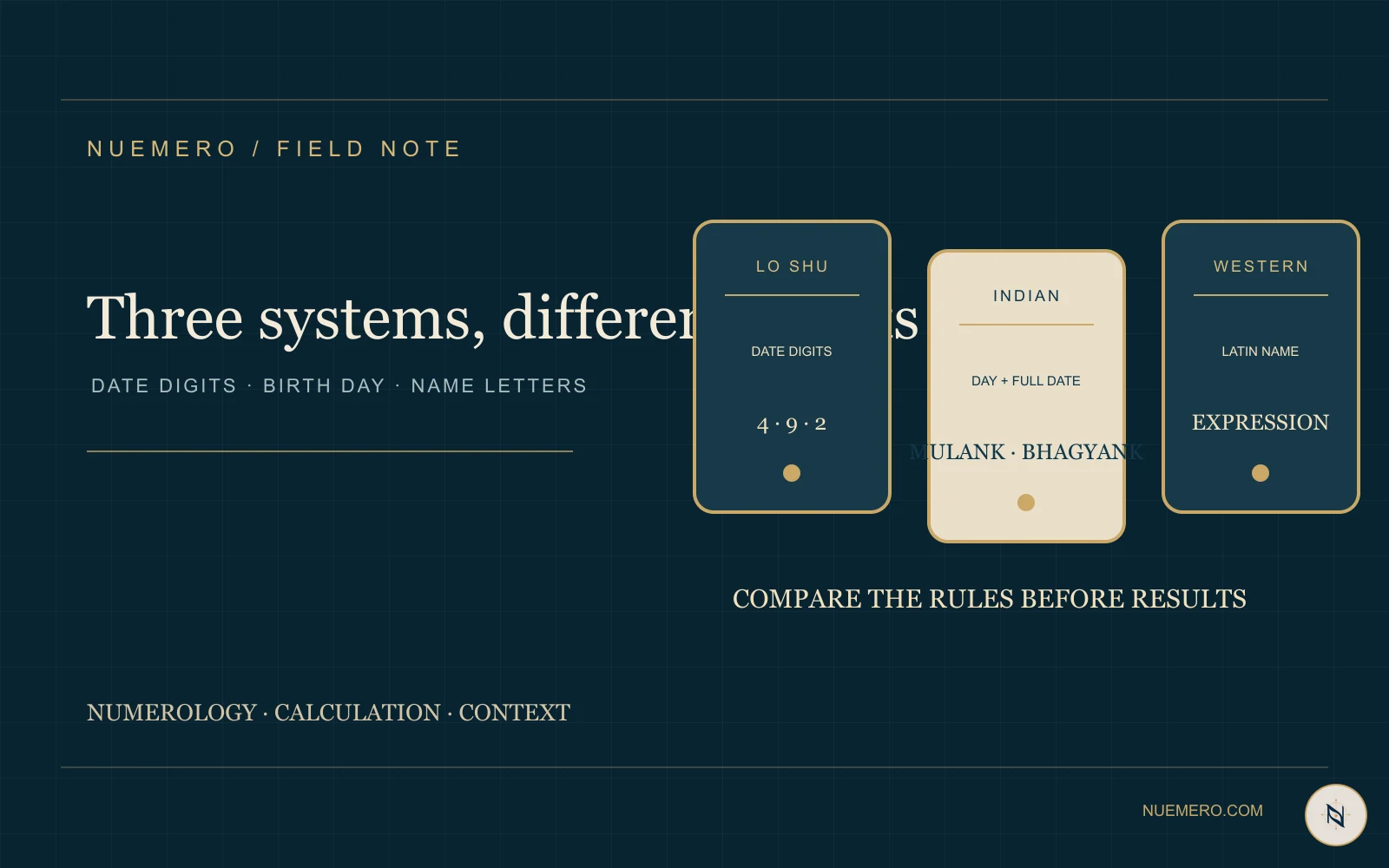
A Lo Shu grid commonly places birth-date digits into a fixed 3 × 3 arrangement; Indian numerology may calculate day-based Mulank, whole-date Bhagyank, and sometimes a name number; Western Pythagorean charts commonly assign values to Latin name letters and calculate date-derived numbers such as Life Path. These methods can share arithmetic operations while using different inputs, labels, layouts, and interpretations. Record each system separately before making comparisons. No chart format has scientifically established predictive power.
Key takeaways
A grid, a birth-day root, a whole-date total, and a name number answer different calculation questions.
Keep the input, letter table, date convention, and reduction rule visible for each system.
Do not combine labels until you know each method's definition and source.
On this page
Three chart families, three input questions
The Lo Shu square starts with the 3 × 3 magic-square layout. A modern birth-date grid places selected date digits into those fixed positions and counts them under the calculator's stated zero and repeat rules. Its first visible output is a pattern of filled, repeated, and empty cells.
Indian numerology is not one formula. A common chart separates Mulank from the birth day and Bhagyank from the whole date, and may add a name value under a declared letter mapping. Pythagorean practice usually maps Latin letters to 1–9 values for name numbers and uses the full date for values such as Life Path. Confirm the exact method before comparing outputs.
A practical way to compare systems
Use one fictional example and make a separate row for each method. Record its name, exact input, date format, letter table if any, reduction rule, and displayed output. For a Lo Shu grid, preserve the digit counts; for a day number, preserve the original date; for a name chart, preserve the exact spelling and script used.
A useful comparison explains where the methods agree and where their questions differ. Do not add the grid's repeated digits to a name total, call a day-only number a Life Path without a source, or describe a cultural interpretation as a measured fact. Share the calculation path so a reader can reproduce it.
Method and limits
This guide describes the conventions stated above and the way Nuemero’s current calculator works. Numerology interpretations are traditional beliefs, not scientific predictions. Check a source’s method before applying its meanings.
Read Nuemero’s full methodQuick answers
Frequently asked questions
Is the Lo Shu grid the same as Indian numerology?
No. The grid is one structure used in some modern readings; Indian numerology also includes other date- and name-based calculations. A practitioner may combine them, but should label each layer.
Does Pythagorean numerology use the Lo Shu layout?
The commonly described Pythagorean letter chart maps alphabet letters to values; that is distinct from placing birth-date digits into the Lo Shu square. Some products show both, so check their labels.
Can I combine results from different numerology systems?
You can compare them as separate traditional frameworks. State each input and rule, and do not treat agreement between symbolic readings as scientific confirmation.
Read further
Sources and method notes
- Hans Decoz: Expression Number calculationPractitioner example of a name-letter calculation in Western numerology.
- VedicSense: Numerology calculatorExample of a practitioner tool that presents birth-day, full-date, name, and Lo Shu calculations together; this article separates those input layers for comparison.
- Free Press Journal: Mulank and Birth NumberExample of an Indian numerology source defining a day-based birth number.
Sources document calculation conventions and claims made within their traditions. They are not evidence that numerology predicts real-world outcomes.
Systems, methods & foundations·8 min
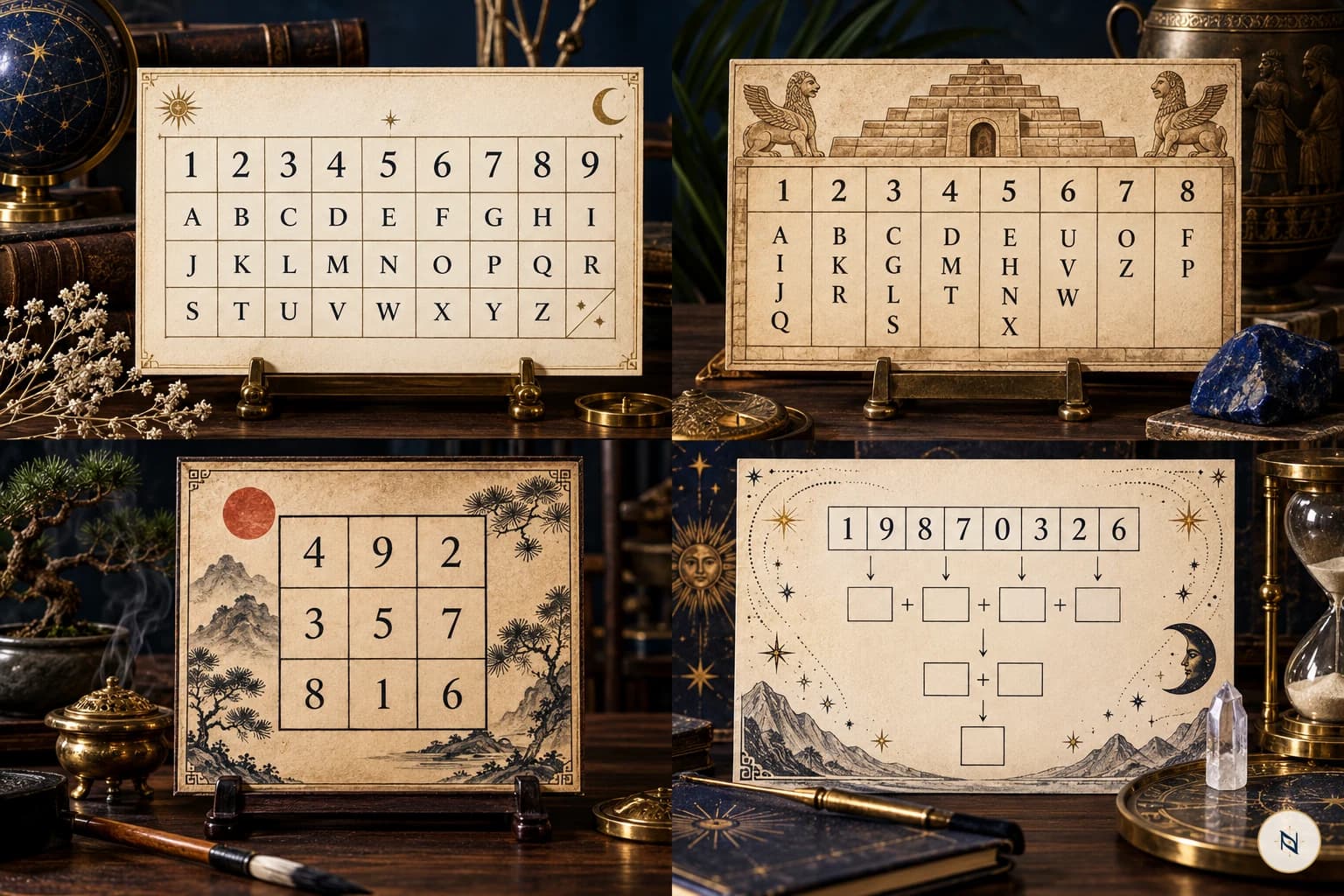
Why the Same Number Means Different Things Across Numerology Systems
Compare how Pythagorean, Chaldean, Lo Shu, and modern Indian numerology choose inputs and assign meanings—without blending their rules into one chart.
Read the guide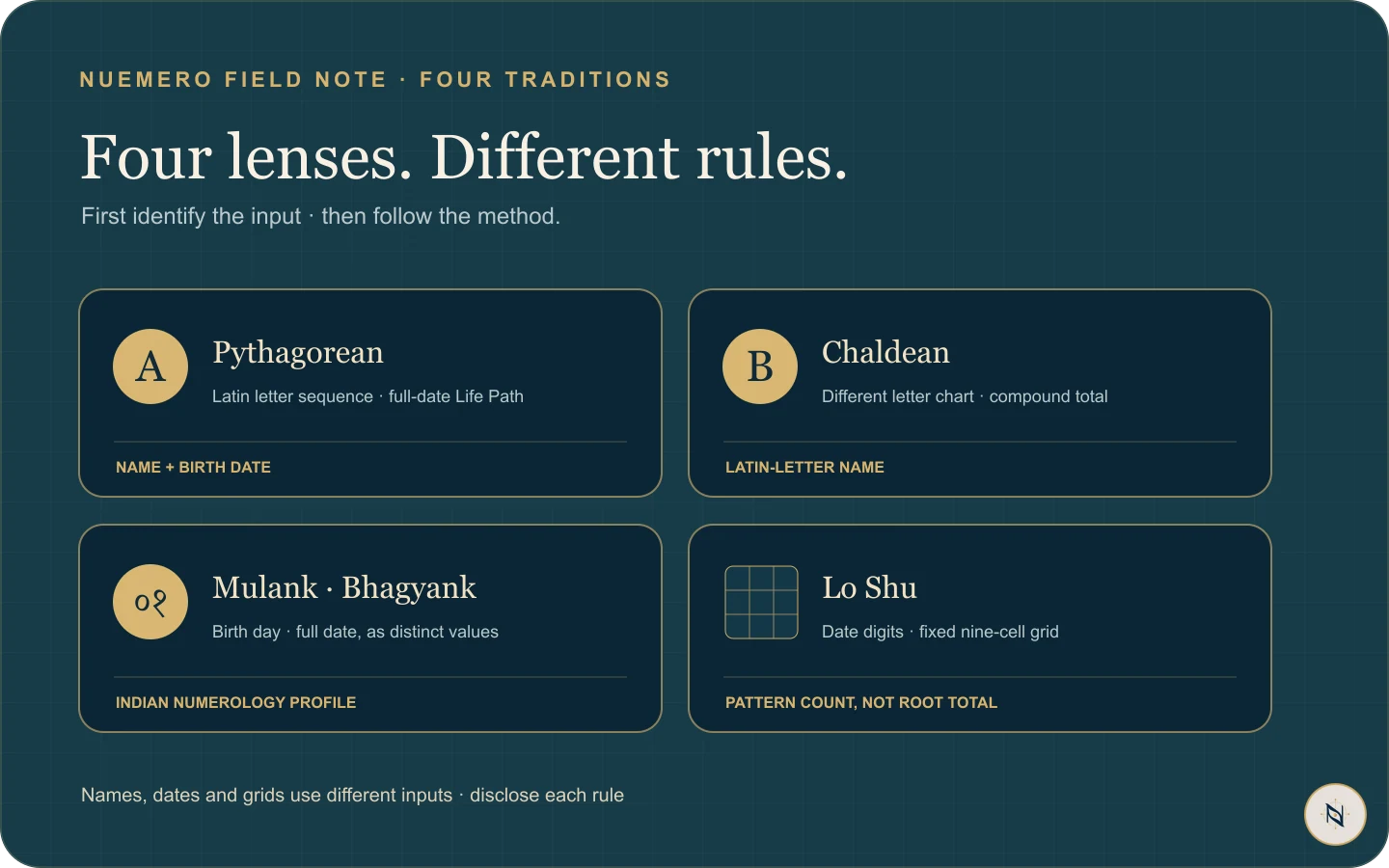
Systems, methods & foundations·9 min
What Is Numerology? Four Systems, Their Inputs, and Different Rules
An evidence-aware introduction to modern Pythagorean, Chaldean, Indian Mulank–Bhagyank, and Lo Shu practices—and why a number has meaning only inside its stated method.
Read the guide