
Systems, methods & foundationsNumerology guide
Why the Same Number Means Different Things Across Numerology Systems
Compare how Pythagorean, Chaldean, Lo Shu, and modern Indian numerology choose inputs and assign meanings—without blending their rules into one chart.
The short answer
Start here
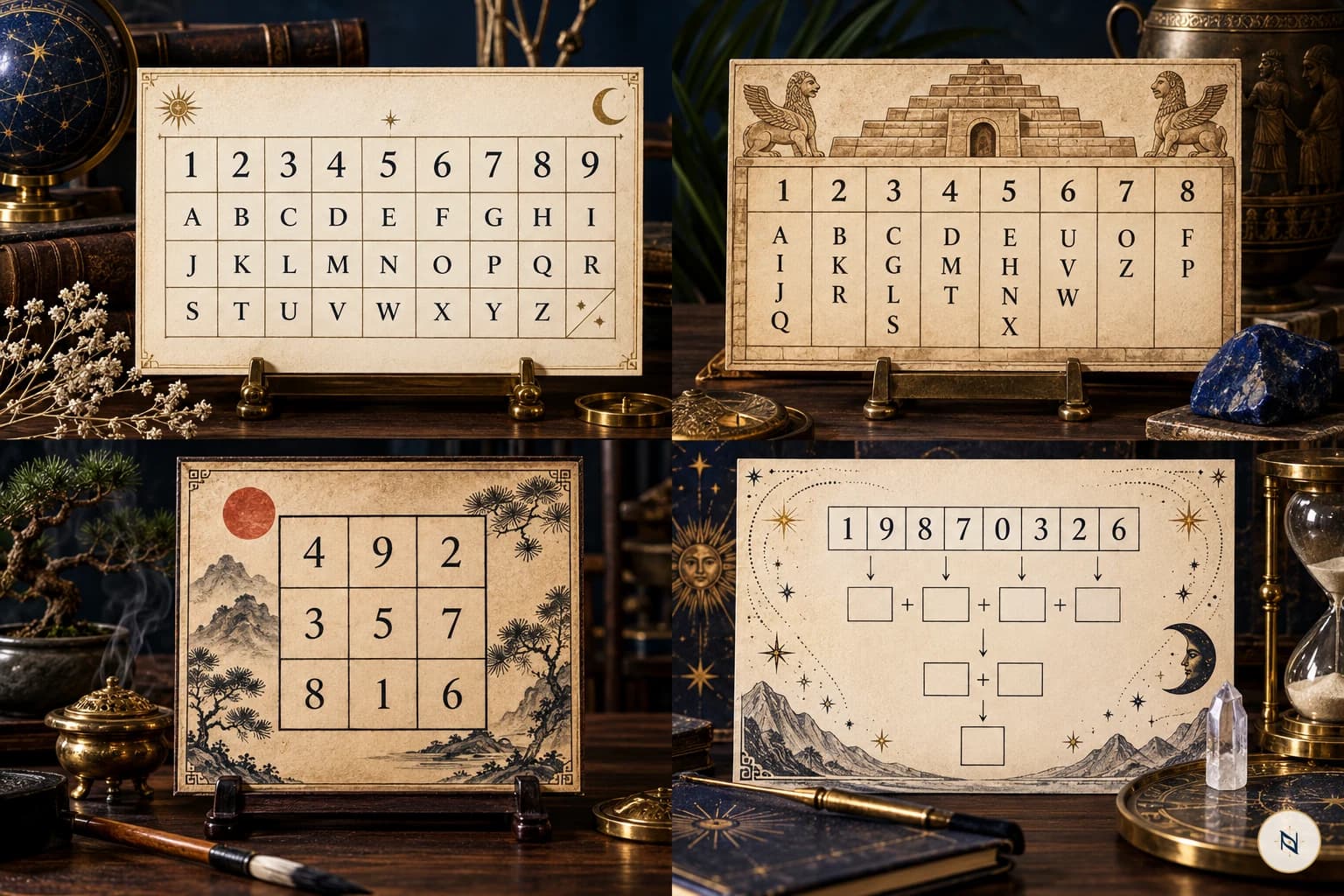
A number is only meaningful within its calculation system and input. Letter tables differ between Pythagorean and Chaldean numerology; Lo Shu places birth-date digits in a fixed grid; Indian methods may distinguish day-based Mulank from full-date Bhagyank. Compare systems by stating the input, formula, reduction, and source—not by assuming a shared number label guarantees a shared meaning.
Key takeaways
Pythagorean and Chaldean name totals can differ because their letter tables differ.
Lo Shu is a date-digit grid, not a letter-to-number name table.
Mulank and Bhagyank often use different date inputs in modern Indian practice.
A fair comparison holds the name/date fixed and changes one system rule at a time.
On this page
Start with the input, not the number
First ask what is being calculated. Pythagorean and Chaldean name numerology convert letters using different mappings. Lo Shu is built from eligible date digits and a fixed 3×3 arrangement. Mulank commonly reduces the calendar day; Bhagyank commonly uses the complete date. These outputs answer different method-specific questions, even when a reduced digit happens to match.
One name, two letter tables
For example, the name MAYA totals 13 in a common Pythagorean mapping (M=4, A=1, Y=7, A=1), reducing to 4. In one common Chaldean mapping it totals 7 because Y is assigned 1. This is a method comparison, not a contradiction. A Lo Shu chart for the same person would use the birth date, not these name letters.
Make a fair system comparison
A useful comparison table records four items for each result: input, value table or date rule, reduction step, and the source used for interpretation. Keep compound values visible and note exceptions such as master numbers. This makes disagreement explainable without choosing a favorite output or merging meanings that were never designed to be combined.
- Use the name comparison tool to inspect Pythagorean and Chaldean letter mappings.
- Use the Lo Shu calculator only with a birth date and its stated date rule.
- Keep each reading labeled by system before comparing its interpretation.
Method and limits
This guide describes the conventions stated above and the way Nuemero’s current calculator works. Numerology interpretations are traditional beliefs, not scientific predictions. Check a source’s method before applying its meanings.
Read Nuemero’s full methodQuick answers
Frequently asked questions
Why does the same name get different numbers?
Letter-value tables and reduction rules differ. Hold the spelling fixed and compare each system's visible calculation.
Does Lo Shu use the same input as name numerology?
No. Lo Shu commonly uses birth-date digits; letter-based name systems map written letters to values.
Which system is the correct one?
Each tradition has its own rules. Choose by the question you want to explore, and keep its calculation separate from others.
Can I combine results from different systems?
You can compare them, but label each method, input, and source. Do not add meanings as if they were one standardized score.
Read further
Sources and method notes
- Nuemero methodologyCompare the declared inputs, mappings, and reduction rules for each tradition.
Sources document calculation conventions and claims made within their traditions. They are not evidence that numerology predicts real-world outcomes.
Systems, methods & foundations·7 min
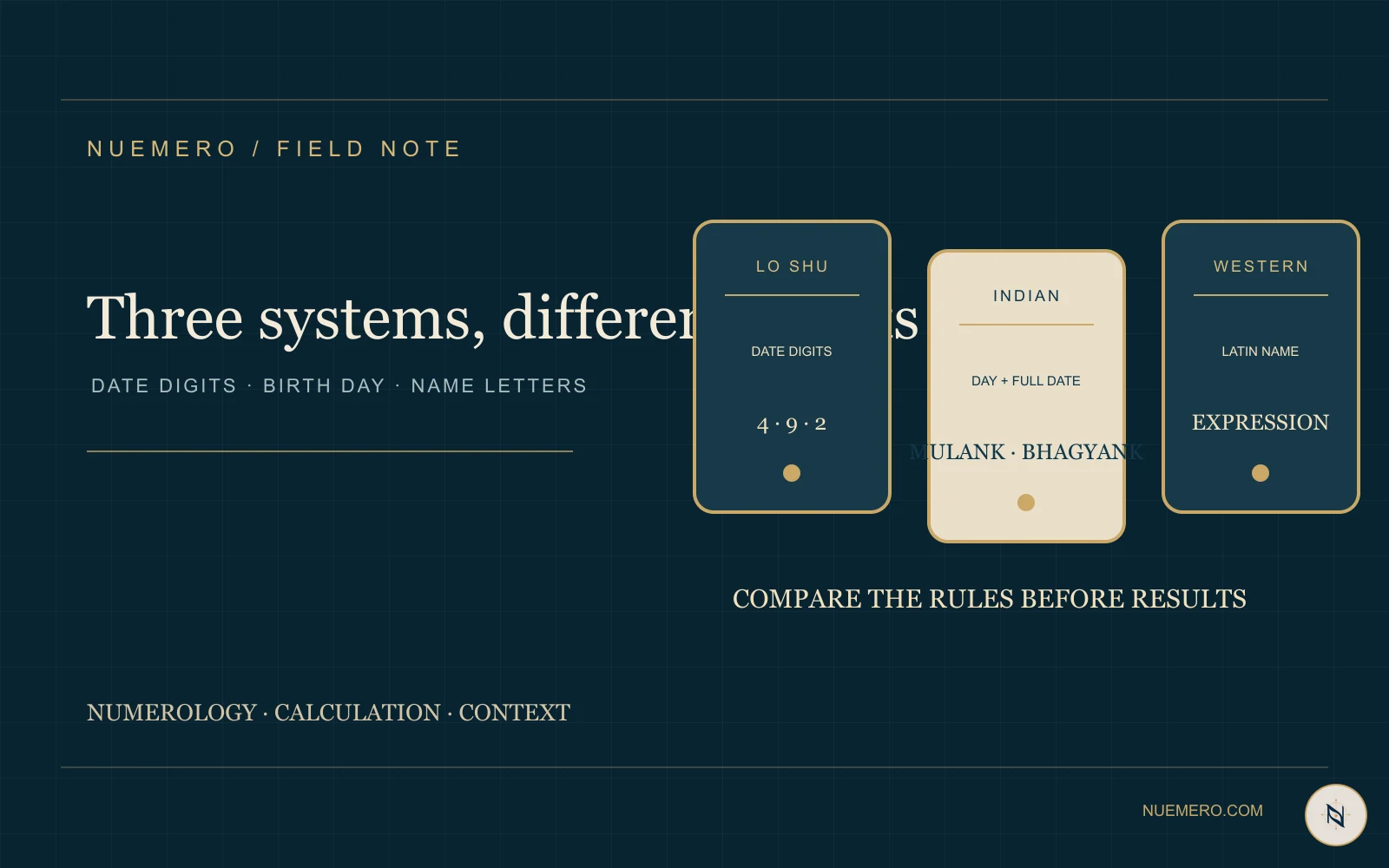
Lo Shu, Indian, and Western Numerology: Compare the Chart Inputs
Compare what a Lo Shu birth-date grid, common Indian birth numbers, and Western name numbers calculate before trying to combine their interpretations.
Read the guide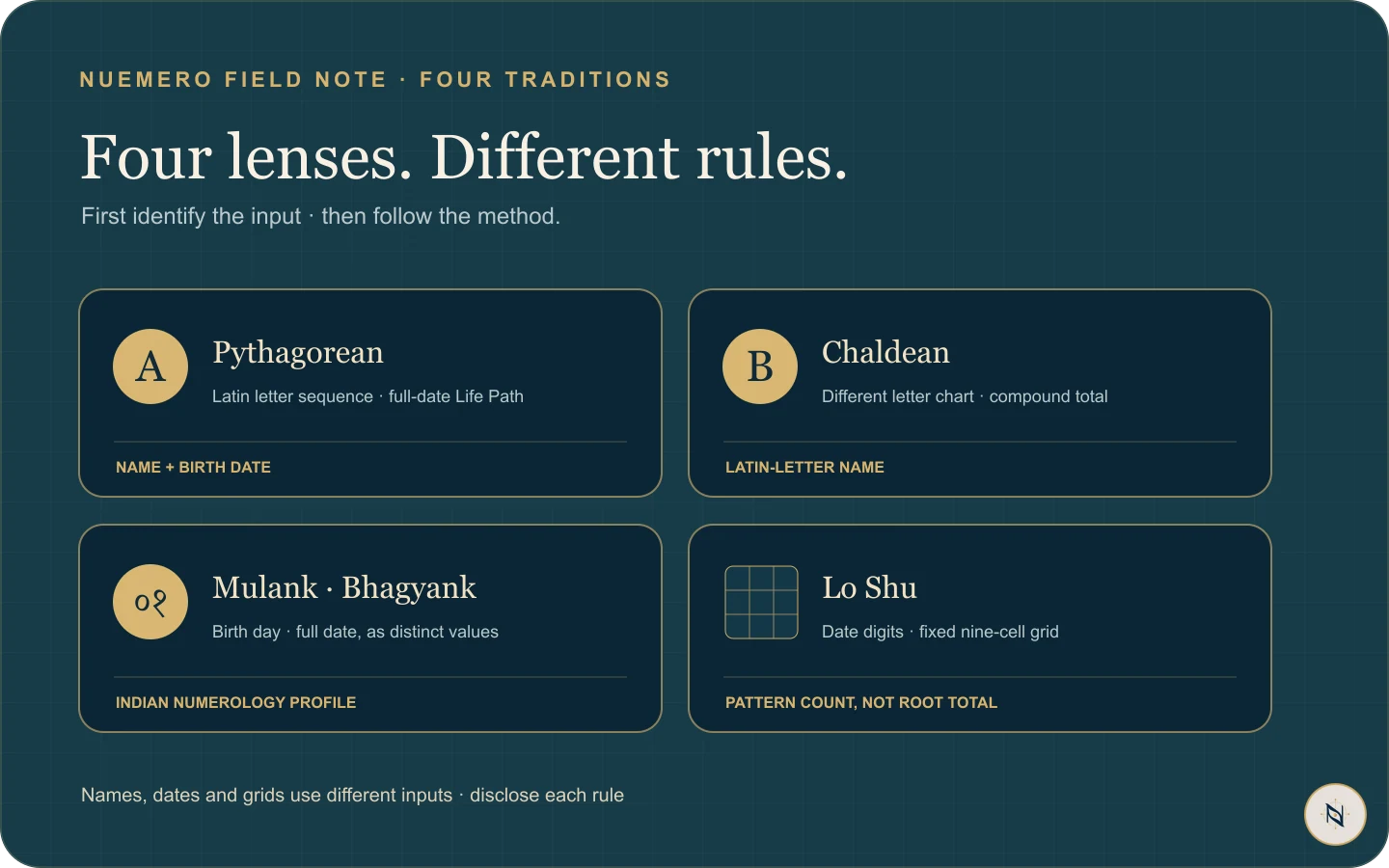
Systems, methods & foundations·9 min
What Is Numerology? Four Systems, Their Inputs, and Different Rules
An evidence-aware introduction to modern Pythagorean, Chaldean, Indian Mulank–Bhagyank, and Lo Shu practices—and why a number has meaning only inside its stated method.
Read the guide