
Systems, methods & foundationsNumerology guide
What Is Numerology? Four Systems, Their Inputs, and Different Rules
An evidence-aware introduction to modern Pythagorean, Chaldean, Indian Mulank–Bhagyank, and Lo Shu practices—and why a number has meaning only inside its stated method.
The short answer
Start here
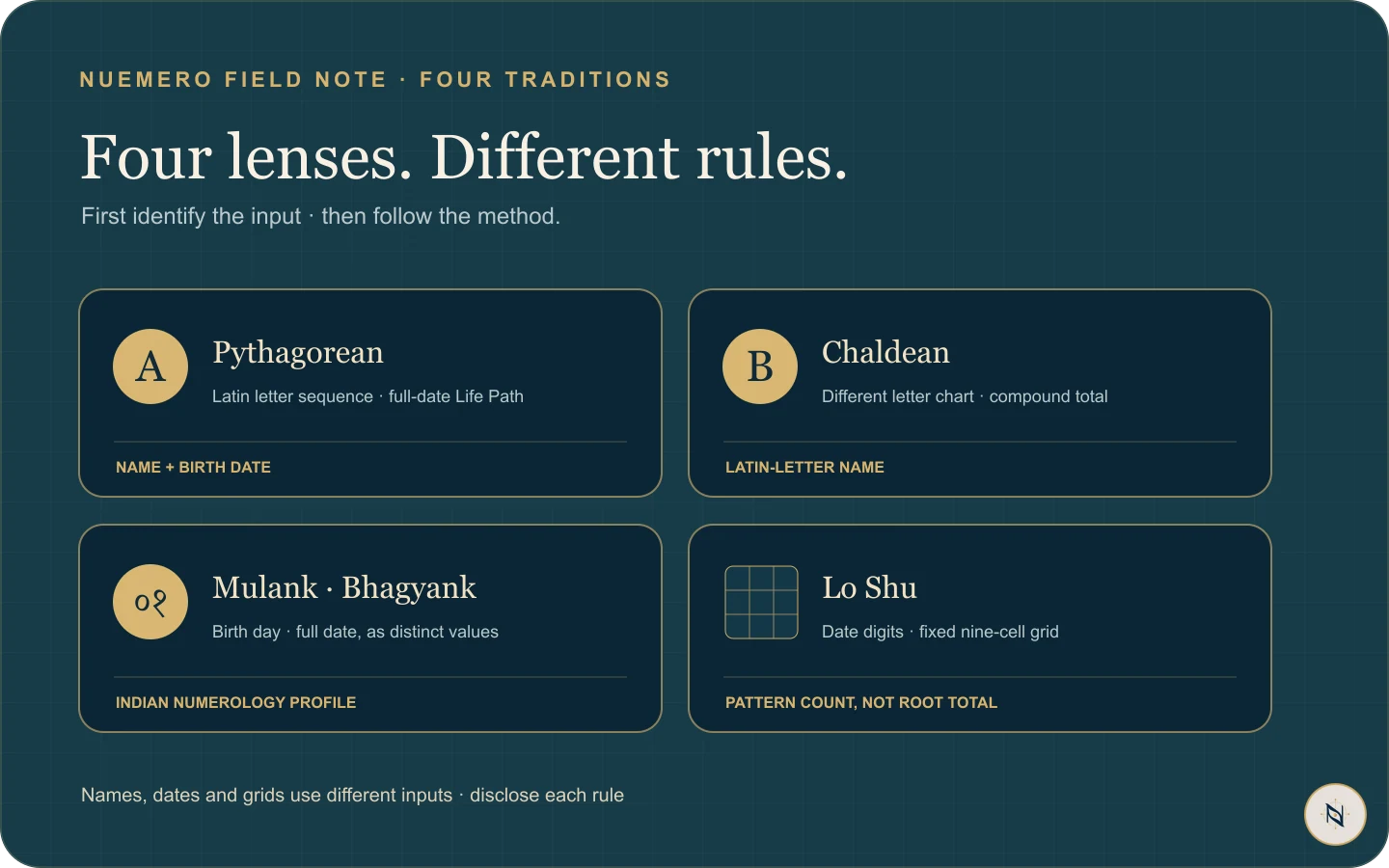
Numerology is a family of symbolic systems that assign meanings to numbers calculated from dates, names, or patterns. It is not one universal formula. Modern Pythagorean name numerology uses a Latin-letter sequence; Chaldean practice commonly uses another letter chart and preserves compound totals; Indian numerology distinguishes day-based Mulank and full-date Bhagyank; Lo Shu practice counts date digits in a fixed nine-cell arrangement. Arithmetic can be reproduced when inputs and rules are stated. Traditional interpretations are matters of belief and are not established scientific predictions.
Key takeaways
Always ask which system, input, and calculation rule produced a number.
Pythagorean and Chaldean name methods use different letter-value charts.
Mulank, Bhagyank/Life Path, name numbers, and Lo Shu cells do not share one formula.
An exact calculation does not prove that its traditional interpretation predicts real events.
On this page
Numerology is a family of methods, not one calculator formula
Numerology practitioners use number calculations as symbolic ways to reflect on identity, timing, or relationships. The same person can receive several different numbers because each method asks for a different input and applies its own rule. A readable result should identify the source data, calculation, and tradition before offering an interpretation.
The four lenses below are examples relevant to Nuemero. Their labels should not be blended: a name value is not a birth-date value, and a grid count is not a reduced Life Path total.
Four systems and the information each one uses
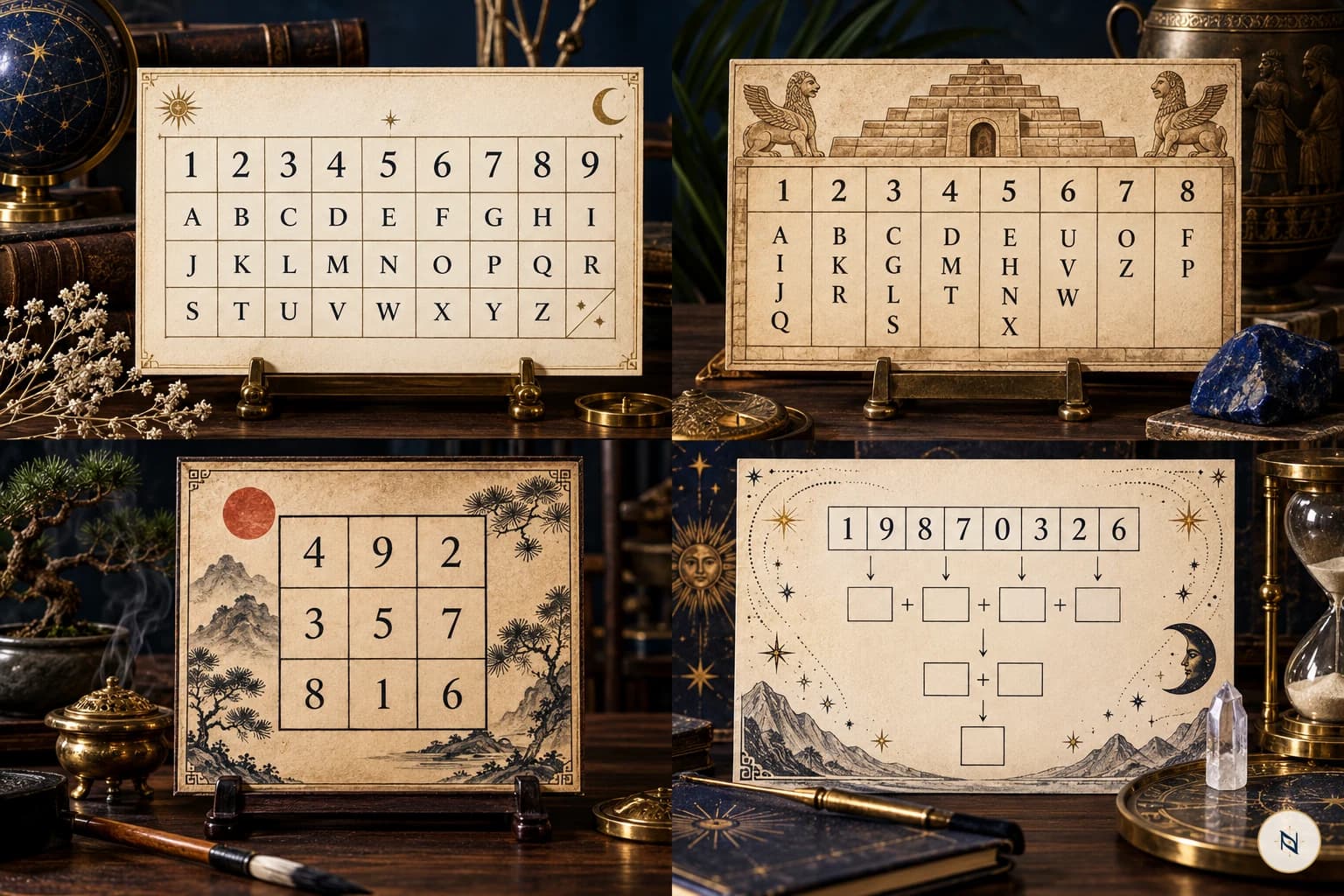
Modern Pythagorean numerology commonly maps Latin letters through a repeating 1–9 sequence and also reduces a complete birth date for Life Path. Chaldean name numerology commonly maps Latin letters to 1–8 values in a different pattern; the Nuemero profile is Cheiro-derived and preserves the compound total before reduction. School and source differences should be disclosed.
In the Indian numerology profile here, Mulank is calculated from the day of birth and Bhagyank from all digits of the complete date. Lo Shu practice counts eligible date digits and places them in the fixed 4–9–2 / 3–5–7 / 8–1–6 arrangement; the product omits zero and keeps repeats visible. Other teachers may explain origins or rules differently, so state the actual convention used.
Separate arithmetic from interpretation
Take a name result as an example. The letters can be mapped, added, and reduced according to a stated table; another person can verify those operations. A statement that the result guarantees confidence, wealth, marriage, or a certain personality is a separate interpretive claim. Do not let precise arithmetic make an unsupported conclusion sound scientifically proven.
A careful reading can still be useful as reflection or entertainment when you choose it freely. For consequential health, financial, legal, career, or relationship decisions, use reliable evidence, personal circumstances, and qualified advice.
Method and limits
This guide describes the conventions stated above and the way Nuemero’s current calculator works. Numerology interpretations are traditional beliefs, not scientific predictions. Check a source’s method before applying its meanings.
Read Nuemero’s full methodQuick answers
Frequently asked questions
Is numerology one system?
No. Different traditions use names, dates, letter charts, grids, and reduction rules differently. A result should say which one it uses.
What is the difference between Mulank and Life Path?
In Nuemero’s Indian profile, Mulank uses the birth day; Bhagyank uses the full birth date. Pythagorean Life Path uses the full birth date under its declared reduction rule. Similar inputs do not make the names or traditions interchangeable.
Are numerology calculations scientific?
Arithmetic can be checked against a formula. That is different from evidence that a symbolic interpretation predicts personality or events; those predictive claims are not established by addition itself.
Which numerology system should a beginner learn first?
Choose based on the question you want to explore, then learn one method’s inputs, formula, and limitations before comparing it with another. Keep a worked calculation so you can audit your own result.
Read further
Sources and method notes
- Nuemero calculation methodologySee the product’s chosen inputs and arithmetic rules for each lens.
- Learn numerologyBrowse lessons by tradition and subject.
Sources document calculation conventions and claims made within their traditions. They are not evidence that numerology predicts real-world outcomes.
Systems, methods & foundations·8 min
Why the Same Number Means Different Things Across Numerology Systems
Compare how Pythagorean, Chaldean, Lo Shu, and modern Indian numerology choose inputs and assign meanings—without blending their rules into one chart.
Read the guide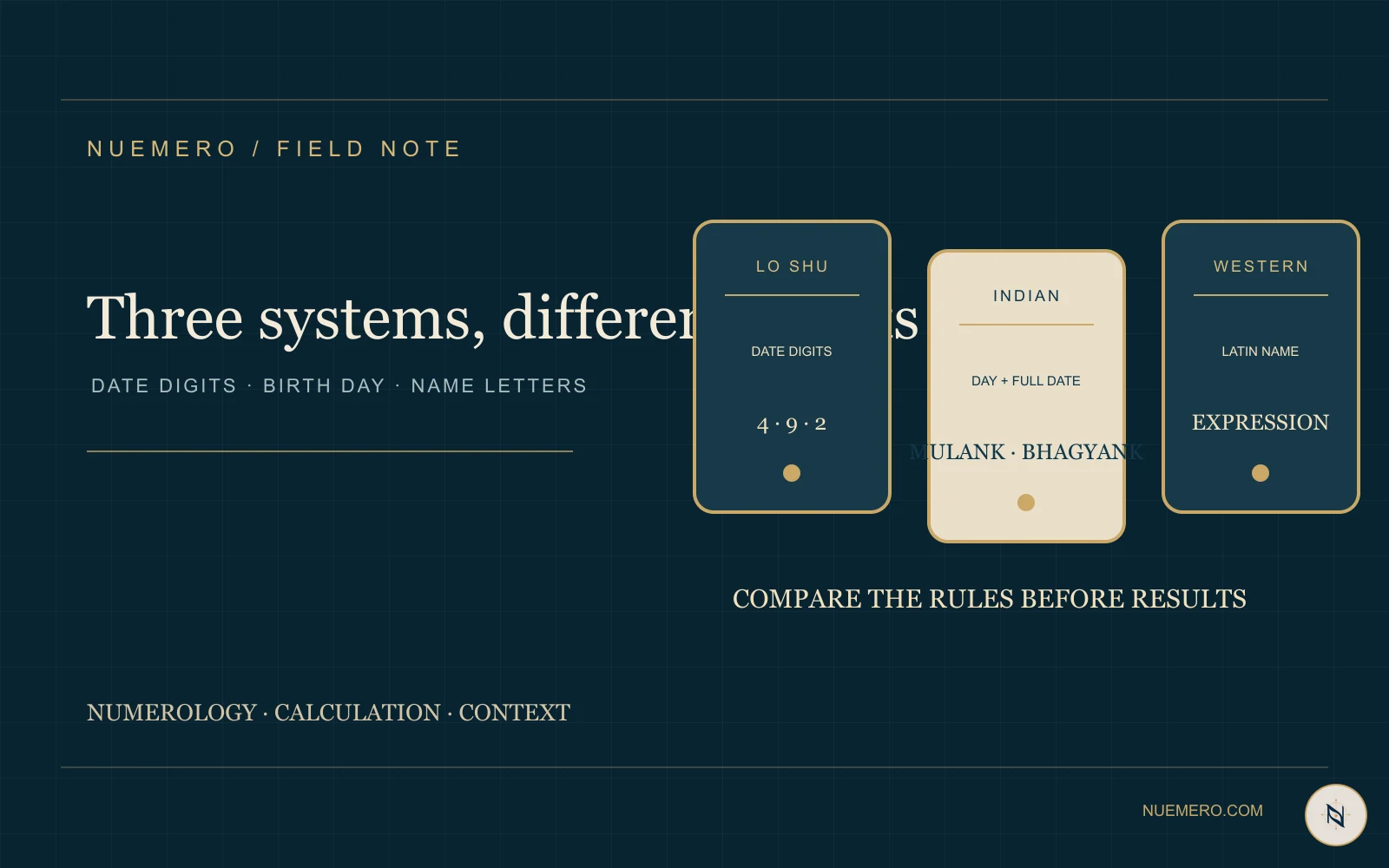
Systems, methods & foundations·7 min
Lo Shu, Indian, and Western Numerology: Compare the Chart Inputs
Compare what a Lo Shu birth-date grid, common Indian birth numbers, and Western name numbers calculate before trying to combine their interpretations.
Read the guide