
Systems, methods & foundationsNumerology guide
Master Numbers 11, 22, and 33: When Should You Reduce Them?
See the arithmetic behind master-number claims, learn why reduction rules vary, and keep compound totals visible instead of assuming one universal convention.
The short answer
Start here
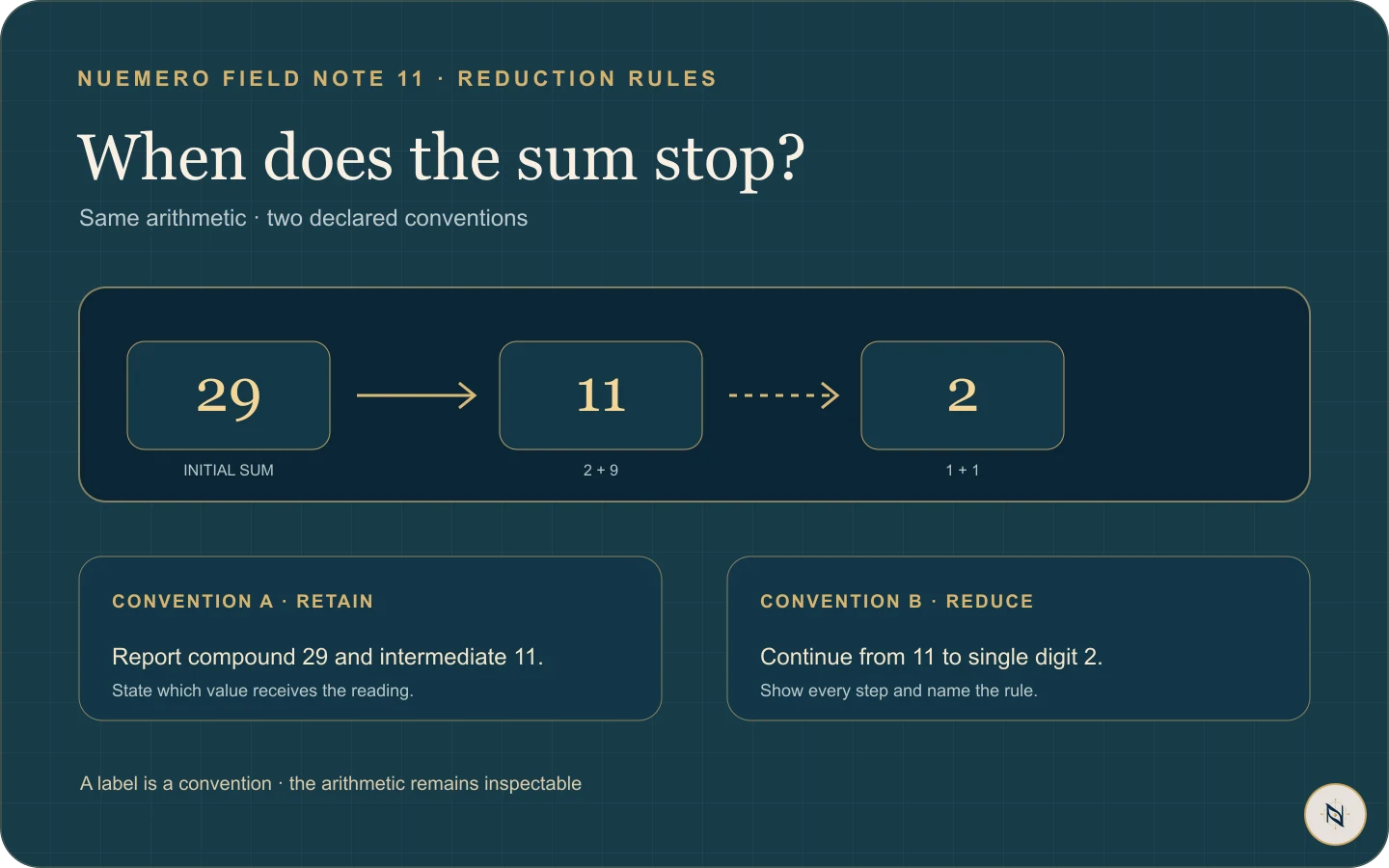
“Master number” is a numerology label used differently across schools, commonly for 11 and 22 and sometimes 33. In a digit-sum reduction, 29 becomes 2 + 9 = 11; one source may retain 11 while another reduces it to 1 + 1 = 2. The key is to name the method, show the compound total, and state where reduction stops. Arithmetic can be checked; claims attached to master numbers are traditional interpretations, not scientifically verified predictions.
Key takeaways
The label and the decision to retain 11, 22, or 33 depend on a stated numerology convention.
Show the original sum and every reduction step so the result can be reproduced.
Do not mix one source’s calculation rule with another source’s interpretation chart.
A master-number label does not establish special ability, pressure, or destiny.
On this page
First define what your source calls a master number
Many modern numerology guides give 11 and 22 a special status; some also include 33. That list is not a universal mathematical law. “Master number” is a category inside an interpretive system, and authors can differ about which totals qualify, which calculations retain them, and what meanings they attach.
So start with a specific question: which number are you calculating, and which school’s rule applies to it? Life Path, expression, and other values may not share the same reduction convention even within one practitioner’s approach.
Work the sum before deciding whether to stop
Suppose the digits of a date component sum to 29. The transparent steps are 2 + 9 = 11, and—if the chosen convention continues—1 + 1 = 2. A source that recognizes master numbers may present both 29 and 11 and stop there for that value. A source that reduces to a single digit may continue to 2. Neither page is auditable if it only prints a final label without the input and steps.
Write the un-reduced total, the intermediate result, and the stopping rule. If another calculator differs, compare those items first. A mismatch may come from a different date input, a different number definition, or a reduction rule—not necessarily a faulty addition.
One sum, two documented stopping rules
292 + 9 = 11Report 111 + 1 = 2Treat the label as interpretation, not diagnosis
Practitioner descriptions often associate 11, 22, and 33 with heightened intuition, building, or service. Those are themes within the tradition; the arithmetic does not test or prove that a person has those traits. Interpretations also vary, so a reading should name its source and avoid presenting symbolic language as certainty.
Do not let a label create fear or pressure to perform a special destiny. Use it, if you wish, as a journaling question—what habits, skills, and supports would help with a goal you chose? For health, money, education, and relationship decisions, use relevant evidence and qualified advice.
Method and limits
This guide describes the conventions stated above and the way Nuemero’s current calculator works. Numerology interpretations are traditional beliefs, not scientific predictions. Check a source’s method before applying its meanings.
Read Nuemero’s full methodQuick answers
Frequently asked questions
Are 11, 22, and 33 always master numbers?
No universal rule covers every school or every calculated value. State which tradition and number calculation you mean, then follow that source consistently.
Should I reduce 11 to 2?
It depends on the stated method. Some calculations retain 11 and may also note its digit root 2; others continue reduction. Display both steps and explain which value is interpreted.
Do master numbers mean a person has a special destiny?
That is a traditional belief, not an outcome established by the calculation or reliable scientific evidence. Do not use the label to pressure or limit yourself.
Why do two sites give me different Life Path numbers?
Check date format, which date components are added together, whether intermediate totals are reduced separately, and the master-number stopping rule. Compare the written steps rather than the label alone.
Read further
Sources and method notes
- Nuemero personal cyclesInspect date-based cycle inputs and the displayed calculation steps.
- Nuemero methodologyRead the app’s chosen reduction and interpretation conventions.
Sources document calculation conventions and claims made within their traditions. They are not evidence that numerology predicts real-world outcomes.

Systems, methods & foundations·7 min
Why Do Numerology Calculators Give Different Answers?
A clear guide to why numerology results change across systems, letter charts, date formulas, and master-number rules—with worked examples you can check.
Read the guide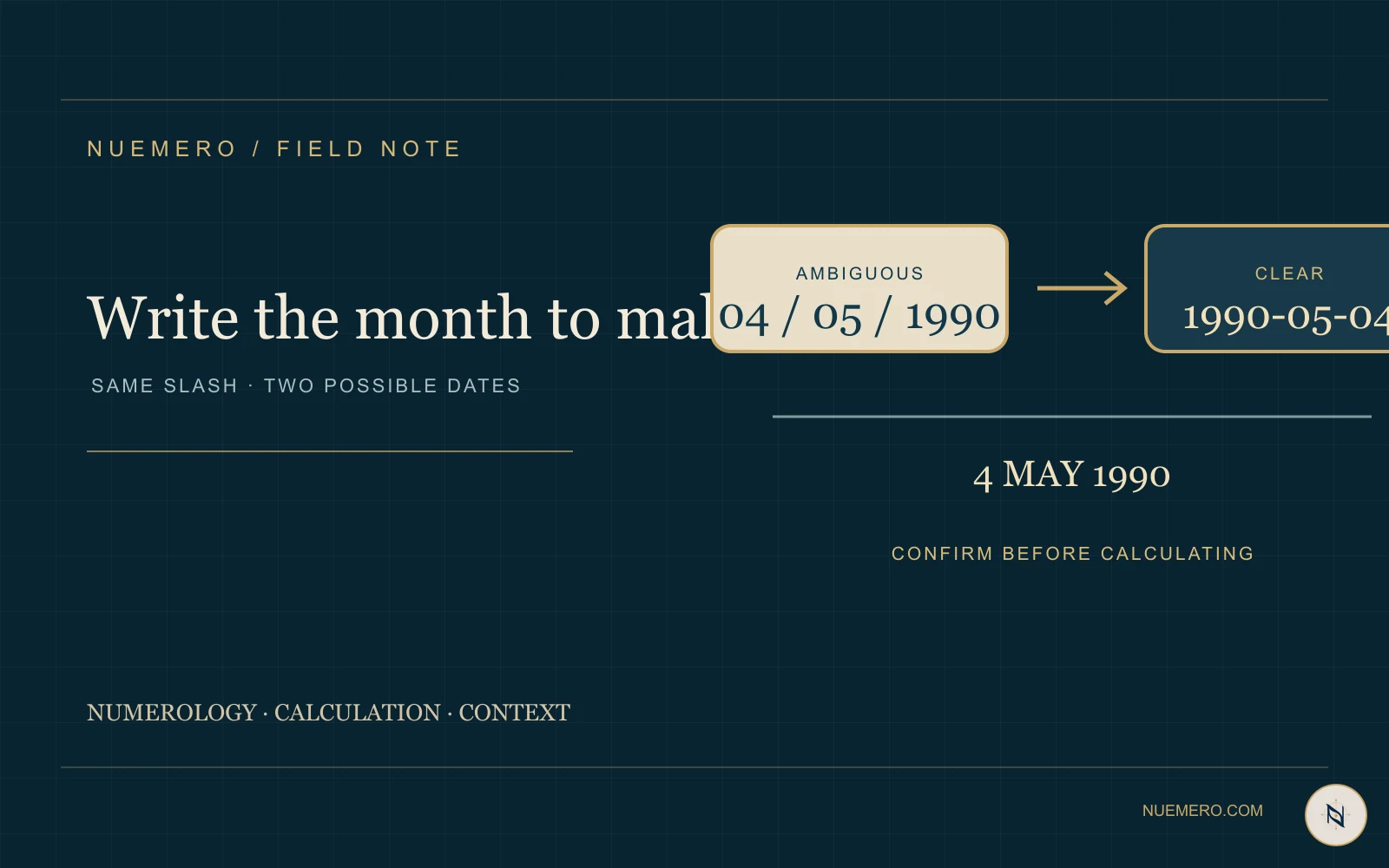
Systems, methods & foundations·7 min
Birth-Date Format in Numerology: Prevent Day–Month Mix-Ups
See how an ambiguous numeric date can change a calculation, learn a clear date-entry format, and record the original calendar date before reducing digits.
Read the guide