
Systems, methods & foundationsNumerology guide
A Beginner’s Numerology Reading List: How to Evaluate Books and Claims
Start with clearly identified editions, compare historical practitioner books with modern guides, and learn how to separate a book’s documented tradition from evidence for its claims.
The short answer
Start here
A useful reading list should identify the author, edition, publication year, system, and rights-aware source. Nuemero's research library includes historical Western number-symbolism works and Cheiro-derived materials; public-domain scans document what practitioners wrote, not whether predictions work. For modern Lo Shu or Chaldean guides, compare publisher details and do not assume a search-result PDF is authorized. Read one primary practitioner text alongside independent mathematical or historical scholarship, then record exactly which claims are supported by which kind of source.
Key takeaways
Record the exact edition; older books may use different tables and terminology.
Historical practitioner writing documents beliefs, not predictive validation.
Pair practitioner sources with independent history or mathematics scholarship.
Check permission and rights before downloading or sharing a scan.
On this page
Choose sources by what they can establish
Begin by grouping books by what they can teach: primary practitioner texts show a tradition's own vocabulary; modern guides explain how current readers adapt it; mathematics sources verify a square or calculation; historical scholarship checks when a practice appears in records. One category cannot automatically answer questions assigned to another. A book that teaches a meaning does not test whether the meaning predicts an outcome.
Check edition and publication rights
For every title, save its complete title, author, edition, year, and a catalog or library record. Check whether a scan is public domain or offered under a license; digitization does not make a newer edition free to redistribute. If rights are unclear, use the catalog page, borrow or buy a lawful copy, and do not upload the file to a public folder.
Read claims alongside independent sources
A practical starter set pairs one historical Western source, one current book from the tradition you want to understand, and an independent reference on the mathematical or historical topic. Read claims in context and mark them as arithmetic, historical statement, tradition-specific interpretation, or empirical prediction. Only the last category needs outcome data—and it needs a fair, repeatable test.
- Browse the Library of Congress records linked in Nuemero's book research notes.
- Compare one practitioner claim with an independent historical or mathematical source.
- Keep a citation and rights note for each item you reuse.
Method and limits
This guide describes the conventions stated above and the way Nuemero’s current calculator works. Numerology interpretations are traditional beliefs, not scientific predictions. Check a source’s method before applying its meanings.
Read Nuemero’s full methodQuick answers
Frequently asked questions
Are old numerology books evidence that predictions work?
They document what an author or tradition taught. Predictive accuracy needs separate, appropriately designed outcome tests.
Can I share every PDF I find online?
No. Check the edition's rights and the source's license; newer scans or editions may remain copyrighted.
Read further
Sources and method notes
- Library of Congress · Numerology Made Plain catalog recordA catalog and rights reference for one historical edition; a digitized practitioner book documents its claims, not their predictive validity.
Sources document calculation conventions and claims made within their traditions. They are not evidence that numerology predicts real-world outcomes.
Systems, methods & foundations·8 min
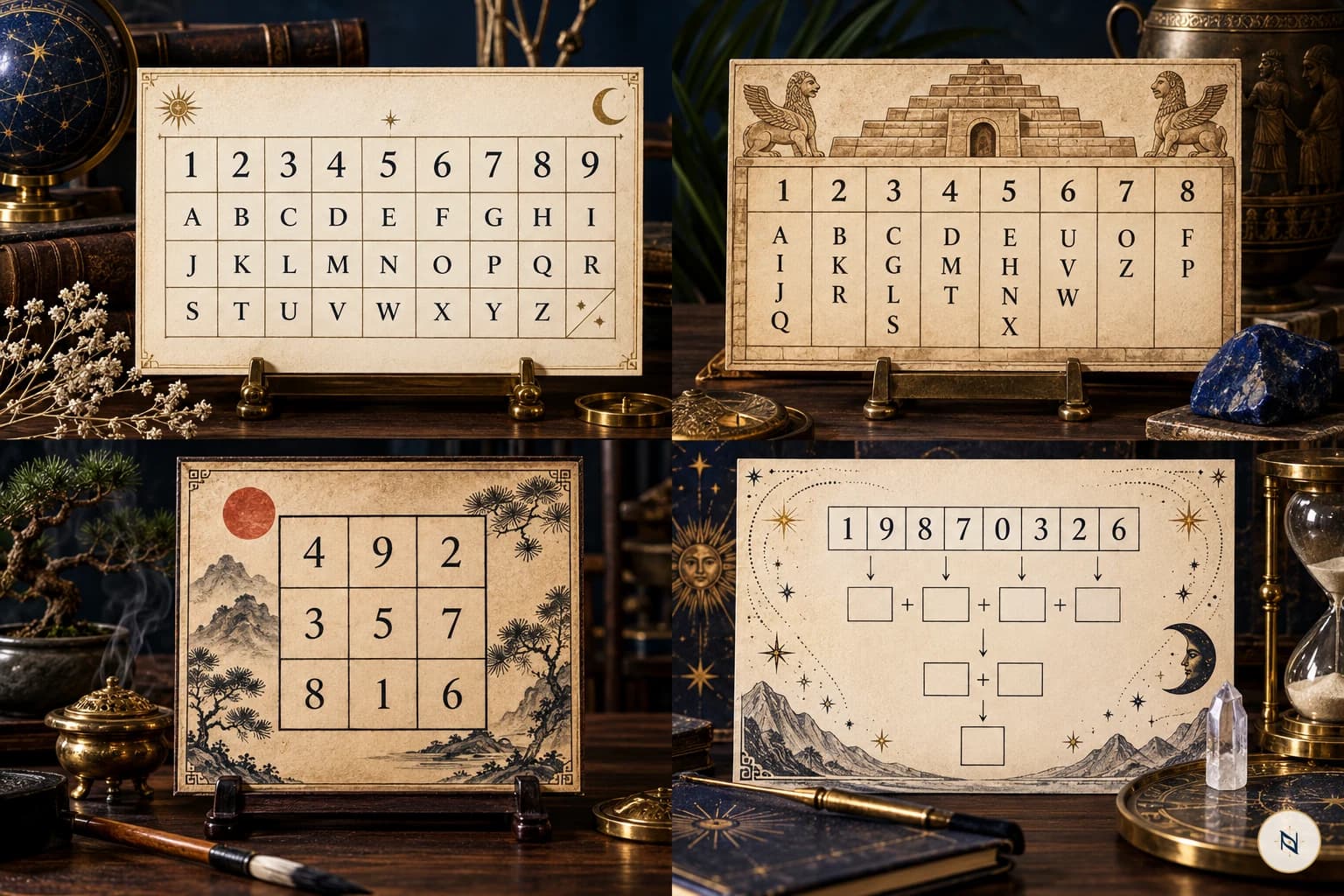
Why the Same Number Means Different Things Across Numerology Systems
Compare how Pythagorean, Chaldean, Lo Shu, and modern Indian numerology choose inputs and assign meanings—without blending their rules into one chart.
Read the guide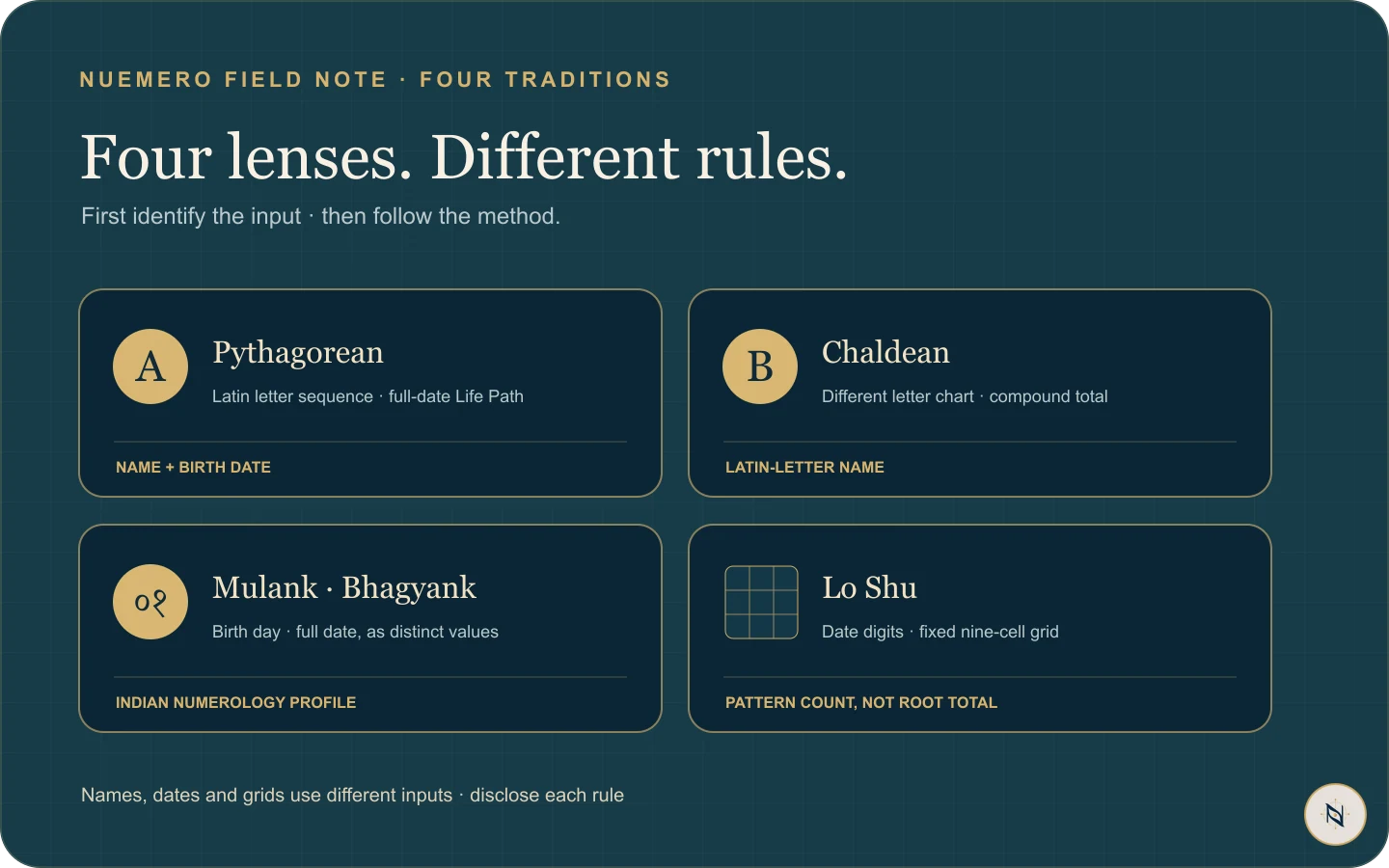
Systems, methods & foundations·9 min
What Is Numerology? Four Systems, Their Inputs, and Different Rules
An evidence-aware introduction to modern Pythagorean, Chaldean, Indian Mulank–Bhagyank, and Lo Shu practices—and why a number has meaning only inside its stated method.
Read the guide