
Name numerologyNumerology guide
Pythagorean vs Chaldean Name Numbers: Why Maya Becomes 4 and 7
Compare the same spelling through two letter charts, inspect every value, and understand why neither result is an arithmetic error.
The short answer
Start here
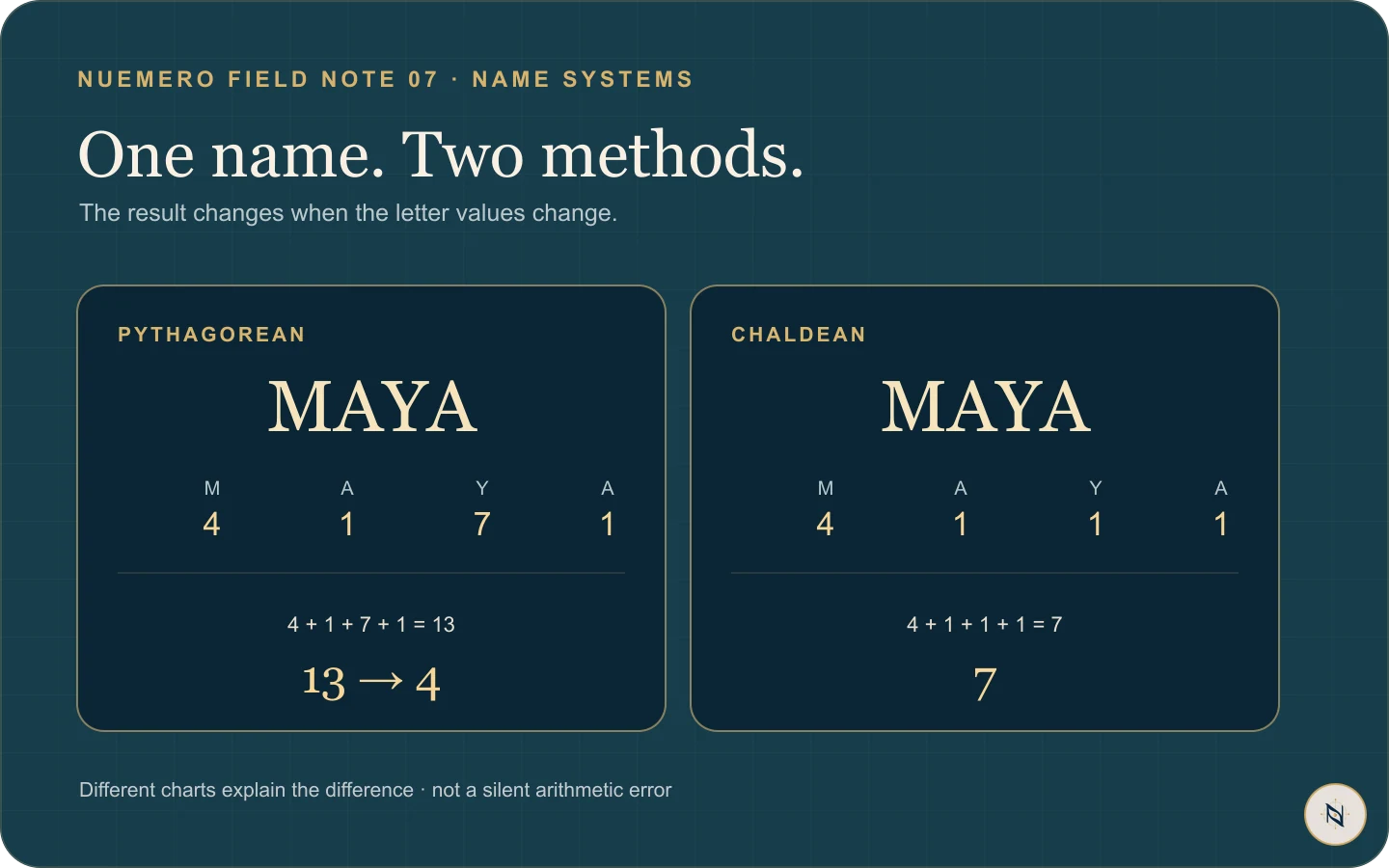
A name can have different totals in Pythagorean and Chaldean numerology because the letter-value charts differ. With the spelling MAYA, the commonly used Pythagorean values give 4 + 1 + 7 + 1 = 13, then 1 + 3 = 4; a common Chaldean chart gives 4 + 1 + 1 + 1 = 7. Both sums follow their own tables. Compare inputs, charts, totals, and reductions before comparing interpretations; these traditions do not establish a person’s character or future.
Key takeaways
The two systems use different letter-value charts; a changed total is expected.
MAYA calculates to 13 → 4 in the common Pythagorean table and 7 in a common Chaldean table.
Ask which spelling, chart, compound rule, and reduction rule produced each result.
Different symbolic readings are not proof that one number is more accurate about you.
On this page
One spelling, two tables
Name numerology is not one universal alphabet. Pythagorean numerology commonly repeats a 1–9 sequence across the Latin alphabet. A commonly printed Chaldean chart uses a different allocation and leaves some digits unused. Writers may also disagree within a tradition. That is why a result should identify the exact table instead of presenting a bare number as if all calculators share one formula.
Worked example: MAYA
Using the common Pythagorean table: M = 4, A = 1, Y = 7, A = 1. The raw sum is 13; reducing the digits gives 1 + 3 = 4. Using a common Chaldean table: M = 4, A = 1, Y = 1, A = 1. The raw sum is 7, which is already a single digit. The letter Y is the clearest reason the totals diverge in this example.
This example names the chart convention so it can be checked. If a calculator uses a different source or handles a compound total differently, its output may differ; that is a method question to investigate, not an automatic sign of a bug.
Same input, separate calculations
M 4 · A 1 · Y 7 · A 113 → 1 + 3 → 4M 4 · A 1 · Y 1 · A 17How to compare the readings fairly
Keep four questions beside each result: Is the exact spelling identical? Which published chart was used? Is the unreduced total shown? What reduction or master-number rule was applied? Only after those are answered should you compare the traditions’ interpretations, and even then label them as traditional viewpoints rather than established facts.
Method and limits
This guide describes the conventions stated above and the way Nuemero’s current calculator works. Numerology interpretations are traditional beliefs, not scientific predictions. Check a source’s method before applying its meanings.
Read Nuemero’s full methodQuick answers
Frequently asked questions
Which system is more accurate?
There is no accepted scientific test showing either letter system predicts character or events more accurately. Choose based on the tradition you want to explore and make its calculation reproducible.
Why does Y change the Maya result?
The common Pythagorean chart assigns Y = 7, while a common Chaldean chart assigns Y = 1. The other letters shown here have the same illustrative values, so this one change explains the 13-versus-7 raw totals.
Is one calculator wrong if it shows 4 and another shows 7?
Not necessarily. They may be calculating different systems. Check the selected method and its letter assignments before judging either output.
Can these numbers decide whether I should change my name?
Do not make a legal or personal decision from a number alone. Consider identity, practical consequences, and qualified advice; treat numerology as optional reflection.
Read further
Sources and method notes
- Nuemero name comparisonView the same spelling in separate system columns and inspect each calculation.
- Nuemero methodologyRead how the product labels arithmetic separately from interpretation.
Sources document calculation conventions and claims made within their traditions. They are not evidence that numerology predicts real-world outcomes.
Name numerology·8 min
Chaldean Compound Numbers 10–52: Read the Total Without Fear Claims
Understand why Chaldean name readings may preserve a compound total before reducing it, how sources differ, and why traditional descriptions are not forecasts.
Read the guide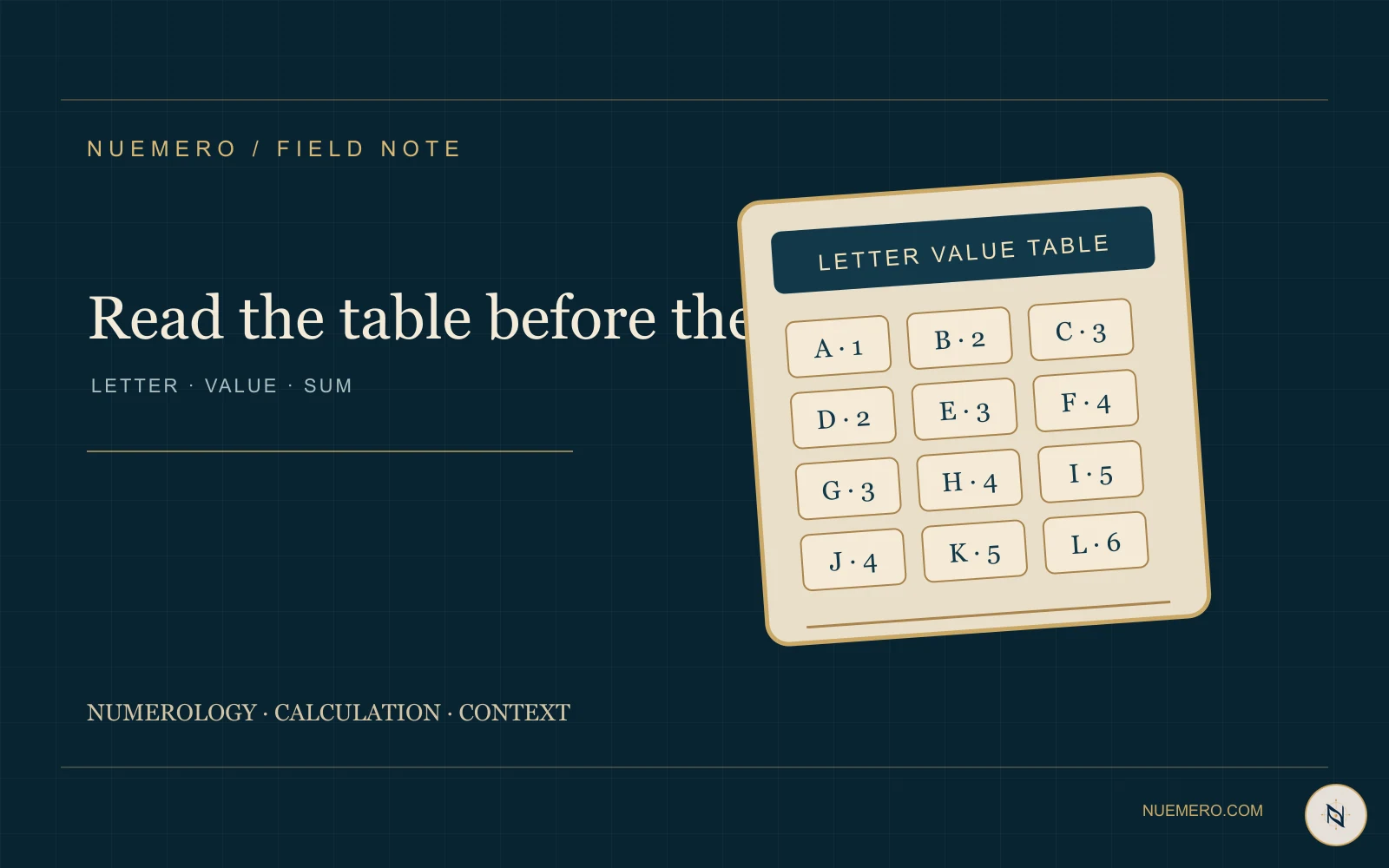
Name numerology·8 min
Chaldean Numerology Letter Chart A–Z: Values, Name Example, and Limits
Review the commonly printed 1–8 Chaldean-style letter table, calculate a fictional name, and distinguish Cheiro’s published scheme from claims of ancient origin.
Read the guide